

India Demographic Dividend as a Time Bomb
(Relevant for Sociology Paper II: Population Dynamics)
IntroductionIndia is home to the world’s largest youth population. Nearly 65% of Indians are below the age of 35, and over 50% are below 25. For decades, economists have projected this demographic dividend as India’s greatest strength. A large working-age population, if skilled and employed productively, could accelerate India’s rise as a global economic powerhouse. But there is a flip side. As the Nobel laureate Rabindranath Tagore once observed, “Don’t limit a child to your own learning, for she was born in another time.” India’s education system and labour market structures have failed to adapt to the new realities of the 21st century. Millions of graduates are entering the workforce each year, but many remain underemployed, unemployed, or unemployable. The mismatch between education and employability, compounded by the disruptive force of Artificial Intelligence (AI) and automation, has turned India’s demographic dividend into what some call a ticking time bomb. What is Demographic Dividend?In demographic studies, a demographic dividend refers to the economic growth potential that arises from shifts in a population’s age structure—specifically when the working-age population (15–64 years) grows larger relative to the dependent population (children and elderly). For India, this is supposed to be a “window of opportunity” until around 2055. But whether it becomes a dividend or a disaster depends on how effectively the nation creates jobs, equips youth with relevant skills, and integrates them into productive employment. Why India Demographic Dividend Risks Becoming a Time Bomb
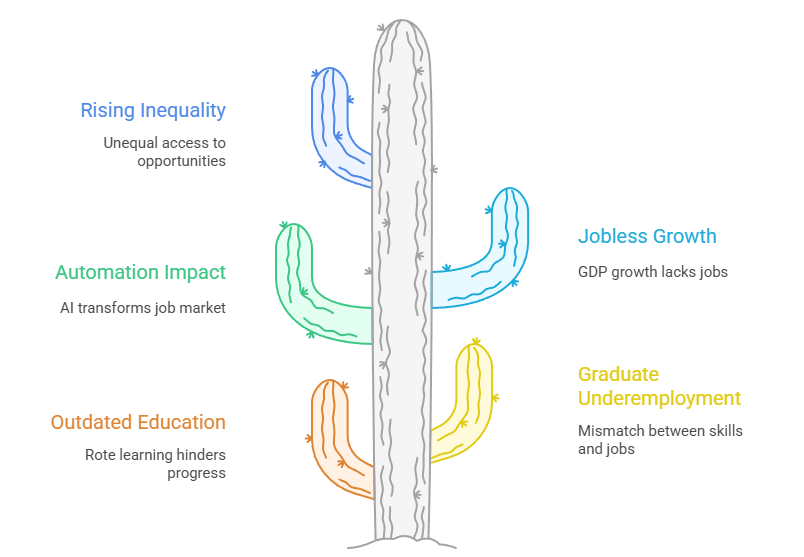
India’s education system continues to emphasize rote learning and exam performance. Curricula are outdated, often teaching skills suited to jobs of the past rather than preparing students for the future of work. With AI, machine learning, robotics, and big data reshaping industries, many graduates find themselves ill-equipped for the job market.
Every year, millions of graduates enter the job market. Yet surveys show that a large proportion is either unemployed or working in low-skill, low-wage jobs unrelated to their qualifications. This mismatch is visible in the fact that engineers drive cabs, MBAs work in clerical jobs, and graduates prepare endlessly for government exams due to lack of alternatives.
The AI revolution is transforming global labour markets. Studies suggest that up to 70% of jobs globally will be impacted and nearly 30% of current tasks may be automated. While new jobs in AI development and data-driven industries are emerging, the majority of India’s youth lack the technical training to enter these fields. The curriculum update cycle in schools and colleges, often three years long, is too slow for such rapid technological change.
India has witnessed high GDP growth in recent decades, but this has not translated into proportionate employment growth. Economic growth has been led by capital-intensive sectors like IT, finance, and telecom, while labour-intensive manufacturing has lagged. This phenomenon of jobless growth threatens to push the demographic dividend into a demographic disaster.
The inability to absorb youth into productive work has sharpened class inequalities and regional disparities. The urban middle class is able to adapt to new opportunities, while rural youth often remain trapped in low-paying, insecure jobs. This deepens social stratification and fuels frustration, migration, and social unrest. Sociological Analysis
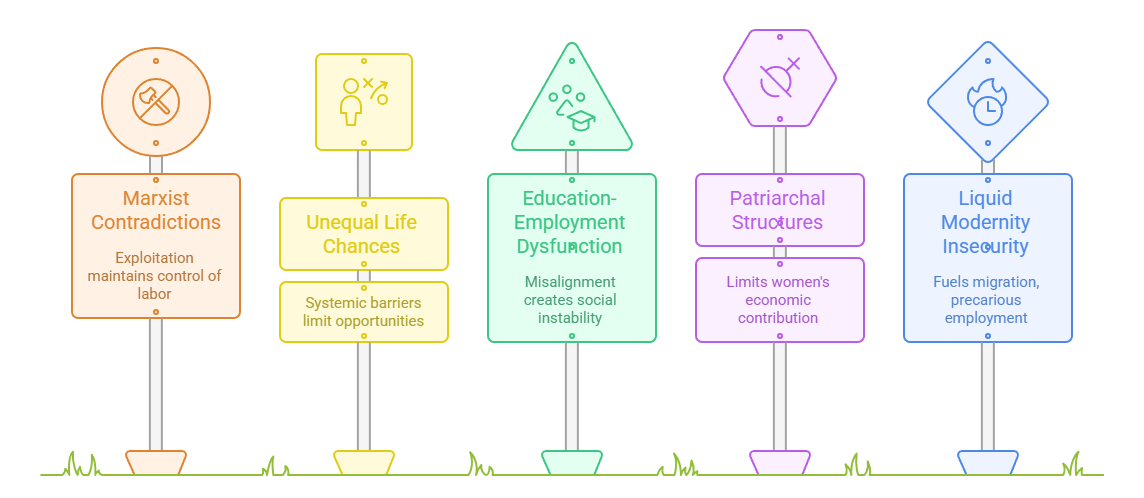
From a Marxist lens, the demographic crisis highlights the contradictions of capitalism. The capitalist system produces surplus labour, keeping wages low and profits high. Young graduates, despite having degrees, are forced into precarious jobs or remain unemployed. This reflects Marx’s concept of the “reserve army of labour”—a pool of unemployed that capitalism exploits to maintain control over labour markets.
Max Weber’s theory of life chances is also relevant. Not all youth have equal access to quality education, digital skills, or social networks. Middle-class urban students may find opportunities, but rural or lower-caste youth face systemic barriers. Thus, the demographic dividend is unequally distributed.
From a functionalist perspective, education is supposed to act as an agent of socialization and skill development. But in India, it has failed to align with the needs of the economy. The dysfunction between education and employment creates social instability and discontent.
Women face an additional layer of challenge. While female enrolment in higher education has increased, labour force participation of women in India remains one of the lowest in the world (around 25%). The patriarchal family structure, coupled with lack of safety and workplace flexibility, prevents women from contributing fully to the economy—wasting a significant portion of the demographic dividend.
Sociologist Zygmunt Bauman’s idea of liquid modernity also applies. In today’s “liquid” job market, careers are no longer stable. Young Indians face constant insecurity, rapid technological changes, and the pressure to re-skill. This insecurity fuels migration, gig work, and precarious employment. Current Relevance
Consequences of Ignoring the Time Bomb
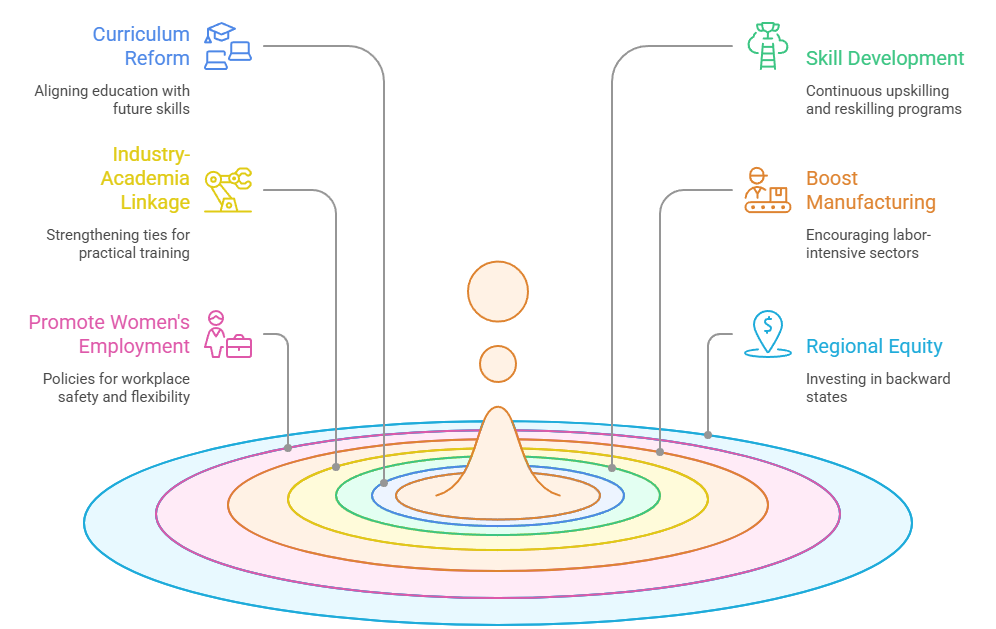
Way Forward
ConclusionIndia’s demographic dividend is a double-edged sword. It holds the potential to transform India into an economic superpower, but if neglected, it can explode as a time bomb of unemployment, frustration, and inequality. The challenge is not just economic but deeply sociological. It involves the interplay of education, class, caste, gender, urbanization, and technology. Only by addressing these through holistic reforms can India turn its youth bulge into an asset rather than a liability. As Tagore reminded us, we cannot prepare children for yesterday’s world. The future belongs to those who adapt, innovate, and empower their young population. For India, this is not just an opportunity—it is a necessity. PYQsPaper 2“India’s demographic dividend offers both opportunities and challenges. Discuss the factors driving this phenomenon and suggest measures to address the associated challenges.” (2024) |
To Read more topics, visit: www.triumphias.com/blogs
3 comments