
Strategic Ripples: India-China Tensions over the Brahmaputra
(Relevant for GS paper-2,International Relation)
Introduction: India-China Tensions over the BrahmaputraThe Brahmaputra River, originating in Tibet as the Yarlung Tsangpo, flowing through India as the Brahmaputra, and finally entering Bangladesh as the Jamuna, plays a crucial role in the ecological, cultural, and economic fabric of South Asia. However, growing water-related tensions between upstream China and downstream India have raised concerns in recent years, especially with China’s aggressive hydropower ambitions. The strategic nature of the river, the absence of a binding water-sharing treaty, and a fragile data-sharing mechanism have made this transboundary river a potential flashpoint in the Indo-China relationship. Geography and Significance of the Brahmaputra
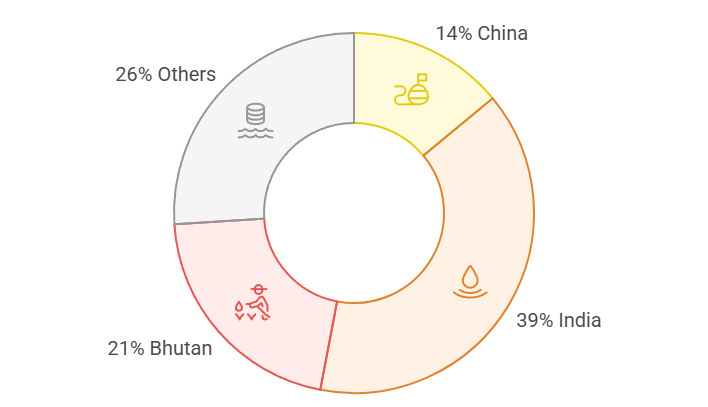
The Brahmaputra originates near Mount Kailash in Tibet, where it is known as the Yarlung Tsangpo. It travels around 2,880 kilometers, passing through Tibet, India (Arunachal Pradesh and Assam), and Bangladesh. Although China holds about 50% of the total basin area, it contributes only 22–30% of the river’s discharge. India, with about 34% of the basin, contributes 39%, and Bhutan adds another 21%. Interestingly, only 14% of the river’s water is generated in the upper stretches within China, while the remaining 86% is contributed by tributaries and monsoon rainfall after it enters India. Despite this, China’s control over the headwaters gives it a strategic advantage and has led to concerns over unilateral development projects. Current Developments and China’s Dam ProjectsIn late 2024, China began construction of the Medog (Motuo) Hydropower Station on the Yarlung Tsangpo near the Great Bend, close to the Indian border. This mega-dam, once completed, will have a staggering capacity of 60 gigawatts, more than double the capacity of the Three Gorges Dam. It is expected to generate about 300 billion kilowatt-hours annually, roughly equivalent to the UK’s annual electricity consumption. The estimated cost of this project is over ¥1 trillion (approximately USD 130–170 billion). Chinese authorities maintain that the dam is a run-of-the-river project with limited downstream impact, but Indian experts and environmentalists warn that the dam could affect sediment flow, water availability, and aquatic biodiversity in Assam and beyond. India’s Strategic Response
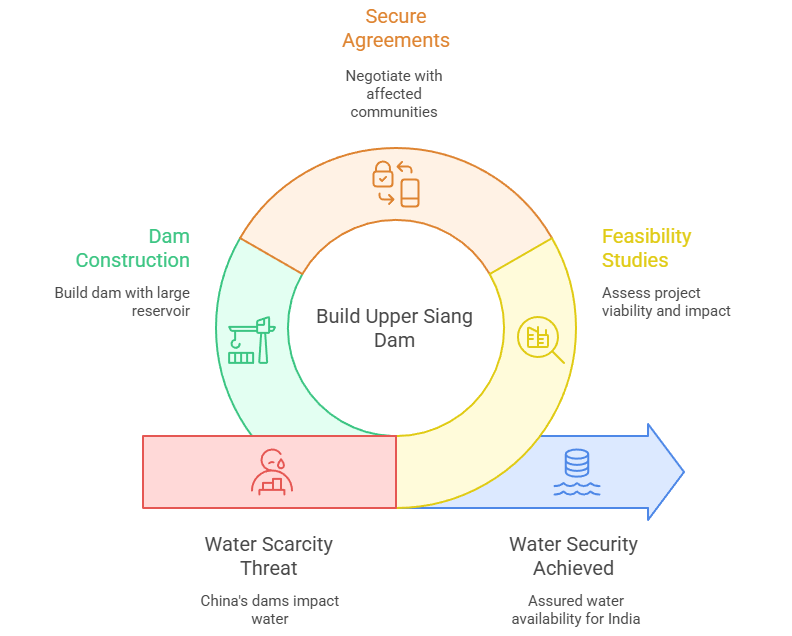
In response to China’s dam-building spree, India has initiated plans to build its own mega-dam on the Siang River (as the Brahmaputra is known in Arunachal Pradesh). In May 2025, pre-feasibility studies began for the proposed Upper Siang Hydroelectric Project with a capacity of around 11,000 MW. The proposed dam would have a massive storage reservoir of approximately 9 billion cubic meters. The move is being projected by Indian officials as a “dam for a dam,” signaling India’s intent to assert its own riparian rights and secure water availability in the face of Chinese upstream infrastructure. However, the project has drawn mixed reactions. While around 98 households in Riew village have signed preliminary MoUs, many tribal communities remain concerned about displacement, submergence of ancestral lands, and ecological damage. Hydrological Cooperation: Data-Sharing but No TreatyIndia and China established an Expert-Level Mechanism (ELM) in 2006 to exchange hydrological data during the flood season. This cooperation was formalized through a Memorandum of Understanding (MoU) in 2013. China provides real-time water level data for the Brahmaputra and Sutlej rivers during monsoons, in exchange for an annual payment by India. However, this mechanism has proven fragile. In 2023, China abruptly stopped sharing data amid worsening border tensions, as had happened during the Doklam standoff in 2017. The absence of a legally binding water-sharing agreement between the two nations leaves India vulnerable to unilateral decisions by China, especially during high-tension scenarios. Environmental and Social Concerns
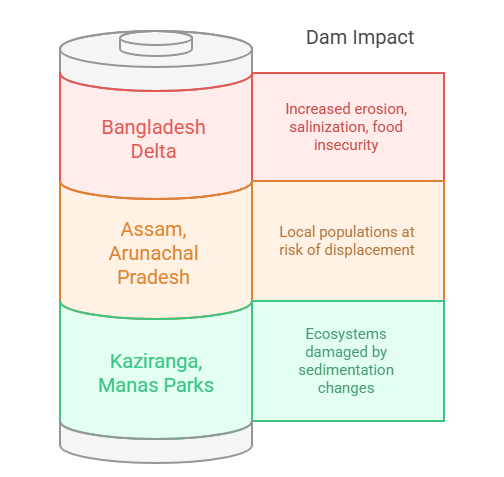
The Brahmaputra basin is ecologically sensitive, home to rich biodiversity, including the Kaziranga and Manas National Parks, the Gangetic river dolphin, and unique riverine systems. Changes in sedimentation patterns and flow volumes due to upstream dams can damage these ecosystems. Local populations, especially in Assam and Arunachal Pradesh, are at risk of displacement. In Bangladesh, the deltaic region relies heavily on Brahmaputra sediment for land formation and agriculture. Disruption of this balance due to Chinese or Indian damming activities can lead to increased erosion, salinization, and food insecurity. Furthermore, fisheries and riverine livelihoods in lower riparian regions, particularly in Bangladesh, have already started experiencing changes due to shifting flow patterns, exacerbating regional socio-economic vulnerabilities. Geopolitical and Security DimensionsWater is increasingly seen not only as a resource but also as a strategic tool. China’s dam construction near disputed borders, particularly in Arunachal Pradesh, which it claims as “South Tibet,” adds a layer of geopolitical tension. There are concerns that China might “weaponize” water during future border conflicts by manipulating flows, either by flooding or withholding water. Although experts believe the likelihood of an all-out “water war” is low due to the Brahmaputra’s monsoon-fed nature, the potential for coercion through infrastructure control is real. This makes hydropower infrastructure not just a development tool but also a component of strategic deterrence. Need for a Holistic Approach and Regional CooperationUnlike India’s legally binding Indus Waters Treaty with Pakistan, no such treaty exists between India and China. Both countries are also not signatories to the 1997 UN Convention on the Law of the Non-Navigational Uses of International Watercourses. This makes it imperative for India to push for a robust, legally binding agreement or at least a transparent cooperative framework. Regional cooperation involving Bangladesh and Bhutan could ensure a basin-wide approach to sustainable development and water management. Enhanced use of satellite-based monitoring, real-time hydrological data sharing, and joint environmental impact assessments can help build trust and mitigate conflict. ConclusionThe Brahmaputra River represents both opportunity and risk in the India–China relationship. While cooperation in river basin management could build trust, the present trajectory suggests increasing competition and strategic maneuvering. India must enhance its domestic water management infrastructure, engage in proactive diplomacy, and build strategic alliances with downstream stakeholders like Bangladesh. Water, if managed cooperatively, can be a bridge between nations. If weaponized, it risks becoming a trigger point for conflict. The Brahmaputra is at that crossroads today. |
To Read more topics, visit: www.triumphias.com/blogs
2 comments