Introduction
The issues of illegal migration and refugee influx have gained prominence in India due to their complex socio-political, economic, and humanitarian implications. These groups, often fleeing persecution, poverty, or conflict, are not just legal subjects under international law but are also central to the sociological study of migration, identity, marginalization, and integration.
With recent debates around the Citizenship Amendment Act (CAA), National Register of Citizens (NRC), and the influx of Rohingya, Bangladeshi migrants, and Afghan refugees, the topic has become a core concern for governance, civil society, and scholars alike.
Who Are Illegal Migrants and Refugees?
- Illegal Migrants: People who enter or stay in a country without legal authorization (e.g., expired visa, no documentation, crossing border unlawfully).
- Refugees: As per the 1951 Refugee Convention, individuals fleeing persecution, war, or violence, and unable to return safely to their home country. India is not a signatory to the Convention but hosts many refugees.
India makes a de facto distinction: Bangladeshi migrants are treated as illegal migrants, whereas Tibetan, Sri Lankan Tamils, and Rohingyas are seen as refugees or asylum seekers.
Legal and Political Framework in India
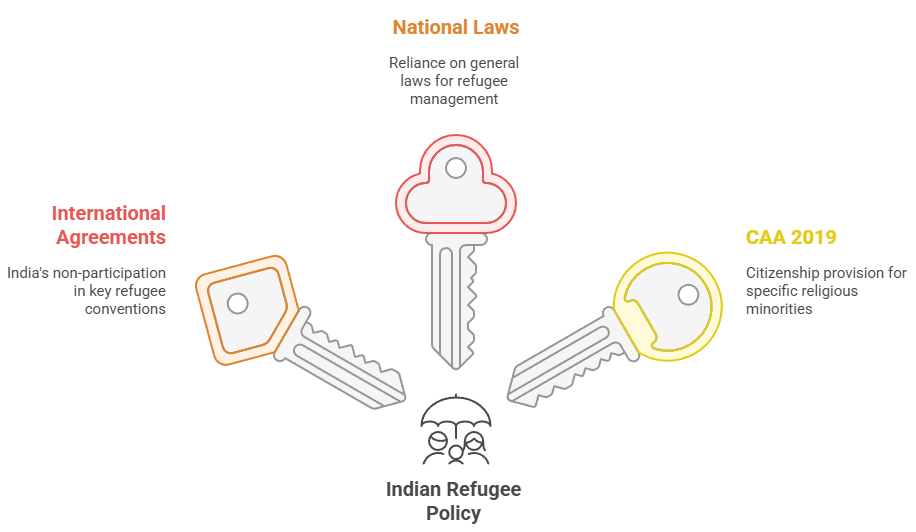
- India is not a signatory to the 1951 Refugee Convention or its 1967 Protocol.
- No national refugee law exists; policies are guided by:
- Foreigners Act, 1946
- Passport Act, 1920
- Registration of Foreigners Act, 1939
- The CAA 2019 offers citizenship to minorities (Hindus, Sikhs, Buddhists, Jains, Parsis, and Christians) from Pakistan, Bangladesh, and Afghanistan, but excludes Muslims, sparking debates on secularism and discrimination.
Examples
- Rohingyas from Myanmar settled in Jammu, Delhi, Hyderabad.
- Bangladeshi migrants in Assam, Bengal, and Tripura – a core issue behind NRC.
- Afghan Sikh and Hindu refugees granted long-term visas and citizenship post-CAA.
Sociological Analysis
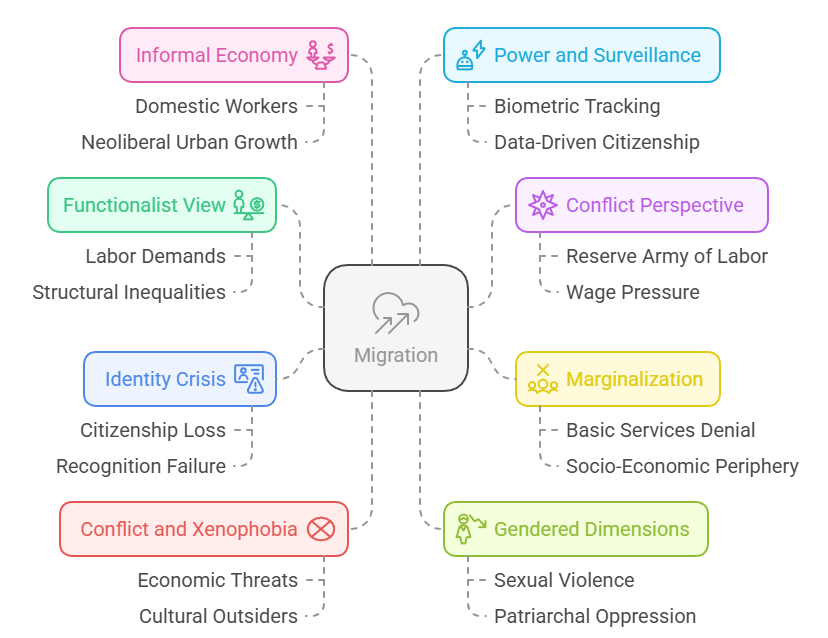
- Functionalist View of Migration: From a functionalist perspective, migration fulfills the labor demands of a growing economy. Refugees and migrants, though marginalized, serve a latent function by filling low-wage gaps. However, this view often ignores the structural inequalities that lead to exploitation and dehumanization.
- Conflict Perspective (Marxist): Marxist sociology interprets illegal migration as a tool of capitalist exploitation. Migrants form a “reserve army of labor”—cheap, unprotected, and easily disposable. This maintains downward pressure on wages and weakens the bargaining power of native workers.
- Marginalization and Social Exclusion: Illegal migrants and refugees often face structural exclusion from mainstream society. They are denied access to basic services like education, healthcare, and housing, pushing them to the socio-economic periphery. Using Gurvitch’s framework, they constitute a new social stratum—voiceless, vulnerable, and often invisible to policy frameworks.
- Identity Crisis and Statelessness: Displacement often leads to an identity vacuum, where individuals are neither accepted as citizens by their home country nor by the host state. Zygmunt Bauman’s concept of “wasted lives” highlights how refugees become symbols of modernity’s failures—stripped of citizenship, rights, and recognition.
- Conflict and Xenophobia: Migrants are frequently perceived as economic threats or cultural outsiders, sparking xenophobic sentiments and local resistance. According to Robert Merton’s strain theory, such hostility can be seen as a response to resource scarcity and societal anomie, where locals blame outsiders for their own deprivation.
- Gendered Dimensions of Displacement: Refugee and migrant women are disproportionately affected by displacement. They face sexual violence, human trafficking, and reproductive health neglect. Ann Oakley’s feminist lens reveals how displacement deepens patriarchal oppression, reducing women to passive victims in both camps and informal sectors.
- Integration into Informal Economy: Migrants often enter informal sectors—working as domestic workers, construction laborers, or street vendors—without legal protection. Saskia Sassen’s analysis of global cities explains how this informalization is a by-product of neoliberal urban growth that exploits unregulated migrant labor.
- Power, Surveillance, and Citizenship: Using Michel Foucault’s theory of biopolitics, we can see how the state exercises power over refugees through technologies of surveillance like biometric tracking, NRC, or Aadhaar. These mechanisms reduce citizenship to a data point, regulating who belongs and who does not.
Current Affairs
| Event |
Sociological Link |
| CAA-NRC Protests |
Identity politics, citizenship as exclusion |
| Manipur Violence |
Ethnic migration, internal displacement |
| Rohingya in India |
Global refugee crisis, statelessness |
| Ukraine/Russia War Impact on Refugees |
Comparative migration crisis |
| Afghan Refugee Influx |
South Asia’s role in refugee rehabilitation |
Policy Suggestions and Way Forward
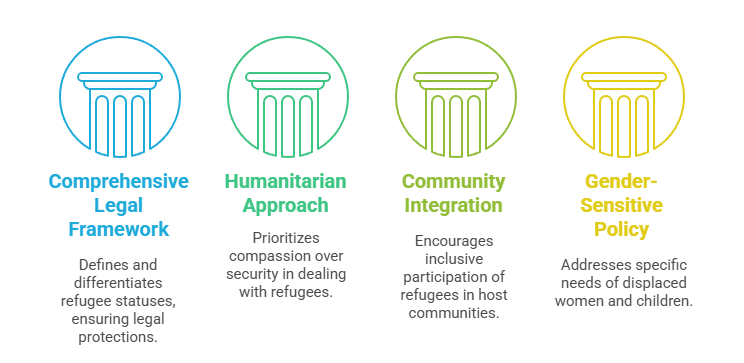
- India needs a comprehensive national refugee law: To define and differentiate between refugees, asylum seekers, and illegal migrants clearly, ensuring legal protections.
- Promote humanitarian approach over securitization: Avoiding criminalization of people fleeing real persecution.
- Foster community integration models: Encouraging participatory inclusion of migrants in host communities through civil society engagement and decentralized governance.
- Gender-sensitive refugee policy: Addressing health, education, and protection needs of displaced women and children.
Conclusion
The distinction between illegal migrants and refugees is not just legal—it is deeply sociological. It touches upon identity, belonging, citizenship, and justice. As India grapples with questions of national security, demographic balance, and humanitarian responsibility, it must reimagine citizenship and migration not as tools of exclusion but as pathways for inclusive development.
In the words of sociologist Ulrich Beck, globalization brings new “cosmopolitan risks”—and refugees are emblematic of this era. India’s response must be a balance of sovereignty and solidarity.
PYQs
- “Discuss the impact of migration on social transformation in India.” (2016)
- “What is marginalization? Discuss the social consequences of marginalization with reference to refugees.” (2018)
- “How does the concept of citizenship relate to exclusion in modern society?” (2020)
|

One comment