Introduction
In modern political discourse, the idea of the nation-state is often framed as a unifying project — binding people together through a shared territory, political identity, and cultural heritage. Yet, the very process that integrates also generates fault lines. Hyphenated identities such as Indian-American, Indo-Trinidadian, or Anglo-Indian embody this paradox. They acknowledge dual belonging but also invite scrutiny about loyalty, authenticity, and the boundaries of national belonging. In India, these tensions are more pronounced due to colonial legacies, communal politics, and ongoing social stratification. The experience of religious minorities — Muslims, Christians, Sikhs — often reflects a “hyphenated citizenship” where their allegiance is subtly questioned and their inclusion remains conditional.This discussion is not merely cultural; it is deeply sociological, touching themes from identity politics to nation-building, from citizenship theory to communalism.
Understanding Hyphenated Nationality
Hyphenated nationality refers to an identity that combines two distinct cultural or national affiliations. In global contexts, it often reflects migration, diaspora communities, or colonial histories. In India’s context, however, it can reflect internal ‘othering’ even within one nation-state.
Example:
- Indian-American is often seen as a celebration of multicultural belonging.
- Indian Muslim or Indian Christian may be viewed politically with suspicion in certain contexts, reflecting differential citizenship.
The Nation-State and Its Paradox
A nation-state seeks to align ethnic identity with political sovereignty. This alignment promises solidarity but can also generate exclusion:
- Inclusion: Shared symbols, language, and history unify diverse groups.
- Exclusion: Minority identities may be viewed as not “fully” part of the nation, creating social and political marginalization.
Benedict Anderson’s concept of “Imagined Communities” explains that nations are socially constructed. While this construction can unite, it also involves defining who not part of the nation is.
Colonial Legacy and Hyphenated Citizenship in India
India’s colonial history institutionalized religious categories through censuses, legal codes, and separate electorates. This left a political legacy where:
- Hindu identity often became central to the idea of Indian-ness.
- Religious minorities were treated as separate blocs, even post-Independence.
The Partition of 1947 further cemented the association of religion with national identity. The result is a nation-state where formal equality exists in law, but informal hierarchies and suspicions persist.
Sociological Analysis
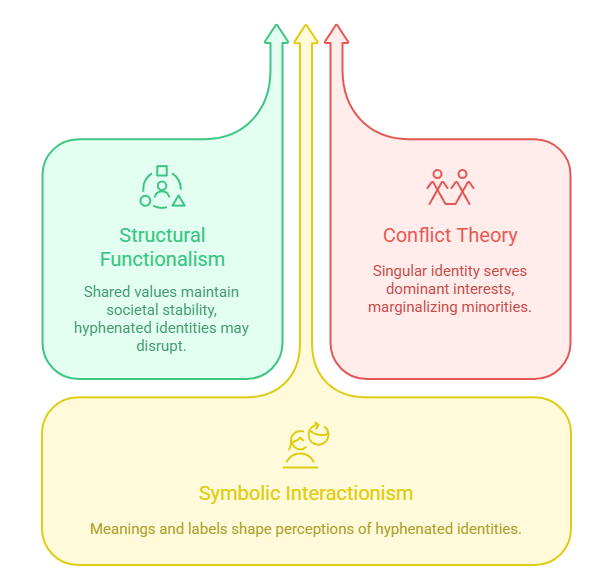
- Structural Functionalism: From a structural functionalist perspective (Talcott Parsons), a stable society requires shared values. Hyphenated identities may be seen as disruptive if they challenge the dominant cultural narrative.
- Conflict Theory: From Marxist and A.R. Desai’s viewpoint, the emphasis on singular national identity can serve dominant class/caste interests by marginalizing minority voices, preventing their equal access to political and economic resources.
- Symbolic Interactionism: Symbolic interactionists like Herbert Blumer would focus on the meanings and labels attached to hyphenated identities. For example, “Indian-American” may be associated with success abroad, while “Indian Muslim” might be unjustly associated with divided loyalty.
Hyphenated Identities in the Indian Context
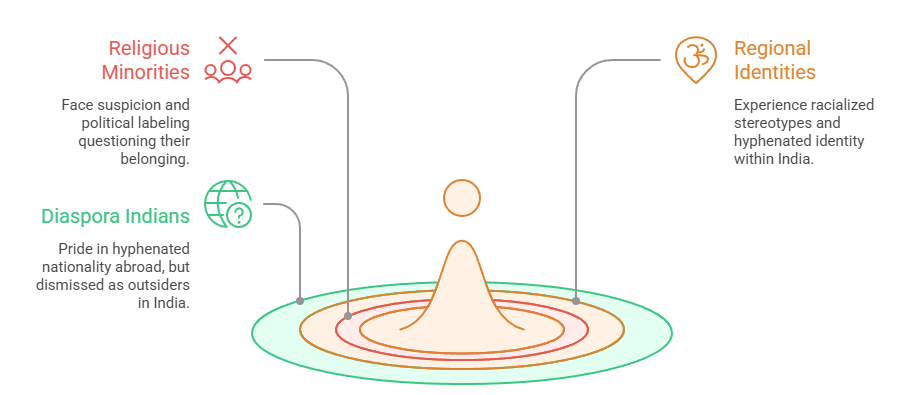
Religious Minorities
- Muslims: Often bear the brunt of suspicion, especially in communal politics. Terms like “pseudo-secular” or “anti-national” are political labels questioning their belonging.
- Christians: Face similar issues, especially in states where anti-conversion laws have been politicized.
Regional Identities
- People from Northeast India often face racialized stereotypes, leading to a feeling of hyphenated identity within India itself.
Diaspora Indians
- For Indian-origin people abroad, hyphenated nationality is a marker of pride and connection. Yet, back in India, diaspora opinions are sometimes dismissed as “outsider”
The Promise and Reality of Citizenship
T.H. Marshall’s theory of citizenship outlines civil, political, and social rights as the basis of inclusion in the nation-state. In practice:
- Civil and political rights exist in constitutional law.
- Social rights, such as freedom from discrimination and equal opportunity, remain inconsistently implemented.
Hyphenated identities reveal the gap between the legal promise of citizenship and lived experience.
Communalism and Political Mobilization
In India, communalism has been a persistent feature of political mobilization. Political parties may exploit hyphenated identities to:
- Consolidate majority votes.
- Create “us vs. them” narratives.
- Question the loyalty of minorities.
Paul Brass’s theory of elite manipulation explains how political elites actively construct and exploit these divides.
Globalisation and Fluid Identities
Globalisation has added complexity:
- Migration and transnationalism make hyphenated identities more common.
- Social media amplifies both multicultural celebration and nationalist backlash.
- The diaspora often negotiates between defending homeland identity and embracing host culture.
Challenges to Inclusive Nationhood
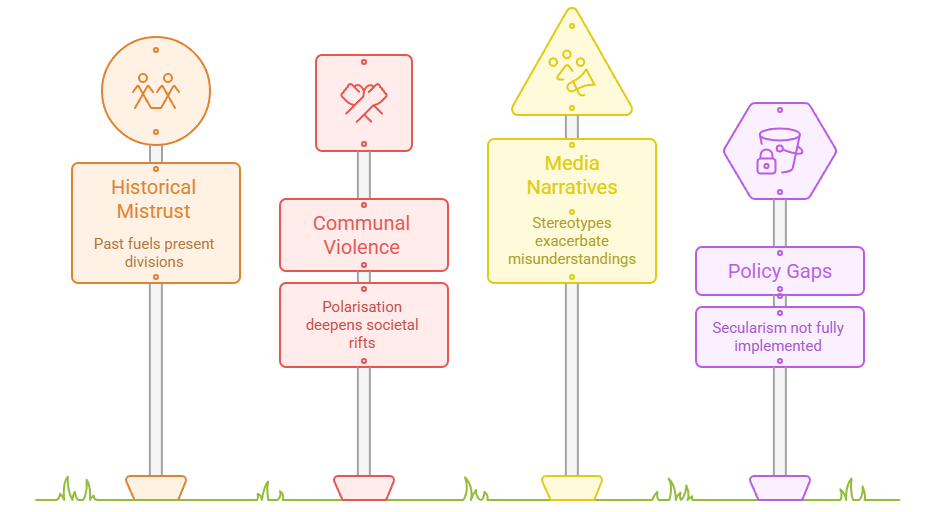
- Historical mistrust from colonial and partition-era politics.
- Communal violence and polarisation.
- Media narratives that reinforce stereotypes.
- Policy gaps in implementing constitutional secularism.
The Way Forward
To reconcile the paradox of the nation-state with hyphenated identities:
- Promote constitutional patriotism over ethnic nationalism.
- Strengthen anti-discrimination laws and ensure their implementation.
- Encourage interfaith dialogue and inclusive education.
- Recognise and celebrate pluralism as part of national strength.
Conclusion
The paradox of the nation-state lies in its simultaneous ability to unite and divide. Hyphenated nationality, when embraced, can enrich the cultural fabric. When weaponised, it can fracture social cohesion. For India, the challenge is to shift from conditional belonging to unconditional citizenship, where identity diversity strengthens rather than weakens the nation.
PYQs
Paper 1
- Discuss the relationship between religion and politics in shaping national identity. (2013)
- Discuss the role of cultural pluralism in nation-building. (2014)
- Examine the role of the state in managing ethnic diversity in multi-cultural societies. (2015)
- Discuss the sociological dimensions of communalism in the context of Indian society. (2016)
- Explain how identity politics challenges the idea of a homogeneous nation-state. (2017)
- “Nation and nationality are sociological concepts that have evolved over time.” Discuss with suitable examples. (2018)
- Explain Benedict Anderson’s concept of Imagined Communities and its relevance in understanding nationalism today. (2019)
- How does symbolic interactionism help in understanding the construction of national identity? (2020)
- Examine the relationship between ethnicity and nationalism in modern societies. (2021)
- Critically examine the concept of citizenship in the context of globalisation and migration. (2022)
Paper 2
- Examine the relationship between communal violence and political mobilisation in India. (2013)
- Evaluate the role of constitutional provisions in safeguarding cultural and religious diversity in India. (2014)
- Analyse the impact of partition and colonial legacy on religious minorities in India. (2015)
- Discuss the persistence of communalism in India despite constitutional secularism. (2016)
- Examine the role of diaspora communities in shaping India’s cultural and political identity. (2017)
- Critically discuss the challenges faced by religious minorities in securing equal citizenship rights in India. (2018)
- How has identity politics influenced electoral democracy in India? (2019)
- Discuss how the media has shaped narratives around nationalism and minority identities in India. (2020)
- Examine the role of regionalism and linguistic identity in the Indian nation-state. (2021)
- Discuss the implications of the Citizenship Amendment Act (CAA) on the idea of inclusive nationhood. (2022)
|

One comment