Introduction
The transformation from Fordism to Post-Fordism marks one of the most significant changes in the world of work and employment since the 20th century. This shift has reshaped the nature of labour, the structure of organisations, and the experience of workers globally, including in India.
What is Fordism?
Fordism refers to the system of mass production and consumption typified by Henry Ford’s automobile factories in early 20th-century America. Its main features included:
- Assembly-line production
- Standardised products
- Stable, long-term employment
- Clear hierarchy and division of labour
- Collective bargaining and strong trade unions
Antonio Gramsci called Fordism not just a technical regime but a “mode of regulation” encompassing the entire social structure.
What is Post-Fordism?
Post-Fordism refers to the era (from the 1970s onwards) characterised by:
- Flexible production systems
- Customised products and niche markets
- Rise of service sector and knowledge economy
- Decentralised organisational structures
- Precarious, short-term, and informal employment
- Weakening of trade unions
Manuel Castells and David Harvey highlighted how information technology and globalisation drive Post-Fordist economies.
Fordism vs. Post-Fordism- Impact on Labour and Employment
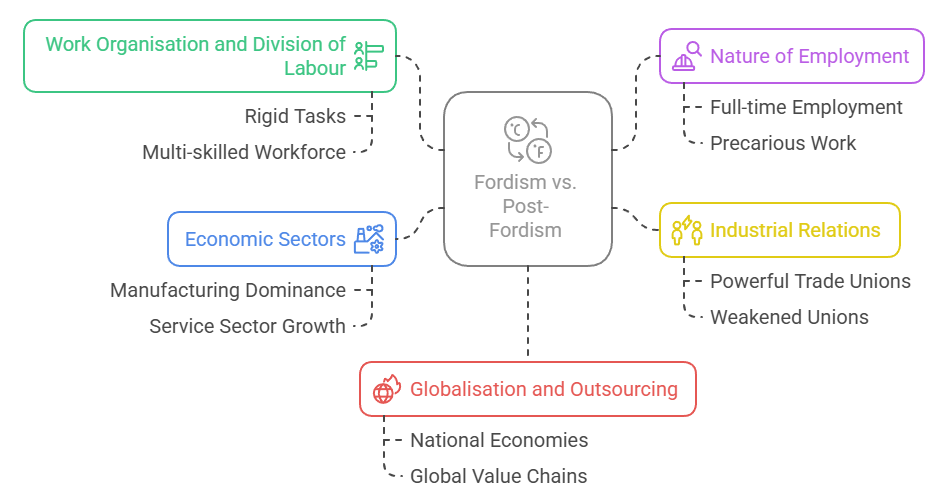
- Work Organisation and Division of Labour
- Fordism was marked by rigid and standardised tasks, where workers performed repetitive functions within a strict hierarchical setup. This approach ensured efficiency but offered little scope for creativity or skill development.
- Post-Fordism, on the other hand, introduced a multi-skilled workforce, encouraging job rotation, teamwork, and flatter organisational hierarchies. This flexibility allowed for innovation and adaptability in a rapidly changing economy.
- Nature of Employment
- Under Fordism, employment was typically full-time and permanent, with workers enjoying social security benefits and job stability.
- Post-Fordism ushered in the rise of precarious forms of work—such as contractual, part-time, gig, and platform-based jobs (for example, Zomato or Uber workers in India). This shift increased flexibility for employers but led to greater insecurity for workers.
- Industrial Relations
- Fordist industrial relations were characterised by powerful trade unions, collective bargaining, and relatively stable relationships between employers and workers.
- In Post-Fordism, trade unions have weakened, individual contracts have become more common, and there is a fragmentation of collective worker identities, making it harder for employees to organise and advocate for their rights.
- Economic Sectors
- During the Fordist era, the manufacturing industry was the dominant economic sector, driving growth and providing mass employment.
- Post-Fordism has witnessed a clear shift towards the service sector, IT, finance, and creative industries, reflecting changing consumer demands and technological advancements.
- Globalisation and Outsourcing
- Fordism was associated with national economies and protectionist policies aimed at self-sufficiency.
- In contrast, Post-Fordism embraces global value chains, outsourcing, and flexible accumulation strategies, connecting economies worldwide and increasing competition as well as opportunities.
Sociological Analysis:
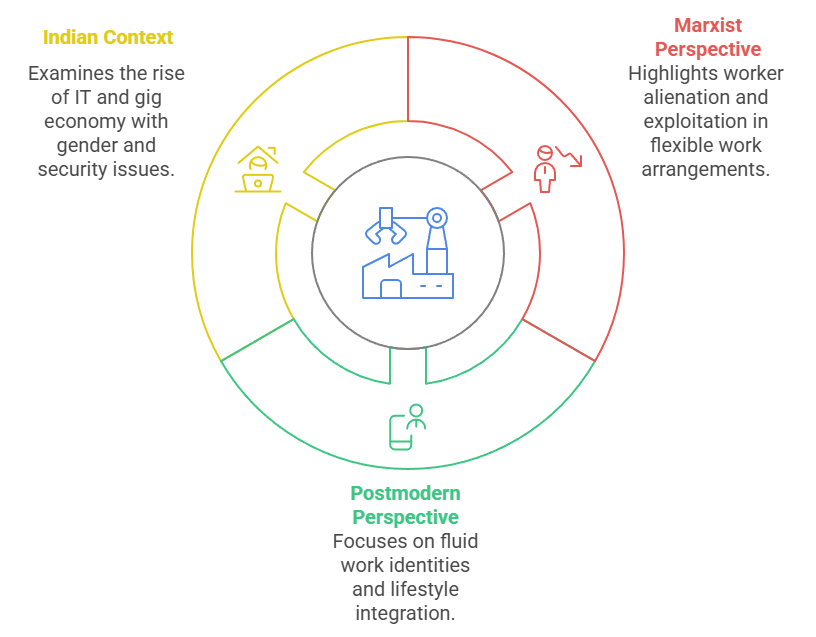
- Marxist Perspective: From a Marxist perspective, the sense of alienation described by Karl Marx remains relevant, as Post-Fordist work is often fragmented, leaving gig workers with little control or security. Furthermore, the exploitation of labour has intensified, with flexible labour arrangements primarily benefiting capital while creating a “reserve army” of precarious workers.
- Postmodern Perspective: The postmodern perspective focuses on how work identities have become more fluid and fragmented. In this era, employment is often seen as a part of one’s lifestyle rather than a stable source of identity, reflecting broader social changes.
- Indian Context: In India, the effects of Post-Fordism are visible in the rise of the IT sector, the gig economy, and informalisation of work. While women’s participation has increased through flexible, home-based jobs, these roles often come with low wages and lack social security. Weak labour laws further contribute to worker vulnerability and exploitation, as seen during crises like the COVID-19 migrant worker exodus.
Challenges
- Job insecurity and precarity
- Erosion of social security
- Stress and mental health issues
- Widening inequality
Opportunities
- Greater flexibility and autonomy for some workers
- Innovation and entrepreneurship
- Scope for work-life balance (for skilled workforce)
Conclusion
The shift from Fordism to Post-Fordism has transformed the very fabric of labour and employment, introducing both opportunities and challenges. For India, the need is to harness the potential of flexible work while ensuring social protection and decent work standards. We must analyse these trends with a critical lens, integrating sociological theories for a comprehensive understanding.
PYQs
Paper 1:
- “Explain the concept of ‘precarious employment’. How has the rise of the gig economy affected labour relations?”(2023)
- “Examine the role of technological changes in transforming the nature of work and the structure of occupations.”(2022)
- “How do trade unions function in the context of changing industrial relations and labour market reforms?”(2021)
- “How does globalisation impact work and economic life in contemporary society? Illustrate with examples.”(2021)
- “Discuss how the process of economic liberalisation has transformed the labour market in India.”(2020)
- “Explain the concept of informalisation of work. Discuss its implications for the working class.”(2019)
- “Examine the sociological implications of the rise of service sector and knowledge economy in India.”(2018)
- “Discuss the features of post-Fordism and explain how it has affected the organisation of work and labour in industrial societies.”(2017)
- “Discuss the impact of new technology on the division of labour in contemporary workplaces.”(2017)
- “What do you understand by ‘Fordism’? Critically examine its relevance in the context of contemporary capitalist societies.”(2016)
Paper 2:
- “What are the sociological consequences of contractualisation and casualisation of labour in India?”(2023)
- “Assess the impact of technology-driven service sector growth on traditional forms of employment in India.”(2021)
- “Analyse the challenges faced by the Indian labour force in the era of economic reforms and globalisation.”(2020)
- “Examine the impact of globalisation on labour and employment in India.”(2019)
- “Discuss the implications of declining power of trade unions in India’s industrial sector.”(2018)
- “Discuss the growth of informal sector in India and its consequences for labour.”(2016)
|

One comment