
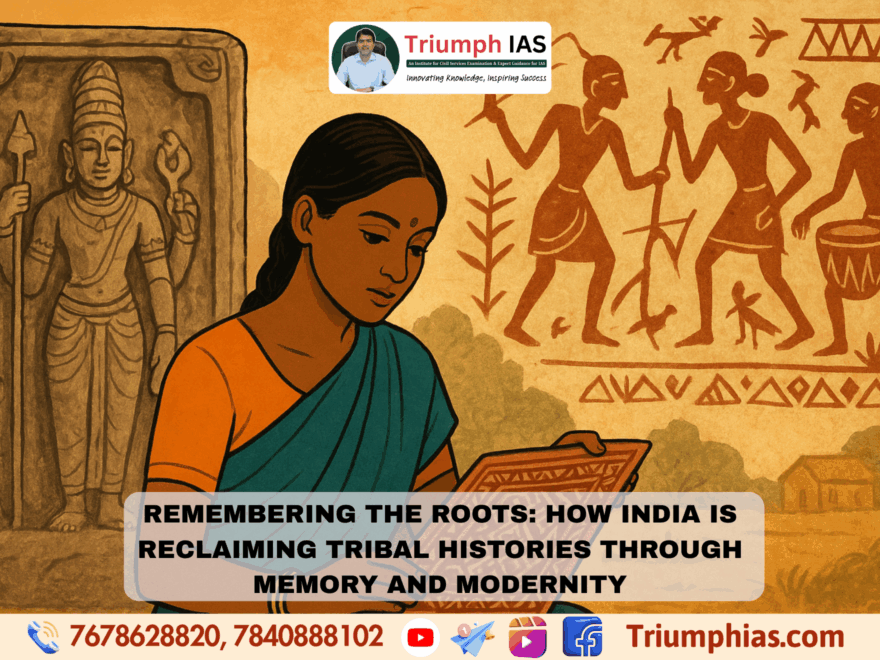
Remembering the Roots: How India is Reclaiming Tribal Histories Through Memory and Modernity
(Relevant for Sociology Paper 2: Sociological thinkers)
Introduction: The Politics of RememberingThe way a nation remembers its past tells us as much about its present as it does about its history. India’s growing effort to celebrate its tribal heroes and movements marks a transformative moment in how the country defines its collective memory. The opening of a Digital Museum of Tribal Freedom Fighters and the annual celebration of Tribal Pride Day (Janjatiya Gaurav Divas) are more than symbolic gestures — they are social acts of reclamation. They signal an ongoing project of decolonizing India’s national consciousness, where those once silenced by history are finally being placed at its center. Through these commemorations, India is not only acknowledging the courage of its tribal communities but also confronting the sociological structures of erasure that have long marginalized them. Digital Memory: Technology Meets Tribal HistoriesThe Shaheed Veer Narayan Singh Memorial and Tribal Freedom Fighters Museum, recently inaugurated in Chhattisgarh, stands as India’s first fully digital museum dedicated to the stories of tribal resistance. Its wood-carved entrance crafted by Sarguja artisans leads visitors into an immersive digital world where interactive “leaves” narrate fourteen major tribal uprisings — from the Halba Rebellion to the Sarguja Revolt. Sculptures of leaders like Birsa Munda, Veer Narayan Singh, and Gend Singh transform the gallery into a living archive of resistance. From a sociological perspective, this museum represents a new form of “digital indigeneity.” Technology here is not a replacement for tradition but a medium through which oral history and cultural memory are preserved. The digital format allows tribal voices — often confined to local or oral storytelling — to enter the national public sphere, reshaping who gets to define Indian freedom. Yet, this digitalization of culture also raises critical questions: Who curates these narratives? Are they being told by tribal communities, or about them? In sociological terms, the museum becomes a site of symbolic negotiation, balancing state-led representation with the authenticity of indigenous self-expression. Veer Narayan Singh: A Sociological Symbol of Moral EconomyAmong the heroes celebrated stands Shaheed Veer Narayan Singh, a Binjwar tribal leader from Sonakhan, revered as Chhattisgarh’s first freedom fighter. During a devastating famine, Singh seized grain from exploitative merchants to feed his starving people — an act that led to his arrest and eventual execution by British forces. Seen through a sociological lens, Singh’s defiance represents the concept of “moral economy” — resistance born not just from political rebellion but from a deep moral commitment to community justice. His leadership challenged both colonial and local hierarchies, embodying the ethics of redistribution and solidarity that remain vital to tribal worldviews even today. His memory, now digitally immortalized, reminds us that revolutions are not always born in cities or among elites; they often begin in the moral landscapes of rural struggle. Tribal Pride Day: Reclaiming National SpaceThe commemoration of Tribal Pride Day, held every year on the birth anniversary of Birsa Munda, extends this reclamation from local memory to the national stage. It is a recognition that India’s freedom struggle was not only fought in Delhi or Calcutta but also in the forests, hills, and villages where tribal communities rose against oppression. This celebration has become a national platform to honor tribal resilience and to showcase new initiatives that address long-standing inequalities — from education to healthcare, from digital inclusion to entrepreneurship. Across the country, programs have been launched to support Particularly Vulnerable Tribal Groups (PVTGs), establish Eklavya Model Residential Schools, and expand Van Dhan Vikas Kendras that promote forest-based livelihoods. Mobile medical units now reach remote areas, and digital scholarships enable young tribal students to pursue higher education. Sociologically, these efforts reflect the emergence of cultural citizenship — the recognition that justice must extend beyond economics to include identity, dignity, and cultural belonging. Birsa Munda: Charisma, Resistance, and the Sociology of HopeAt the center of this growing recognition stands Birsa Munda, one of India’s most iconic tribal leaders. His movement — known as Ulgulan (The Great Tumult) — was more than an armed revolt; it was a spiritual and social awakening. Birsa united Munda and Oraon communities against British rule and missionary domination, envisioning a self-governed tribal world — “Birsa Raj.” He founded the Birsait sect, blending faith, identity, and resistance. His message was profoundly sociological: reclaiming collective identity as a form of empowerment. In Max Weber’s terms, Birsa embodied charismatic authority — a leader whose legitimacy came from moral conviction rather than institutional power. His charisma outlived his short life, shaping generations of political consciousness and eventually inspiring the creation of Jharkhand as a separate state honoring tribal self-determination. Birsa’s life and death remind us that revolutions often begin in cultural reimagination before they manifest as political change. From Memory to Development: The Continuum of RecognitionWhile these cultural recognitions are vital, they cannot exist in isolation from structural transformation. The state’s ongoing efforts — including housing programs, educational schemes, and women’s empowerment initiatives — attempt to bridge the material gaps that colonialism and neglect left behind. But sociology demands that we ask harder questions:
The challenge lies in ensuring that recognition and redistribution move together — a balance that philosopher Nancy Fraser identifies as essential to achieving genuine social justice. The Digital Museum and the Reimagining of the NationThe creation of digital spaces to honor tribal heritage is part of a broader sociological transformation in how India understands nationhood. The digital museum, in particular, represents a re-scripting of national history — moving from a single, linear narrative to a plural, networked one. By combining traditional art forms with augmented reality, these new institutions embody what sociologists call “hybrid modernity” — where technology serves not as a replacement for indigenous knowledge, but as its amplifier. At the same time, the digitalization of history introduces new ethical challenges: the risk of heritage commodification or performative inclusion — where visibility does not necessarily translate to agency. To avoid this, the digital remembrance of tribal history must remain community-led, dialogic, and inclusive, ensuring that technology becomes a tool of empowerment rather than assimilation. Conclusion: Recognition as Social TransformationIndia’s renewed attention to its tribal heritage marks an important sociological shift — from neglect to recognition, from invisibility to representation. Through the Digital Museum and Tribal Pride Day, the country is engaging in an act of collective remembrance, acknowledging that the roots of freedom run deep into its forests and hills. Yet, true recognition extends beyond celebration. It requires dismantling structural inequalities, valuing indigenous knowledge systems, and allowing tribal communities to co-author the nation’s narrative. By fusing digital innovation with cultural memory, India is not just honoring the past — it is reimagining its social future. In remembering the unremembered, the country takes a crucial step toward a more inclusive and plural vision of progress — one where every community, every story, and every struggle matters. |
To Read more topics, visit: www.triumphias.com/blogs
Read more Blogs:
The UN Cybercrime Convention: Digital Cooperation or Digital Control?
One comment