Introduction
In a nation that prides itself on its cultural diversity and constitutional values, the persistent threat of honor killings in response to inter-caste marriages reflects deep-rooted caste hierarchies, patriarchal control, and community dominance. Despite legal protection under Article 21 (Right to Life), couples daring to marry across caste boundaries continue to face social exclusion, harassment, and even lethal violence.
What are Honor Killings?
Honor killings refer to the murder of individuals (mostly women or couples) by family or community members who believe the victims have brought dishonor by violating traditional norms, such as marrying outside their caste, community, or religion. These acts are often justified under the guise of protecting family reputation, especially in rural patriarchal societies.
Why Inter-Caste Marriages Trigger Honor Killings
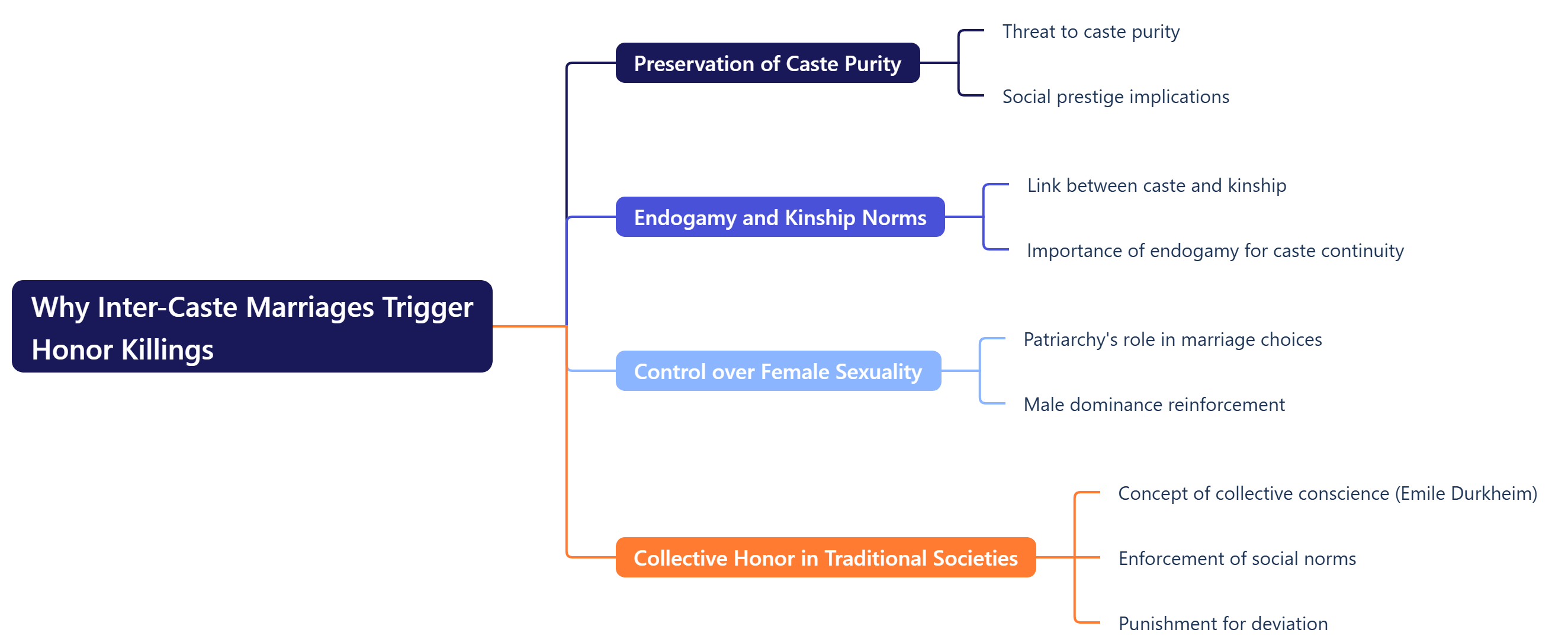
- Preservation of Caste Purity: Inter-caste marriages, especially when involving upper-caste women marrying lower-caste men, are perceived as a threat to caste purity and social prestige.
- Endogamy and Kinship Norms: According to Irawati Karve, kinship structures in India are deeply linked to caste. Endogamy (marrying within caste) is central to caste continuity.
- Control over Female Sexuality: As feminist sociologists like Sylvia Walby argue, patriarchy reinforces control over women’s choices, especially in marriage, to uphold male dominance.
- Collective Honor in Traditional Societies: As per Emile Durkheim’s concept of collective conscience, traditional societies enforce strict social norms, and deviation is punished to maintain social order.
Sociological Analysis
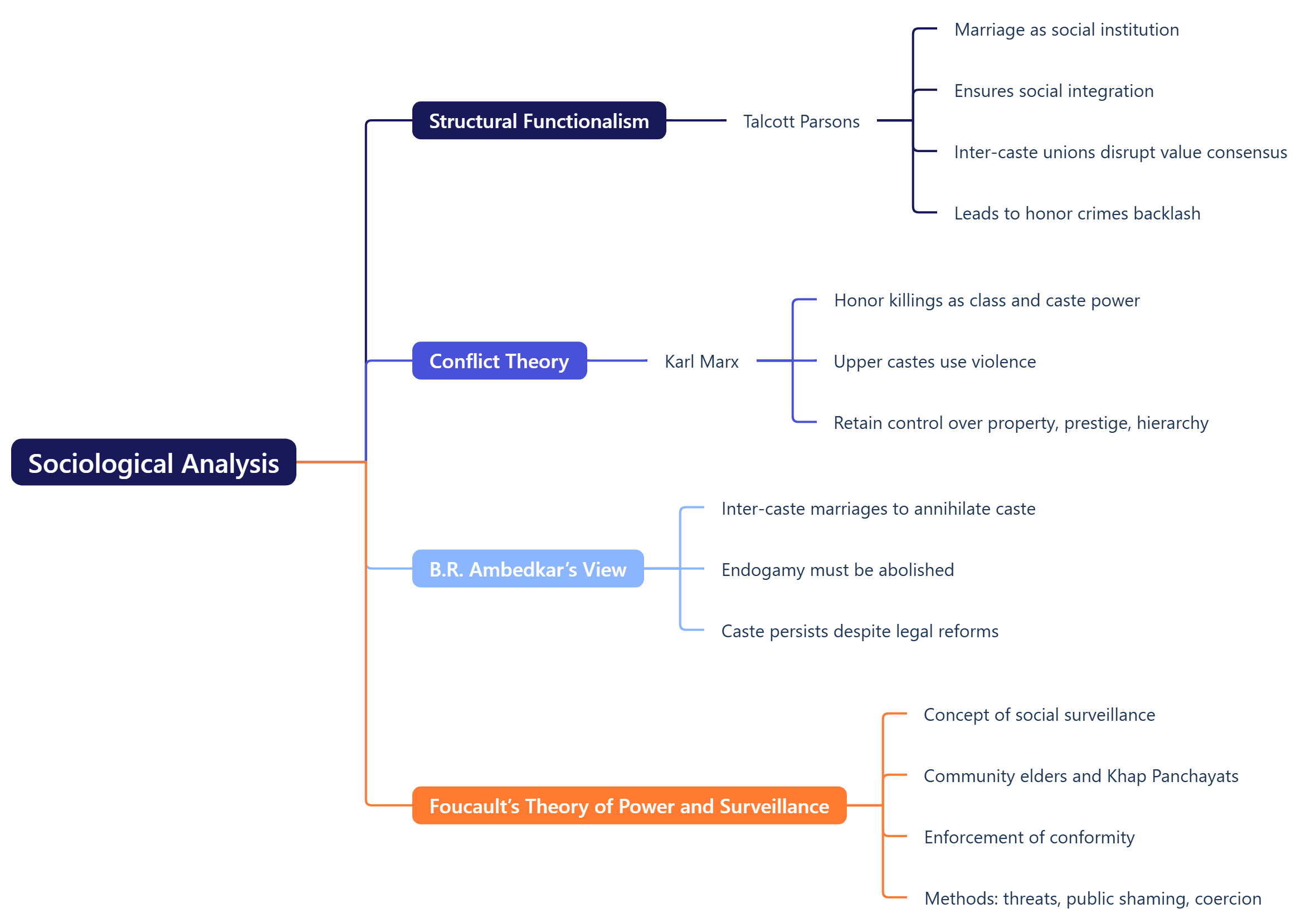
- Structural Functionalism (Talcott Parsons): Marriage is a social institution that ensures social integration. Inter-caste unions disrupt the ‘value consensus’ in traditional Indian society, leading to collective backlash in the form of honor crimes.
- Conflict Theory (Karl Marx): Honor killings are a manifestation of class and caste power. Dominant groups (upper castes) use violence to retain control over property, prestige, and hierarchy.
- B.R. Ambedkar’s View: Dr. Ambedkar advocated inter-caste marriages as a tool to annihilate caste. He emphasized that unless social practices like endogamy are abolished, caste will persist despite legal reforms.
- Foucault’s Theory of Power and Surveillance: Foucault’s concept of social surveillance explains how community elders and Khap Panchayats enforce conformity through threats, public shaming, and coercion.
Recent Examples
- 2024: A Dalit man in Rajasthan was lynched by the girl’s family for eloping with an upper-caste woman.
- Khap Panchayat diktats in Haryana continue to oppose same-village or inter-caste marriages, issuing threats or fines.
- Supreme Court (Shakti Vahini vs. Union of India, 2018) directed states to prevent honor killings and uphold the right of consenting adults to marry.
Government Initiatives and Legal Safeguards
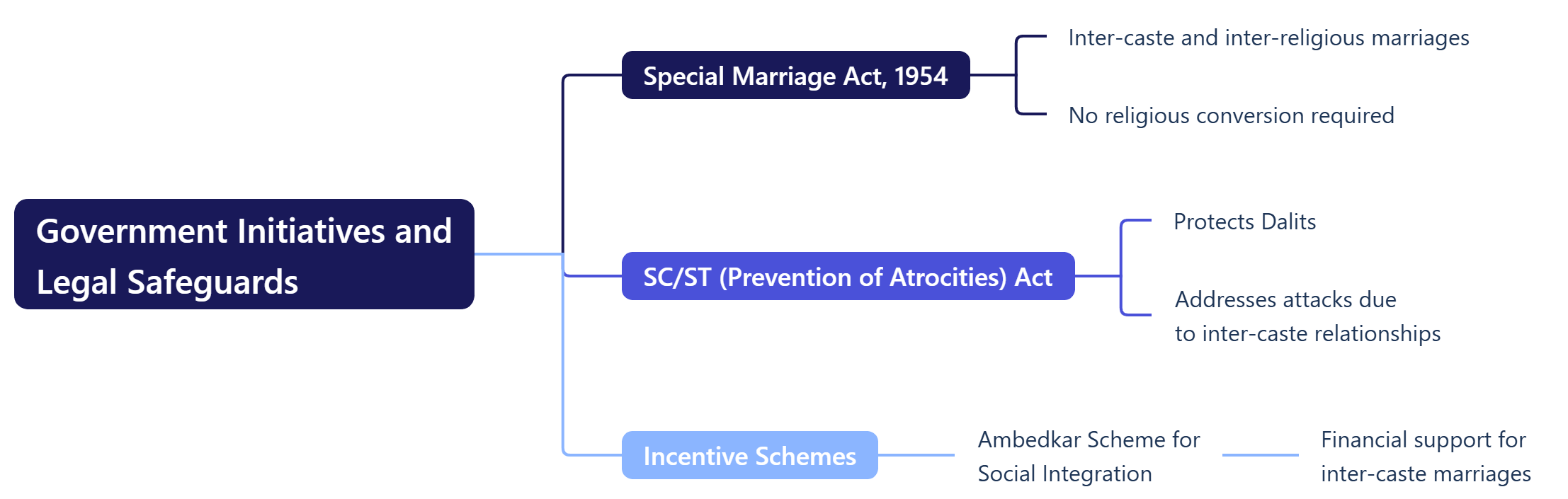
- Special Marriage Act, 1954: Allows inter-caste and inter-religious marriages without religious conversion.
- SC/ST (Prevention of Atrocities) Act: Used in cases where Dalits are attacked due to intercaste relationships.
- Incentive Schemes: Ambedkar Scheme for Social Integration through Inter-Caste Marriages provides financial support.
Challenges Ahead
- Lack of enforcement of protective laws.
- Complicity of local police and community leaders.
- Slow judicial redressal.
- Deep-rooted caste and patriarchal mindset, especially in rural areas.
Conclusion
Honor killings stand as a grim reminder of the oppressive interplay between caste, patriarchy, and tradition in modern India. Promoting inter-caste marriages, ensuring state protection, and fostering social awareness are essential to build an egalitarian society envisioned by the Indian Constitution. Understanding these sociological dimensions is critical for Sociology Optional.
PYQs
Paper 1
- Examine the role of kinship and marriage in maintaining social order in traditional societies. – 2014
- Discuss the role of caste in contemporary social mobility. – 2015
- Explain how social stratification affects social relationships and life chances. – 2017
- Discuss how patriarchy shapes the structure of family and marriage in Indian society. – 2021
- How do you relate the concept of “cultural lag” to the persistence of honor killings despite modernization? – 2018
Paper 2
- Discuss the changes in the institution of marriage and family under the impact of legislation and education. – 2015
- Write a note on caste panchayats and their role in the violation of human rights. – 2016
- Analyze the issues of ‘honour killing’ in the context of the caste system and patriarchy in India. – 2017
- Discuss the socio-cultural factors behind the prevalence of violence against women in Indian society. – 2019
- Discuss the role of Ambedkar’s ideas in promoting inter-caste marriage in modern India. – 2020
- Critically examine the role of media in social movements related to inter-caste marriage and honor killings. – 2021
- In what ways is caste a dominant factor in interpersonal and intergroup relations in contemporary India? – 2022
- How do the patterns of family and marriage reflect wider social changes in India? – 2023
|


One comment