|
On 8 September 2025, International Literacy Day witnessed a momentous announcement: Himachal Pradesh has been declared fully literate, achieving a literacy rate of 99.30%, surpassing the Ministry of Education’s functional literacy benchmark of 95%, deemed equivalent to universal literacy. This noteworthy recognition—under the auspices of the ULLAS (Understanding Lifelong Learning for All in Society) or New India Literacy Programme (NILP)—propels Himachal Pradesh into the elite league of Indian states such as Tripura, Mizoram, and Goa that have similarly realized universal functional literacy. The Union Territory of Ladakh preceded them in June 2024. This triumph offers fertile ground for reflection across various sociological dimensions: structural, cultural, feminist, symbolic, and conflict perspectives.
The Structural-Functional Lens: Literacy as Social Glue
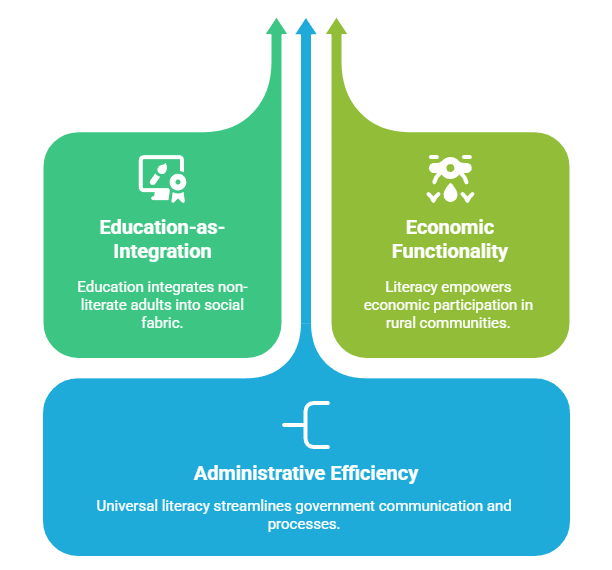
From a structural-functional perspective, literacy stands as a foundational institution—integral for the smooth functioning of society. Literally, the ability to read, write, and carry out basic numerical tasks allows citizens to access public services, engage with digital platforms, understand civic rights, and contribute to local governance. In Himachal’s hilly terrains and dispersed villages, literacy reinforces social cohesion.
- Education-as-Integration: The ULLAS program aligns with Emile Durkheim’s notion that education maintains social solidarity. By bringing non-literate adults into the literacy fold, the state fosters a sense of belonging and shared identity.
- Economic Functionality: Functional literacy empowers individuals to navigate markets, manage finances, and adopt modern agricultural practices, particularly significant in Himachal’s rural economy. Education thus functions as a bridge—linking local traditions to emerging economies.
- Administrative Efficiency: When a state achieves near-universal literacy, the burden on bureaucratic apparatus lessens. Signages, forms, and government communication can be streamlined; reliance on intermediaries diminishes.
Conflict Perspective: Education as Empowerment and Resistance
Marxist and critical theories position education not just as a neutral tool but as a site of power contestation. In Himachal, widespread literacy can disrupt entrenched hierarchies.
- Challenging Elite Dominance: Historically, educational attainment tended to cluster among the landowning, urban, or caste-privileged classes. The ULLAS initiative, by floating 3 crore enrollments and mobilizing 42 lakh volunteers, democratizes access—redistributing cultural capital.
- Empowerment for Marginalized Groups: Literacy becomes a lever for self-advocacy, challenging patriarchal, casteist, or regional marginalization. Women, Dalit communities, and tribal populations—who often faced exclusion in formal schooling—can now mobilize knowledge as resistance.
- Tensions in Educational Bureaucracy: State deployment of literacy drives may encounter friction from local power brokers who feel their authority or privilege threatened. Yet, such disruptions may catalyze democratization of local governance.
Symbolic Interactionism: Literacy, Identity, and Everyday Life
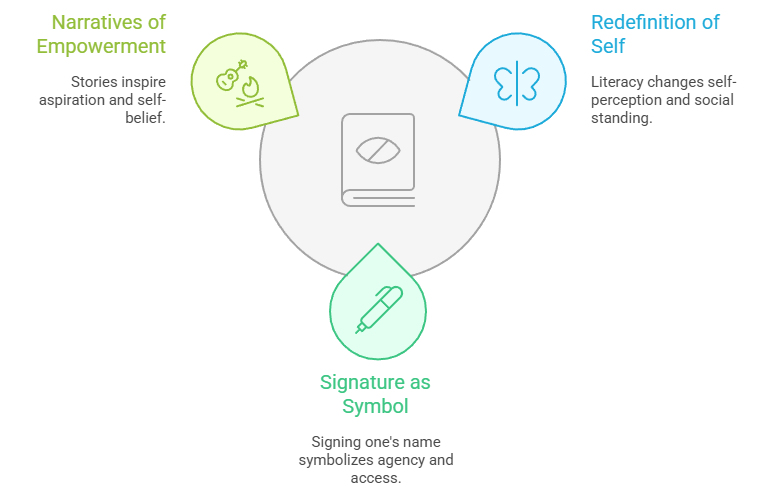
From a symbolic interaction perspective, literacy transforms social symbols and interactions in everyday life.
- Redefinition of Self: Being labeled “literate” alters individuals’ self-concepts. It changes how they are perceived—by kin, by neighbors, by institutions—and how they perceive their own capabilities.
- Signature as Symbol: The ability to sign one’s name is more than a legal tool—it’s a symbolic mark. In local markets or panchayat meetings, signatures reinforce agency. Even social media or messaging platforms gain access.
- Narratives of Empowerment: Stories of former non-literate learners now reading textbooks, helping their children with homework, or reading newspapers recast the internal dialogues around aspiration.
Feminist Perspective: Gender, Literacy, and Social Transformation
The gendered dimension of literacy is critical, particularly in patriarchal contexts.
- Closing the Gender Gap: If ULLAS initiatives prioritized female learners—vital in states with moderate gender disparities—then full literacy heralds strides toward gender equality in adult education.
- Agency in Domestic Spaces: Women who gain literacy, even informally, can better manage household finances, read nutritional or health information, or participate in microfinance schemes. This subtly reconfigures power dynamics within families and communities.
- Collective Mobilization: Female literacy tends to spawn community-based education groups, self-help networks, and social awareness forums—multiplying the sociopolitical ripples of literacy.
Cultural Dimensions: Multilingualism and Inclusive Outreach
India’s linguistic mosaic requires culturally responsive literacy campaigns.
- ULLAS’ 26 Indian Languages: Offering materials in 26 languages showcases a respect for linguistic diversity and cultural identity. From Pahari dialects to Hindi and beyond, localized content breaks down barriers and affirms cultural esteem.
- Adaptation of Curricula: Culturally relevant examples—agricultural analogies, local folktales, traditional numerical systems—can enhance learning retention and enjoyment.
- Resilience of Indigenous Knowledge: Literacy doesn’t erase local knowledge; instead, it can codify and preserve it. Learners may start documenting local medicinal practices, ensuring cultural continuity.
Life-Course Sociology: Adult Learning and Lifelong Growth
ULLAS’s explicit emphasis on adult learning is sociologically rich.
- Deschooling and Unlearning Ageist Norms: Adult participation in literacy classes as learners demonstrates that education is not for the young only; it’s a lifelong journey. It challenges ageist assumptions.
- Building Life Skills: Beyond reading and writing, the focus on digital literacy and financial literacy equips adults to manage mobile payments, participate in e-governance, and budget household expenses—core competencies in modern life.
- Generational Spillovers: Literate adults serve as role models. Their children may be more motivated or receive better educational support—multiplying literacy benefits across generations.
ULLAS/National Landscape: Context and Impact
A sociological analysis would be incomplete without situating Himachal’s success within broader national dynamics.
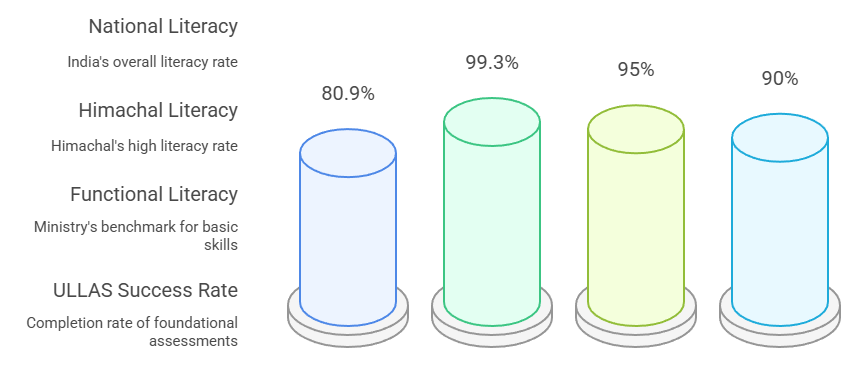
- National Literacy at 80.9% (PLFS 2023–24): Compared to India’s overall literacy of around 80.9%, Himachal’s 99.3% underscores spatial disparities. ULLAS seeks to bridge these divides, but regional variation remains a challenge.
- Functional Literacy as Benchmark: The 95% threshold aligns with the Ministry’s definition of functional literacy—but functional isn’t absolute; rather, it signals minimal proficiency. Even so, surpassing it indicates robust basic skills across adult life.
- Scale of ULLAS: Over 3 crore learners enrolled, with 1.83 crore completing foundational assessments at a remarkable 90% success rate. The mobilization of 42 lakh volunteers speaks to widespread participatory infrastructure.
- Union Territory Precedent: Ladakh’s prior full-literacy status (declared in June 2024) offers a benchmark of ULLAS in action. That trajectory—from Ladakh to four states including Himachal—implies effective decentralization of literacy interventions.
Sociological Dimensions of ULLAS Implementation
Key dimensions of ULLAS from sociological angle:
- Macro-Level (Structural)
- State-civil society partnerships: volunteers meet bureaucracy, forging hybrid governance.
- Redistributive mechanism: resources—time, materials—are redistributed to marginalized groups.
- Meso-Level (Institutional/Community)
- Local centers/formal classes: panchayats, schools, community halls repurposed as learning hubs.
- Peer networks: learners support each other, generating social capital.
- Micro-Level (Individual/Interactional)
- Learner motivators: family well-being, children’s education, social participation.
- Identity shifts: learners move from ‘illiterate’ to empowered individuals with real agency in daily conversations.
Challenges and Critical Reflections
Even with this triumph, critical vigilance is needed.
- Retention and Practice: Achieving foundational literacy is one thing; maintaining it and building upon it is another. Adult learners need continued access to reading materials, refresher sessions, and digitally mediated content.
- Quality Beyond Quantity: A 90% pass rate on foundational assessments is remarkable—but assessments must reflect real-world literacy—not rote tasks. Ongoing evaluations are essential.
- Intersectional Gaps: Even within Himachal, tiny pockets—remote hamlets, resistant caste groups—may lag behind. The final mile may be the hardest.
- Structural Change vs Skill Provision: Literacy alone doesn’t dismantle structural inequalities. While functional skills are necessary, addressing poverty, systemic exclusion, and gender norms remains critical.
Imaginative Epilogue: A Literate Himachal and Its Societal Canvas
Imagine a Himachal where:
- A farmer in Spiti uses a smartphone to check market prices, understand weather alerts, and download digital forms—no more middlemen.
- A housewife in Solan reads healthcare pamphlets, helps her children with homework, manages a small business’s digital transaction, and voices opinions in gram sabha meetings.
- A tribal community leader uses literacy and digital skills to apply for schemes—constructive paths toward community development.
- Intergenerational shifts occur: literate grandparents help grandchildren with stories, alphabets, and mobile interfaces.
This is the socio-cultural metamorphosis that functional literacy—when embedded in purpose and context—can bring.
Conclusion
The declaration of Himachal Pradesh as functionally fully literate is more than a statistical milestone; it’s a sociological triumph. With a 99.30% literacy rate achieved under the ULLAS/NILP model, the state demonstrates how structural mobilization, cultural inclusion, gendered empowerment, and individual transformation can coalesce in educational governance. As Himachal joins Tripura, Mizoram, Goa—and follows Ladakh’s example—the narrative of Indian literacy shifts from fragmented progress to cohesive transformation.
Yet, sustaining this success demands ongoing community engagement, qualitative depth, and attention to emerging socio-economic challenges. Himachal’s journey offers a multifaceted case study—merging theory with real-world impact, from functionalist integration to conflictual empowerment, and from symbolic self-realization to feminist agency. |

One comment