Introduction
Despite India’s impressive economic growth and declining income-based poverty rates, food deprivation remains a persistent challenge. A recent Crisil study using the ‘Thali Index’ revealed that up to 50% of rural Indians and 20% of urban Indians cannot afford two balanced meals a day, exposing hidden hunger that conventional poverty metrics fail to capture. While the World Bank’s Poverty and Equity Brief indicates extreme poverty fell from 16.2% in 2011-12 to 2.3% in 2022-23, the Thali Index uncovers a more nuanced reality: many households, even those above the poverty line, cannot meet basic nutritional requirements. From a sociological perspective, this issue intersects with social stratification, public policy, and structural inequality, emphasizing that food security is not merely an economic problem but a multidimensional social challenge.
Understanding the Thali Index
Unlike conventional calorie-based or income-based poverty measures, the Thali Index evaluates whether households can afford a basic, balanced meal—the “thali”—comprising rice, dal, roti, vegetables, curd, and salad. This method captures both quantity and quality of food, reflecting real nutritional adequacy rather than mere caloric sufficiency. The Thali Index highlights a critical discrepancy: households with sufficient caloric intake may still suffer from nutritional deprivation, particularly protein and micronutrient deficiency, due to economic constraints and subsidy misallocation.
Sociologically, the Thali Index aligns with Amartya Sen’s capability approach, which emphasizes that poverty is not just about income but about real freedoms and opportunities, including access to nutritious food that sustains health, productivity, and dignity.
Challenges in India’s Food Security Landscape
- Limitations of the Public Distribution System (PDS)
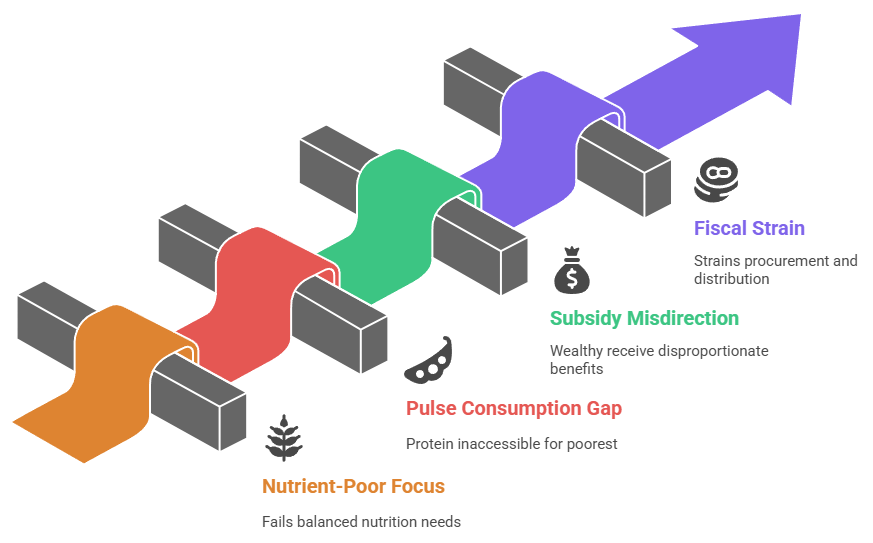
The PDS has successfully equalized cereal consumption, but it largely provides rice and wheat, which are calorie-rich but nutrient-poor. While effective in mitigating hunger, it fails to address balanced nutrition, particularly the protein deficit, leaving households vulnerable to hidden malnutrition.
- Pulse Consumption Gap
Pulses, the main source of protein for low-income households, remain financially inaccessible for the poorest. The poorest 5% of rural households consume only half the pulses compared to the wealthiest 5%. This inequality reflects structural barriers, where food subsidy distribution is misaligned with actual need, perpetuating nutritional disparities.
- Subsidy Misdirection and Inequity
The study reveals that rural households in the top 10% consumption bracket receive up to 88% of PDS subsidies. Such misallocation exacerbates structural inequality, as wealthier households benefit disproportionately, while the truly needy remain undernourished.
- Fiscal and Administrative Challenges
The expansion of the PDS under the National Food Security Act (NFSA, 2013) to 80 crore beneficiaries has strained procurement, storage, and distribution systems. Administrative inefficiencies, inclusion errors, and leakage further compromise effectiveness. The system faces challenges in balancing fiscal sustainability with equitable nutrition access.
Historical Context of Poverty Measurement in India
India’s poverty measures have evolved over decades:
- Working Group (1962): Poverty lines based on minimum food and non-food needs.
- Dandekar & Rath (1971): Calorie-based line (2,250 kcal/day per capita).
- Y.K. Alagh (1979): Differentiated rural (2,400 kcal/day) and urban (2,100 kcal/day) poverty lines.
- Lakdawala Expert Group (1993): Introduced state-specific lines.
- Tendulkar Committee (2009): Recommended shifting from calorie-based to nutritional outcome-based poverty lines with a uniform all-India standard.
- Rangarajan Committee (2014): Reintroduced separate rural and urban poverty lines including food and non-food consumption.
Sociologically, these shifts reflect an evolving understanding that poverty is multidimensional, encompassing income, food security, health, and education, consistent with Martha Nussbaum’s human development approach, which emphasizes capabilities beyond mere survival.
Challenges in Implementing a Nutrition-Sensitive PDS
- Accurate Targeting
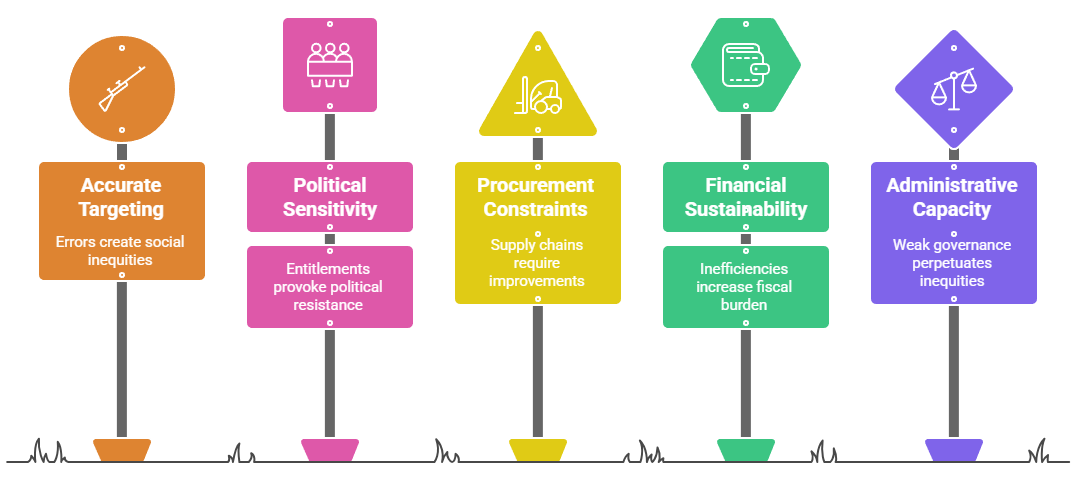
Identifying households below the “two-thalis a day” threshold is complex. Inclusion and exclusion errors are common, creating social inequities.
- Political Sensitivity
Reducing entitlements for better-off households may provoke political resistance, as food subsidies have become entrenched in political economy considerations.
- Procurement and Distribution Constraints
Pulses are produced in smaller quantities, exhibit price volatility, and require robust storage. Expanding pulse distribution involves logistical challenges that necessitate infrastructure investments and improved supply chains.
- Financial Sustainability
Expanding PDS subsidies to cover a diversified basket while maintaining current cereal provisions increases fiscal burden. Inefficiencies in administration and leakage exacerbate the cost of intervention.
- Administrative Capacity
A successful nutrition-sensitive PDS requires digital tracking, biometric integration, and strong oversight. Weak governance can perpetuate inequities and limit access for the most vulnerable.
Proposed Reforms for an Equitable and Nutrition-Sensitive PDS
- Define a Nutrition-Based Food Norm
Establish a “minimum balanced diet” standard including cereals, pulses, vegetables, and dairy, regionally adapted to reflect local dietary patterns.
- Target Subsidies Based on Need
Use recent Household Consumption Expenditure Survey (HCES) data to identify undernourished households. Provide full PDS support to the most deprived and reduce subsidies for households exceeding the minimum nutritional threshold.
- Expand Pulse Inclusion
Procure and distribute pulses (tur, moong, chana) to low-income households. Link procurement with Minimum Support Price (MSP) and buffer stocking mechanisms to stabilize supply and price.
- Reduce Excess Cereal Allocation
Trim quotas for households already consuming adequate cereals. Reallocate savings to diversify the food basket and improve nutrition outcomes.
- Pilot and Scale Gradually
Introduce state-wise pilot programs, monitor fiscal impact, supply chain efficiency, and nutritional outcomes before national rollout.
- Leverage Technology
Digital ration cards, Aadhaar-linked PDS, and real-time monitoring can improve transparency, reduce leakages, and ensure benefits reach intended beneficiaries.
- Integrate with National Nutrition Programs
Coordinate with Poshan Abhiyaan, Integrated Child Development Scheme, and Mid-Day Meal schemes to enhance nutritional impact and efficiency.
- Promote Nutrition Literacy
Educate beneficiaries about diversified diets to increase pulse consumption and dietary variety. Community engagement is crucial to changing food habits and maximizing benefits.
Sociological Insights
- Structural Inequality and Stratification
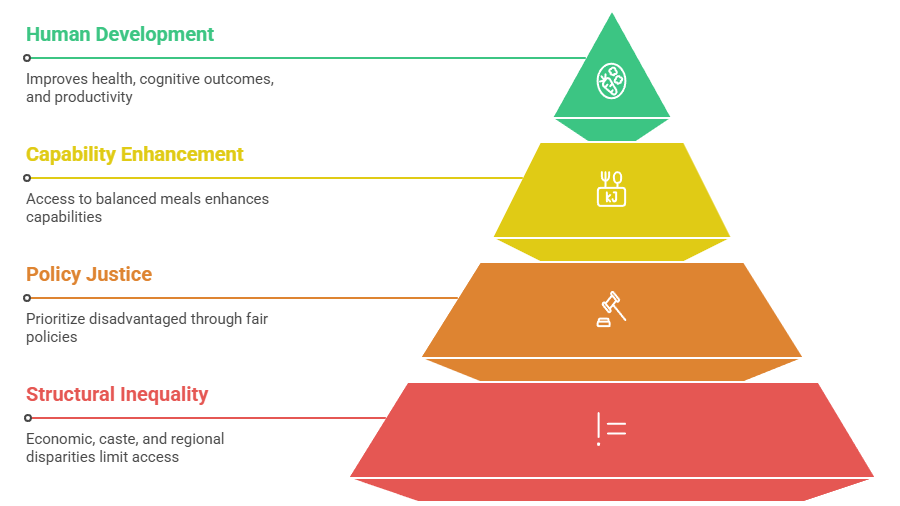
Food deprivation mirrors broader social stratification, where economic, caste, and regional disparities limit access to adequate nutrition. Pierre Bourdieu’s concept of cultural and economic capital can explain how higher-income households leverage subsidies disproportionately, perpetuating intergenerational advantage.
- Policy and Social Justice
From a Rawlsian perspective, social policies should prioritize the most disadvantaged. Restructuring the PDS to target nutritional inadequacy aligns with the principle of justice as fairness, addressing inequities that conventional poverty measures overlook.
- Capability Approach
Amartya Sen’s framework emphasizes freedom to achieve well-being, not just income. Access to balanced meals enhances capabilities, allowing individuals to participate fully in education, employment, and civic life.
- Human Development Perspective
Nutrition-sensitive interventions contribute to human development, improving health, cognitive outcomes, and labor productivity, thereby creating virtuous cycles of socio-economic empowerment.
Conclusion
India faces a hidden hunger crisis: even households above the poverty line may be nutritionally deprived. The Crisil Thali Index highlights the limitations of calorie- or income-based measures, emphasizing the need for nutrition-sensitive, equitable food distribution policies. Reforming the PDS to include pulses, region-specific dietary norms, and targeted subsidies can ensure that the most deprived have access to adequate, balanced nutrition. From a sociological standpoint, such reforms address structural inequalities, enhance human capabilities, and promote social justice, creating a more equitable and dignified food system.
Ultimately, food security is not merely an economic metric—it is a social imperative that reflects the moral and structural health of society. A well-designed PDS can transform India’s hidden hunger into a foundation for inclusive human development.
|

One comment