
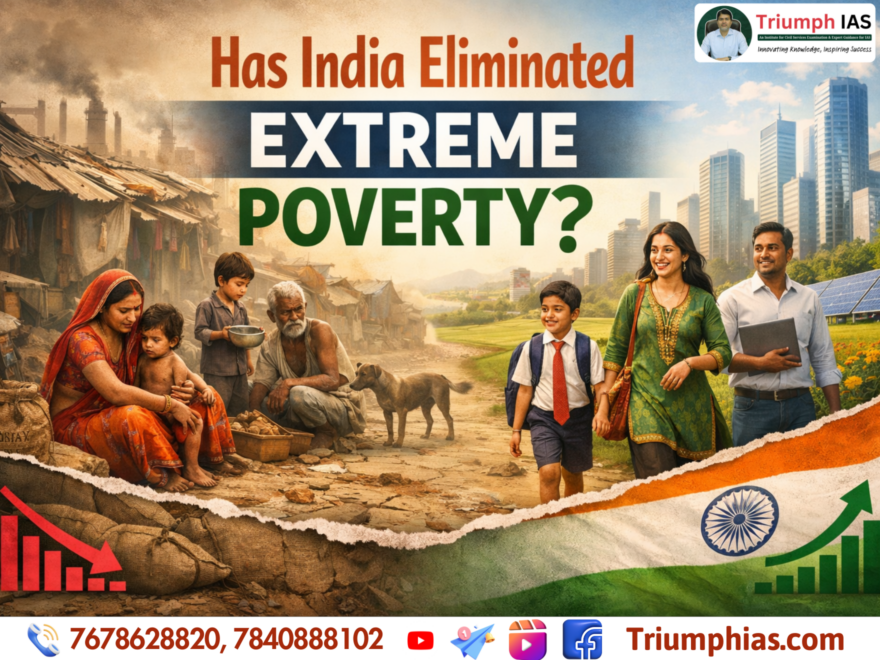
Has India Eliminated Extreme Poverty?
(Relevant for Sociology Paper 2: Rural and Agrarian transformation in India and challenges of Social Transformation)
|
A recent research paper by Arvind Panagariya, Chairman of the 16th Finance Commission, claims that India has “virtually eliminated extreme poverty” between 2011–12 and 2023–24, with poverty declining from 21.9% to about 2.3%. On the surface, this appears to be a remarkable developmental achievement. However, sociology urges us to move beyond headline numbers and ask deeper questions: Understanding Poverty: Beyond IncomeThe World Bank defines poverty as “pronounced deprivation in well-being,” while Indian institutions rely largely on consumption-based poverty lines. Sociologists, however, have long argued that poverty is multidimensional and socially embedded. Amartya Sen’s Capability Approach Amartya Sen famously critiqued income-based measures of poverty, arguing that poverty must be understood as a deprivation of capabilities—the freedom to live a healthy, educated, and dignified life. From this perspective, the reduction in extreme poverty reflects genuine progress, especially due to improvements in nutrition, sanitation, electricity, and welfare access. However, Sen would caution that low consumption poverty does not automatically translate into full social inclusion, especially when inequalities of caste, gender, region, and employment persist. Poverty Decline and Social StratificationCaste and Poverty: A Weberian View The study highlights that poverty has declined across Scheduled Castes (SCs), Scheduled Tribes (STs), OBCs, and Forward Castes, with ST poverty falling to 8.7%. From a Max Weberian perspective, caste represents a status group, where social honor and exclusion operate independently of income. While economic poverty among marginalized castes has reduced, status-based discrimination, occupational segregation, and social exclusion remain entrenched. Thus, poverty reduction does not automatically dismantle caste hierarchies. Religious Poverty and Social Perception The finding that Muslims now record slightly lower rural poverty than Hindus challenges dominant political and media narratives. Sociologically, this highlights what Pierre Bourdieu called symbolic power—the power to define social reality. Even when empirical evidence contradicts stereotypes, social perceptions of deprivation may persist due to political discourse. Rural Poverty Decline: Structural or Temporary?Rural poverty has declined faster than urban poverty, largely due to welfare expansion, rising consumption, and schemes like MGNREGA and PDS reforms. Karl Polanyi and Social Protection Karl Polanyi argued that unregulated markets inevitably produce social dislocation, necessitating state-led social protection. India’s rural poverty reduction aligns with Polanyi’s thesis: food security, employment guarantees, and cash transfers have cushioned rural households against market volatility. However, sociology warns against assuming permanence. Rural livelihoods remain highly dependent on climate, informal labor, and state support, raising concerns about poverty recurrence. Near-Zero Poverty States and Regional InequalityStates like Kerala, Himachal Pradesh, Goa, and Delhi reporting near-zero poverty reflect uneven development. Andre Gunder Frank’s dependency theory helps explain this: regions with better historical access to education, public services, and political mobilization achieve faster poverty reduction. In contrast, states like Bihar, with over 25% poverty, remain trapped in cycles of low human capital and weak institutions. Thus, poverty reduction in India is spatially uneven, reinforcing regional inequality. Multidimensional Poverty: A More Sociological MeasureIndia’s Multidimensional Poverty Index (MPI) shows a decline from 29.17% (2013–14) to 11.28% (2022–23), with 24.82 crore people escaping multidimensional poverty. Pierre Bourdieu and Multiple Deprivations Bourdieu’s framework helps explain why multidimensional poverty is sociologically richer. Poverty is not only about economic capital, but also cultural capital (education), social capital (networks), and symbolic capital (recognition). A household may escape income poverty but still lack:
Thus, poverty reduction must be evaluated in terms of social reproduction, not just income thresholds. Gender and Poverty: Feminist Sociological CritiqueDespite poverty reduction, women remain disproportionately disadvantaged. Female labor force participation remains low, unpaid care work is invisible, and wage gaps persist. Sylvia Walby’s Patriarchal Structures Feminist sociologist Sylvia Walby argues that patriarchy operates through both private and public structures, including labor markets and welfare systems. Poverty decline that does not address gendered division of labor risks reinforcing women’s economic dependence. Schemes like DAY-NRLM and SHGs improve women’s economic participation, but without redistribution of unpaid care work, gendered poverty remains hidden. Poverty, Informality, and Precarious WorkOver 80% of India’s workforce remains informal, and youth unemployment is alarmingly high, especially among graduates. Guy Standing’s “Precariat” Sociologist Guy Standing describes a new class—the precariat—characterized by insecure employment, lack of social protection, and unstable incomes. India’s poverty decline may coexist with the expansion of this precariat, suggesting that poverty is transforming, not disappearing. Climate Change and the New Poverty RisksOver 51% of Indian children face combined poverty and climate vulnerability. Disasters like Cyclone Amphan reveal how environmental shocks can push households back into poverty. Ulrich Beck’s Risk Society Beck’s theory of the risk society explains how modern risks disproportionately affect those with fewer resources. Climate change thus creates a new axis of inequality, where poverty reduction gains remain fragile. Conclusion: From Poverty Reduction to Social JusticeIndia’s success in reducing extreme poverty is real and significant. However, sociology reminds us that poverty is not merely about survival—it is about dignity, security, and life chances. The challenge ahead is not just to eliminate poverty statistically, but to prevent its reproduction through inequality, informality, gender exclusion, and climate risk. A PROSPER strategy, rooted in sociological understanding, must focus on capability expansion, social protection, and structural transformation. As Amartya Sen reminds us, development is not about how many people cross a poverty line, but how far society moves toward justice. |
To Read more topics, visit: www.triumphias.com/blogs
Read more Blogs:
The Right to Disconnect: A Sociological Lens on Work-Life Balance in India
One comment