Introduction: Tariffs for Strategic Trade Gains
India’s trade policy is undergoing a strategic shift. Amid rising global tariff pressures—such as the U.S. imposing a sudden 25% tariff on Indian goods—India is recalibrating its tariff regime to transform constraints into opportunities for domestic manufacturing and exports. Concurrently, Budget 2025 reforms have simplified tariffs, incentivized critical sectors, and aligned trade strategy with Make in India, PLI schemes, and port-led growth.
Global Tariff Pressures: Catalyst for Reform
- In July–August 2025, the U.S. imposed a 25% tariff on Indian imports, citing India’s continued purchases of Russian oil and seeking political leverage amid broader geopolitical tensions.
- India’s exports to the U.S.—valued at $129 billion in 2024—face risks across key sectors like textiles, chemicals, and ceramics, especially from Gujarat-based exporters.
- Analysts suggest this external pressure may trigger transformative reforms in India’s tariff policy, akin to the sweeping liberalization of 1991.
Budget 2025: Restructuring Tariff Landscape
- The Union Budget 2025–26 (effective April–May 2025) reduced seven additional customs duty slabs, bringing the total down to eight—including a 0% rate—simplifying administration and reducing disputes.
- Social Welfare Surcharge (SWS) has been removed on 82 tariff lines, aligning duties with cesses and improving trade Tariff exemptions were expanded for life‑saving drugs, with 36 medicines fully exempted and six more subject to just 5% BCD, significantly reducing healthcare costs.
From Input Relief to Export Push
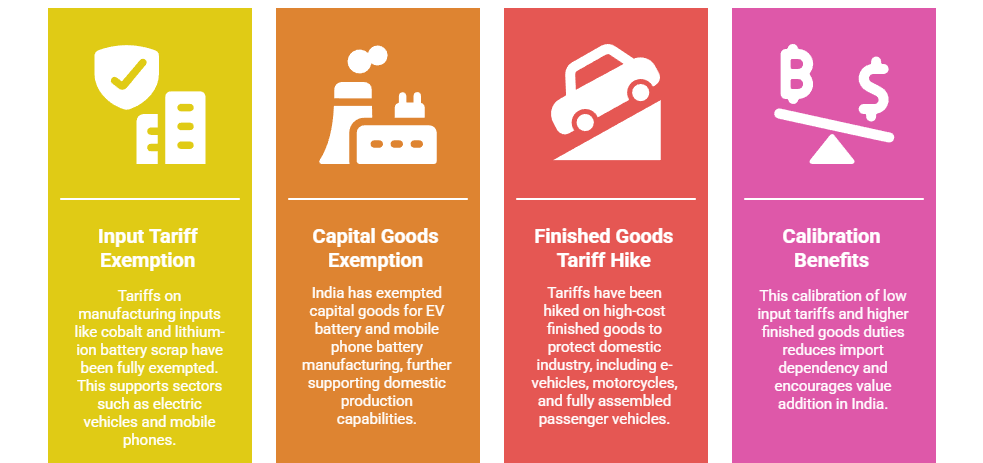
- Tariffs on critical manufacturing inputs—such as cobalt, lithium-ion battery scrap, zinc, and electronics components—have been fully exempted, supporting sectors like EVs and mobile phones.
- India has exempted capital goods for EV battery and mobile phone battery manufacturing—35 and 28 items respectively—to further underpin domestic production capabilities.
- For high-cost finished goods, tariffs have been hiked to protect domestic industry: e‑vehicles, motorcycles, and fully assembled passenger vehicles now attract duties up to 20%, 35%, and 20% respectively.
- This calibration—low input tariffs, higher finished goods duties—helps reduce import dependency while encouraging value addition on Indian soil, aligning with PLI and Make in India strategies.
Leveraging FTAs and Trade Pacts
- India’s ongoing FTAs—such as with the UK, ASEAN, and EU—offer phased tariff reductions that Indian exporters can tap into. The UK‑India FTA signed in July 2025 aims to eliminate tariffs on 99% of Indian exports over time.
- Within South Asia, existing frameworks like SAFTA encourage tariff harmonization, although India remains cautious about widening trade deficits with neighbours like Bangladesh or Sri Lanka.
- External pressure, such as U.S. import tariffs, underscores the importance of negotiating comprehensive trade agreements to ensure market access without punitive trade barriers.
Sectoral Impact: Electronics, EVs & Textiles
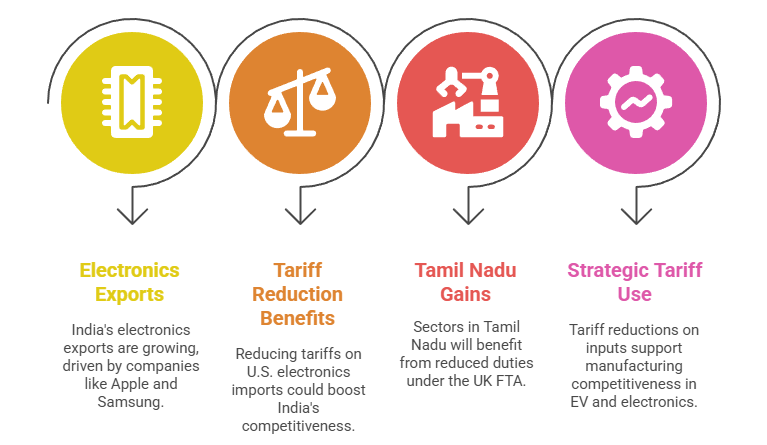
- India’s electronics exports reached ₹20.4 billion (~USD 2.5 billion) in FY 2024, led by firms like Apple (~65%) and Samsung (~20%) under PLI and diversification efforts.
- §Analysts argue that reducing tariffs on U.S. electronics imports to zero would help affordability on components—thus boosting India’s competitiveness and supporting a target of $300 billion in electronics exports by 2030
- In Tamil Nadu, sectors such as auto components, textiles, leather, and footwear stand to gain significantly under the UK FTA, where duties have dropped from over 100% to single digits (~10%).
- Strategic use of tariff reductions on inputs (e.g., battery cells, semiconductor inputs) supports the broader objective of manufacturing competitiveness and global scale‐ups in EV and electronics sectors.
Turning Tariff Challenges into Strategic Opportunities
- Simplified customs slabs and streamlined procedures—such as voluntary disclosures, extended provisional assessment timelines, and single‑window filings—reduce trade friction and compliance costs.
- Facilitated clearance, port modernization (Sagarmala), and customs digitization reinforce India’s ambition to become a port‑led manufacturing hub and reduce trade logistics costs.
- India’s approach—raising tariffs on finished goods while exempting inputs—aligns with global best practice fallback policies to shift trade terms while preserving export direction.
- Uniform enforcement of anti-dumping and countervailing duty measures—such as on steel and solar panels—protects domestic players while keeping trade policy responsive to unfair pricing pressures.
Challenges & Moving Forward
- Despite reform momentum, uneven tariff hikes could backfire if not accompanied by adequate capacity building. For instance, domestic players in sectors like textiles and auto components must upgrade to handle higher duties on finished imports.
- India must guard against retaliation and trade diversion effects under U.S. or other punitive tariffs—balancing strategic autonomy with global trade diplomacy.
- Non-tariff barriers (NTBs) remain significant—compliance delays, technical standards, rules of origin—requiring reforms beyond just adjusting duties
Significance for UPSC Aspirants
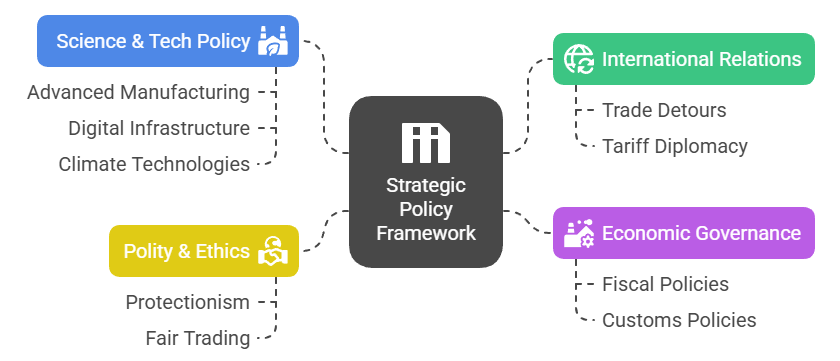
This case study is rich in relevance for mains and interview preparation:
- International Relations: Illustrates strategic trade detours, tariff diplomacy, and power asymmetries.
- Economic Governance: Demonstrates how aligned fiscal, customs, and industrial policies can mitigate global shocks.
- Polity & Ethics: Highlights balance between protectionism and fair trading principles within WTO constraints.
- Science & Tech Policy: Shows how tariff strategy supports push towards advanced manufacturing, digital infrastructure, and climate technologies.
Conclusion
India’s evolving tariff policy—spurred by global pressures and guided by Budget 2025 reforms—offers a template for how developing economies can turn ‘tariff walls’ into springboards for industrial growth and export competitiveness. By aligning low-cost input access with protective measures on finished goods, enhancing FTAs, and modernizing customs processes, India is strategically positioning itself as a resilient trade hub. The journey ahead requires vigilance: ensuring reforms remain inclusive, competitive, and responsive to global uncertainties while delivering on Make in India’s promise. |