|
On 4th September 2025, the 56th GST Council unveiled GST 2.0, a landmark reform of India’s indirect tax system. The overhaul replaces the earlier four-slab system (5%, 12%, 18%, 28%) with a simpler two-slab structure—a 5% merit rate for essential goods and an 18% standard rate for others—while retaining a 40% demerit tax on luxury and harmful items like tobacco and pan masala.
Key highlights include:
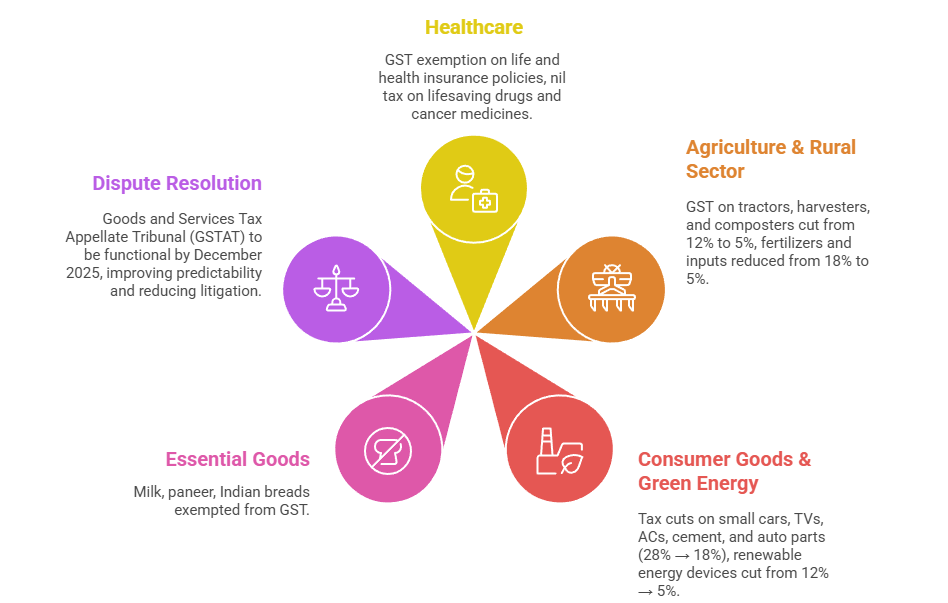
- Healthcare: Full GST exemption on life and health insurance policies; nil tax on 33 lifesaving drugs and on critical cancer medicines.
- Agriculture & Rural Sector: GST on tractors, harvesters, and composters cut from 12% to 5%; fertilizers and inputs reduced from 18% to 5%.
- Consumer Goods & Green Energy: Tax cuts on small cars, TVs, ACs, cement, and auto parts (28% → 18%); renewable energy devices cut from 12% → 5%.
- Essential Goods: Milk, paneer, Indian breads exempted from GST.
- Dispute Resolution: Goods and Services Tax Appellate Tribunal (GSTAT) to be functional by December 2025, improving predictability and reducing litigation.
The government projects these reforms will make GST citizen-centric, boost agriculture and health, encourage green energy adoption, strengthen MSMEs, and improve ease of doing business.
Why Sociologists Should Care
Though GST is an economic measure, it shapes society at multiple levels—class relations, rural–urban dynamics, consumption patterns, federalism, and even national identity. As C. Wright Mills’ sociological imagination teaches us, we must see how personal troubles (affordability of healthcare, cost of food, jobs) connect to public issues (tax policy, state power, globalization).
State, Economy, and Legitimacy
- Weberian rationalization: GST 2.0 represents rational-legal authority in practice. By eliminating multiple state-level taxes, it creates a predictable, rule-based system. Bureaucracy is modernized through digital compliance, enhancing legitimacy.
- Durkheim’s solidarity: A uniform tax fosters organic solidarity by binding diverse groups into a shared fiscal system. Tax contributions link urban consumers, rural producers, and the state.
- Indian federalism: The GST Council exemplifies cooperative federalism—a negotiation space between Centre and states. Sociologically, it mirrors India’s plural society, where governance must balance diversity.
GST and Class Inequality
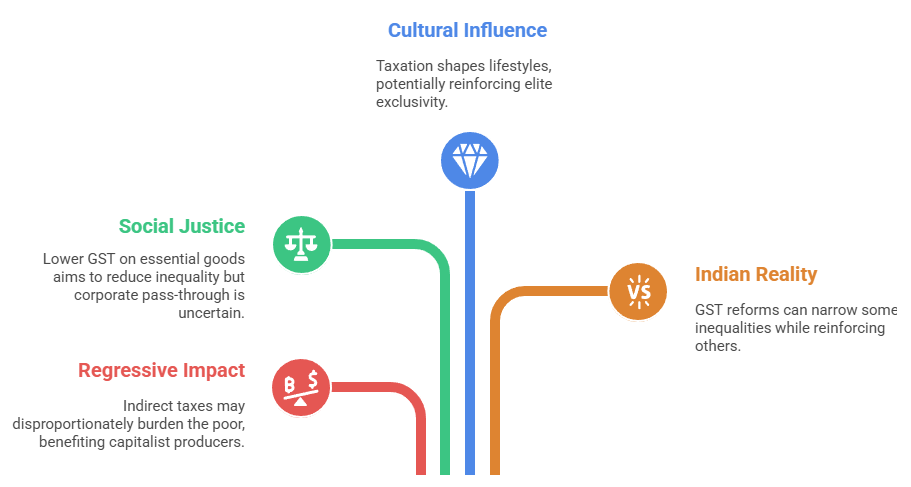
- Marxian critique: Indirect taxes can be regressive, disproportionately burdening the poor. GST benefits may largely accrue to capitalist producers who gain from cheaper inputs.
- Redistribution: Lower GST on food, drugs, and rural goods reflects an attempt at social justice. Yet, whether corporates pass on benefits to consumers remains uncertain.
- Bourdieu’s cultural capital: Taxation subtly directs lifestyles—making ACs and TVs cheaper expands middle-class aspirations, while demerit taxes on luxury goods reinforce elite exclusivity.
- Indian reality: With stark wealth gaps, GST reforms can narrow some inequalities (in healthcare, food) while reinforcing others (through indirect burden).
Labour, Occupations, and Informal Economy
- Support to artisans and MSMEs: Reduced taxes on handicrafts, leather, and marble support communities historically tied to caste-based occupations. This ties into the sociology of caste economy in India.
- Breman’s “footloose labour”: Informal workers dominate small-scale sectors. Relief in taxation provides partial protection, but precariousness remains.
- Gender dimension: Many women are employed in handicrafts and cottage industries. Lower taxes indirectly strengthen women’s economic participation.
- Polanyi’s “embedded economy”: The economy is embedded in society—farm input subsidies or tax cuts are not purely economic but safeguard agrarian social structures.
Agriculture, Rural Society, and Development
- Cheaper farm inputs: GST cuts on tractors, fertilizers, and harvesters reduce rural costs. For marginal farmers, this can mean survival.
- Dhanagare on agrarian movements: Historically, rural discontent over inputs has driven protest. Policy relief may reduce agrarian unrest.
- Green Revolution parallel: Just as subsidies transformed village stratification, GST reforms may empower large farmers more than small ones—thus, new class hierarchies may emerge.
- Caste dynamics: Traditional caste-linked occupations (weavers, leather workers, potters) benefit from lower GST, linking fiscal policy to caste mobility.
Healthcare and Social Well-being
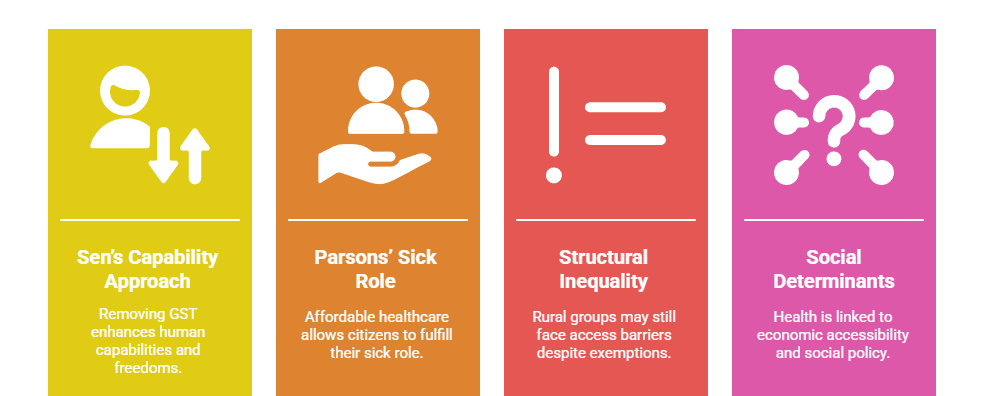
- Sen’s capability approach: Removing GST from lifesaving drugs enhances human capabilities, directly expanding freedoms.
- Parsons’ “sick role”: Affordable healthcare enables citizens to fulfill their sick role without plunging into poverty, preserving social stability.
- Structural inequality: Despite exemptions, rural and marginalized groups may still face access barriers due to infrastructure, showing fiscal policy’s limits.
- Social determinants: GST exemptions highlight that health is not just medical—it is linked to economic accessibility and social policy.
Technology, Compliance, and Citizenship
- Foucault’s governmentality: Digital filing and GSTN create a regime of surveillance, where citizens and businesses are disciplined into compliance.
- Bauman’s liquid modernity: Governance becomes fast, digital, and borderless, but precarious for those left behind.
- Digital divide: For MSMEs in rural India, lack of digital literacy risks exclusion. This reflects stratification by technology in Indian society.
- Threshold exemptions: Protecting small businesses reveals state acknowledgment of India’s hybrid economy—formal and informal coexisting.
Cultural and Symbolic Dimensions
- Consumption as identity: Tax cuts on consumer goods reshape what it means to be “middle-class.” Cheaper ACs and TVs symbolize aspirational India.
- Green taxation: Lower GST on renewable energy frames sustainability as a moral and cultural norm.
- Anderson’s imagined community: “One Nation, One Tax” creates a sense of fiscal nationalism, contributing to identity-building.
- Ritual economy: By altering costs of items like sweets, idols, or decorative goods, taxation indirectly shapes festival practices and religious life.
GST and Federal Society
- Functional conflict (Coser): Disagreements between states and Centre in GST Council are not destructive but necessary for balance. Conflict institutionalized in GSTAT enhances legitimacy.
- Béteille’s institutional mediation: The Council mediates inequalities between richer and poorer states, urban vs. rural priorities.
- Plural society: Different regional consumption cultures (South’s rice, North’s wheat, East’s fish) are affected differently, showing how fiscal policy interacts with cultural diversity.
Globalization and Comparative Dimension
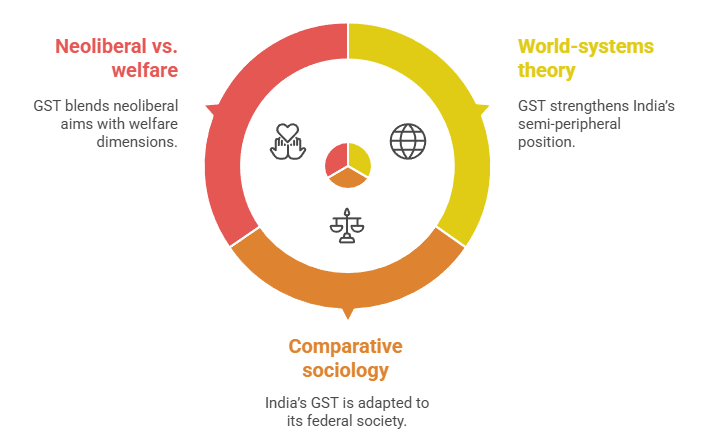
- World-systems theory (Wallerstein): By making exports competitive, GST strengthens India’s semi-peripheral position in the global economy.
- Comparative sociology: India’s GST is inspired by VAT models worldwide but uniquely adapted to its federal and caste-ridden society.
- Neoliberal vs. welfare state tension: GST 2.0 blends neoliberal aims (simplification, investment) with welfare dimensions (healthcare, agriculture relief).
Challenges and Contradictions
- Regressive nature: Indirect taxes remain regressive—poorer groups may still bear proportionately higher burdens.
- Digital exclusion: The benefits of digital compliance are limited by the rural–urban divide.
- Informal sector stress: Large sections of economy remain outside GST, risking a dual economy.
- A.R. Desai’s caution: Indian state often serves capitalist classes under populist rhetoric—sociologists must critically examine who gains most.
Conclusion
GST 2.0 is far more than a tax reform. It is a social project. It rationalizes governance (Weber), mediates class conflict (Marx), expands health capabilities (Sen), embeds economy in society (Polanyi), and disciplines citizens through compliance (Foucault).
Its impact touches every dimension:
- Class (redistribution vs. corporate gains),
- Caste (traditional occupations benefiting),
- Gender (women workers in handicrafts),
- Rural–urban divide (farm vs. industrial support),
- Culture (consumption, festivals, sustainability), and
- Federalism (centre–state negotiations).
In essence, taxation is a social mirror. Through GST 2.0, India redefines not only its economy but also its society—reshaping aspirations, inequalities, and the very meaning of citizenship.
|

2 comments