
Good Governance and the Sociology of Power: Rethinking the State, Citizens, and Trust in India
(Relevant for Sociology Paper 2: Politics and Society)
|
Good Governance Day, observed on 25 December, commemorates the birth anniversary of Atal Bihari Vajpayee and celebrates ideals of transparency, accountability, and inclusive governance. Yet, beyond official commemorations and policy frameworks, good governance raises deeper sociological questions: Who exercises power? How is it legitimised? Who participates? And who is excluded? From a sociological perspective, governance is not merely about efficient administration—it is about the relationship between the state and society, shaped by power, trust, institutions, and participation. Governance as Social Relationship, Not Just AdministrationThe UNESCAP definition of governance emphasises decision-making and implementation. Sociology goes further by asking whose decisions, whose interests, and whose voices dominate. Governance involves multiple actors—bureaucracy, judiciary, civil society, markets, and media—but power is unevenly distributed among them. Thus, good governance is not automatic; it must be socially produced and constantly negotiated. Atal Bihari Vajpayee’s vision of governance combined administrative efficiency with democratic sensitivity, recognising that legitimacy flows not only from authority but also from consent. Weber and the Bureaucratic State: Efficiency vs Alienation
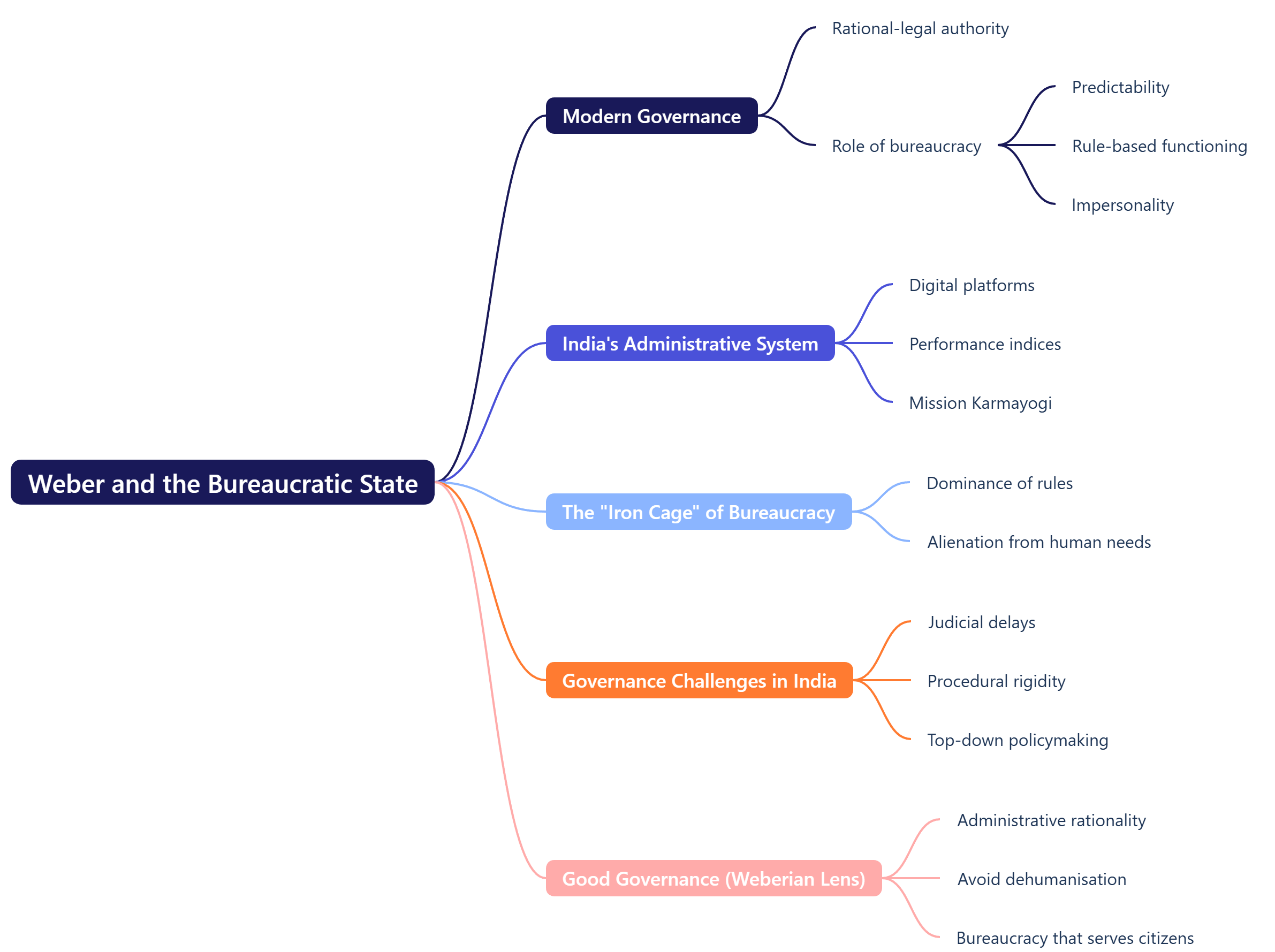
Max Weber described modern governance as based on rational-legal authority, where bureaucracy ensures predictability, rule-based functioning, and impersonality. India’s administrative system—digital platforms, performance indices, Mission Karmayogi—fits squarely into this model. However, Weber also warned of the “iron cage” of bureaucracy, where rules dominate over human needs. Many governance challenges in India—judicial delays, procedural rigidity, top-down policymaking—reflect this tension. Good governance, from a Weberian lens, requires administrative rationality without dehumanisation—a bureaucracy that serves citizens rather than overwhelms them. Durkheim: Governance, Morality, and Social SolidarityÉmile Durkheim viewed institutions as moral structures that sustain social solidarity. Laws, policies, and governance systems express collective values about fairness, justice, and responsibility. When governance fails—through corruption, weak accountability, or delayed justice—it creates anomie, a breakdown between norms and lived reality. Citizens lose faith not only in institutions but also in shared moral expectations. Good governance, therefore, is not only about outcomes but about moral legitimacy. Transparent decision-making, ethical leadership, and responsive administration reinforce trust and social cohesion. Power, Inequality, and the Marxian CritiqueKarl Marx reminds us that the state is not neutral; it operates within existing class structures. In India, despite welfare schemes and inclusive rhetoric, economic inequality and insecurity persist. Unemployment, informal labour, and unequal access to public services weaken citizen participation. For marginalised groups, governance often appears distant, coercive, or inaccessible. From a Marxian perspective, good governance cannot exist without addressing structural inequality. Welfare delivery without empowerment risks becoming paternalistic rather than transformative. Foucault: Governance, Surveillance, and Digital Power
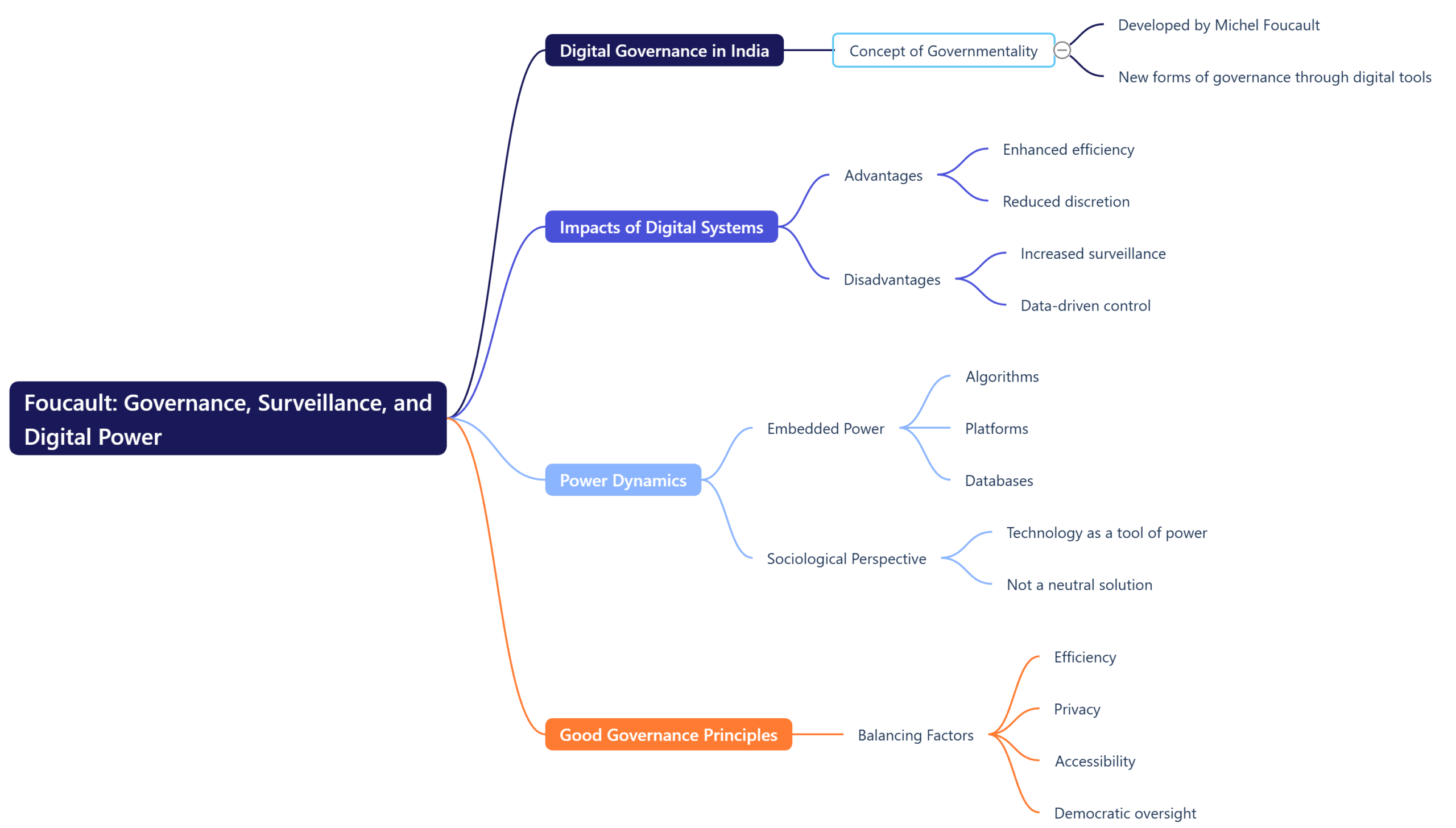
India’s push towards digital governance—DBT, Aadhaar-linked services, e-Courts, grievance portals—represents a new form of governmentality, a concept developed by Michel Foucault. Digital systems enhance efficiency and reduce discretion, but they also increase surveillance and data-driven control. Power becomes embedded in algorithms, platforms, and databases. While digital governance can empower citizens, it may also exclude those without digital literacy or access. Thus, sociologically, technology must be seen as a tool of power, not a neutral solution. Good governance requires balancing efficiency with privacy, accessibility, and democratic oversight. Habermas: Participation, Dialogue, and Democratic LegitimacyJürgen Habermas argued that democratic legitimacy flows from public reasoning and participation. Policies gain acceptance when citizens feel heard, not merely governed. India’s governance discourse increasingly recognises this through concepts like Jan Bhagidari (people’s participation) and platforms like MyGov. However, participation often remains consultative rather than deliberative. Top-down policymaking, limited decentralisation, and weak local institutions restrict meaningful dialogue. Habermas would argue that good governance demands institutionalised participation, not symbolic consultation. Decentralisation and Grassroots DemocracySociologically, decentralisation is not merely administrative—it redistributes power. Empowering Panchayats and Urban Local Bodies brings governance closer to lived realities. However, resistance to decentralisation reflects deeper anxieties about losing control. Without adequate funds, functions, and functionaries, local governments remain dependent and weak. True good governance requires democratic deepening, where citizens shape development priorities rather than merely receive benefits. Amartya Sen and Governance as Capability ExpansionAmartya Sen’s capability approach offers a powerful sociological lens. Governance should expand people’s real freedoms—the ability to live healthy, educated, and dignified lives. Schemes like PMAY, NRLM, DBT, and skill development programmes matter not just as outputs, but as means of enhancing agency. Good governance succeeds when citizens are not passive beneficiaries but active agents of change. Corruption, Trust, and Institutional CrisisCorruption, criminalisation of politics, and weak accountability erode trust—the invisible foundation of governance. Sociologically, trust is a form of social capital; once lost, institutions struggle to function effectively. The rise of populism and freebie politics further complicates governance by prioritising short-term electoral gains over long-term structural reform. Ethical governance, transparency, and strong oversight institutions are essential not just for efficiency, but for restoring moral authority. Vajpayee’s Legacy: Governance with HumanityAtal Bihari Vajpayee’s governance philosophy balanced firm leadership with democratic grace. His emphasis on connectivity, consensus, and institutional integrity reflected an understanding that development is as much social as it is economic. He recognised that governance must combine strength with sensitivity, authority with dialogue. Conclusion: Good Governance as a Sociological ProjectGood governance is not a checklist—it is a social process shaped by power relations, institutional capacity, ethical norms, and citizen participation. From Weber’s bureaucracy to Habermas’s public sphere, sociology teaches us that governance succeeds when institutions are efficient and legitimate, strong and responsive. Ultimately, good governance is not about ruling better—it is about governing together. |
To Read more topics, visit: www.triumphias.com/blogs
Read more Blogs:
From Right to Work to Managed Employment: A Sociological Reading of the VB-G RAM G Bill, 2025