

Global Knowledge, Local Futures: A Sociological Lens on India’s Opening to Foreign Universities
(Relevant for Sociology Paper 2: Visions of Social Change in India)
| In a landmark move, the University Grants Commission (UGC) has approved 17 foreign universities, mainly from the UK and Australia, to set up campuses in India under the UGC (Setting up and Operation of Campuses of Foreign Higher Educational Institutions in India) Regulations, 2023. This decision aligns with the National Education Policy (NEP) 2020, which envisions India as a global education hub rooted in access, equity, quality, affordability, and accountability.
At one level, this policy initiative appears administrative—an outcome of educational planning. But from a sociological perspective, it represents something far deeper: a moment of structural transformation in India’s relationship with global knowledge, social class, and postcolonial identity. Education is not just an economic investment; it is a site of power, culture, and mobility. Understanding this shift requires both data and theory, both policy and philosophy. Globalization and Reflexive Modernity: Giddens’ Perspective
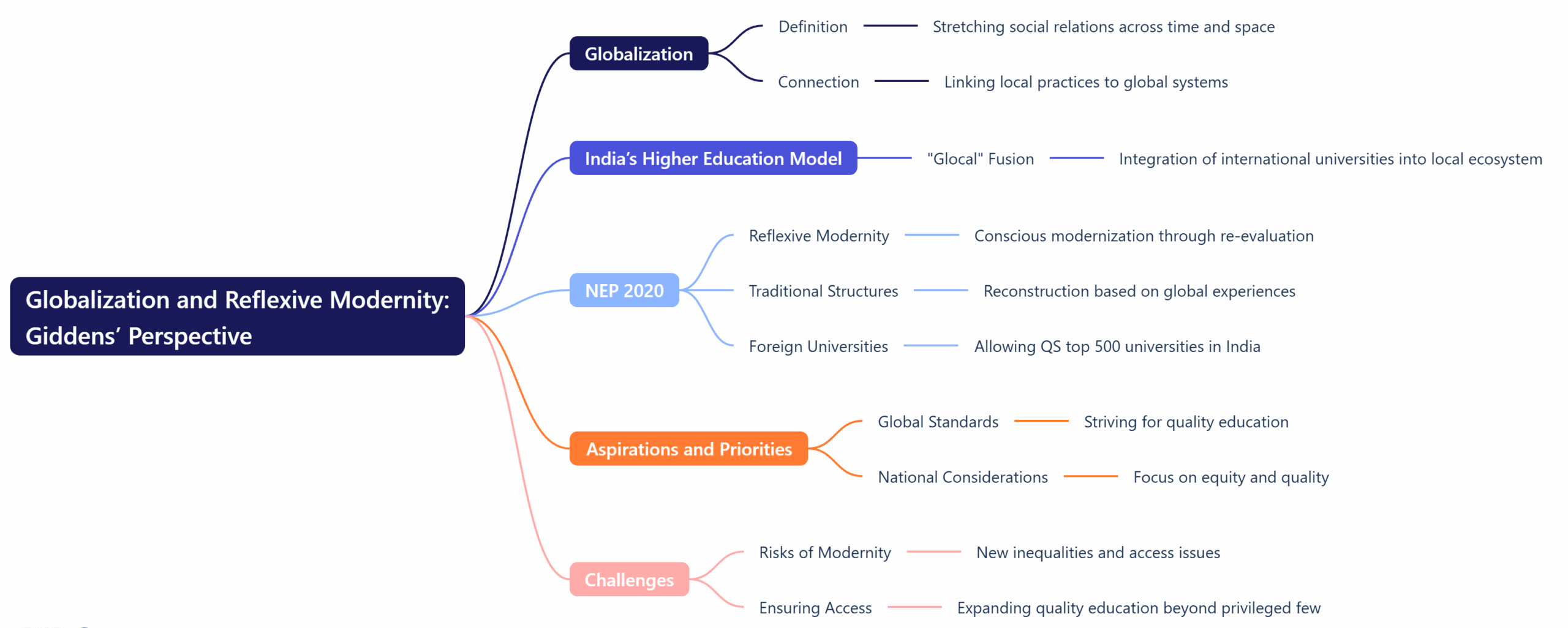
Sociologist Anthony Giddens conceptualized globalization as a process that stretches social relations across time and space, connecting local practices to global systems. India’s new higher education model embodies this “glocal” fusion—where international universities integrate into India’s local academic and cultural ecosystem. Through NEP 2020, India is engaging in what Giddens called reflexive modernity: a conscious attempt to modernize by re-evaluating and reconstructing traditional structures in light of global experience. Allowing top 500 QS-ranked foreign universities to establish Indian campuses reflects this reflexivity—an aspiration to global standards while maintaining national priorities of equity and quality. However, Giddens also warned that modernity brings new risks and inequalities. The challenge will be ensuring that these campuses don’t merely serve the privileged few but expand meaningful access to quality education across class and region. Sociology of Capital and Inequality: Bourdieu’s InsightsPierre Bourdieu helps decode how education reinforces social hierarchies. His concept of cultural capital—the linguistic, behavioral, and cultural competencies that signal social status—is especially relevant. Foreign universities symbolize not just quality education but symbolic power—they represent a form of distinction. Students who can afford such education, or possess the cultural capital to thrive in English-medium, globally-oriented spaces, will likely benefit the most. Thus, instead of democratizing higher education, foreign campuses could deepen the stratification between the globalized elite and the masses. In Bourdieu’s framework, these institutions might reproduce existing hierarchies under a new guise: the “global graduate.” This class of students, armed with transnational degrees, embodies what he called symbolic capital—prestige that converts into career mobility and social privilege. The sociological question becomes: will these campuses challenge or reproduce India’s educational inequalities? If unregulated, the global promise may remain confined to the urban, English-speaking elite. World-Systems and Educational Dependency: Wallerstein’s FrameworkImmanuel Wallerstein’s World-Systems Theory offers a geopolitical angle. In the global knowledge economy, education functions within a core-periphery dynamic. Core countries—such as the UK and Australia—export academic models, while semi-peripheral or peripheral nations often consume them. From this view, India’s openness to foreign campuses might be read as a strategy to reposition itself closer to the global “core.” Yet, Wallerstein would caution against assuming this leads to autonomy. If foreign universities primarily serve as satellite campuses that funnel resources, talent, and legitimacy back to their parent institutions, India risks entering a new form of academic dependency. This dynamic recalls colonial education systems that privileged Western epistemologies while sidelining indigenous knowledge. The challenge for policymakers is to ensure that internationalisation does not perpetuate epistemic dependency but promotes knowledge co-creation—where Indian research, languages, and perspectives contribute to the global intellectual commons. Risk Society and Cosmopolitan Education: Beck’s View
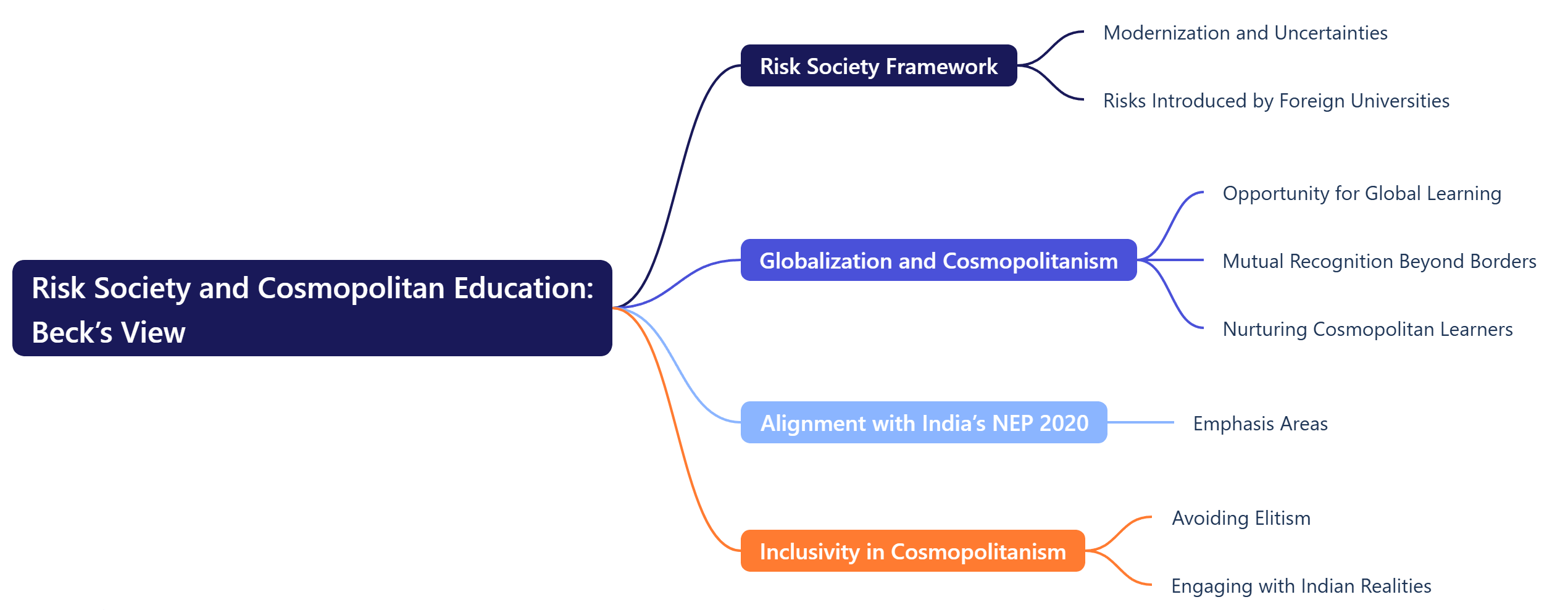
Ulrich Beck’s “risk society” framework highlights that modernization generates new uncertainties even as it promises progress. The arrival of foreign universities in India introduces such risks—regulatory ambiguity, financial sustainability, and cultural compatibility. However, Beck also saw globalization as an opportunity for cosmopolitanism—a form of global learning and mutual recognition beyond national boundaries. Foreign universities could nurture a generation of cosmopolitan learners, comfortable navigating global challenges like climate change, digital transformation, and multiculturalism. This vision aligns with India’s NEP 2020 emphasis on critical thinking, interdisciplinary learning, and global citizenship. Yet, cosmopolitanism must be inclusive, not elitist. To achieve that, curricula must engage with Indian realities—rural development, inequality, and local innovation—rather than merely replicate Western frameworks. Postcolonial Reflections: Knowledge, Power, and IdentityPostcolonial theorists like Edward Said and Homi Bhabha remind us that knowledge and power are intertwined. The expansion of Western universities into the Global South can reproduce what Said called “epistemic imperialism”—where Western norms define what counts as valid knowledge. India’s postcolonial context makes this tension especially salient. While foreign campuses promise quality education, they must also respect and integrate Indian epistemologies—from Gandhian educational philosophy to indigenous environmental thought. If internationalization merely means the import of Western syllabi, it risks erasing local intellectual traditions. However, postcolonial hybridity also creates opportunity. As Bhabha might argue, these campuses can become “third spaces”—sites where global and local cultures interact, negotiate, and produce new hybrid forms of knowledge. A truly global Indian university would be one where a British or Australian faculty member co-teaches a course on sustainable technology alongside an Indian scholar drawing from local innovation models. Structural Drivers: Beyond Sociology of TheorySeveral structural factors explain why this internationalization is occurring now:
From a sociological lens, these drivers illustrate how global capitalism and local aspirations intersect to produce educational reform. Education, here, is not just about learning—it’s about market positioning, mobility, and identity formation. Challenges and Sociological Pathways ForwardDespite its promise, this transformation faces structural and cultural challenges:
Sociologically, the way forward lies in dialogic globalization—a model of partnership that values reciprocity over dominance. This means encouraging joint degrees, credit transfers, and collaborative research that reflect both global standards and local relevance. Conclusion: Toward a Sociology of Global KnowledgeIndia’s decision to host foreign universities is more than an educational reform—it is a sociological experiment in globalization, modernity, and postcolonial negotiation. It encapsulates Giddens’ reflexive modernity, Bourdieu’s reproduction of capital, Wallerstein’s global hierarchies, and Beck’s cosmopolitan risk. If executed inclusively, it could make India a co-creator of global knowledge rather than a passive consumer. But success will depend on whether India can balance foreign autonomy with national priorities—ensuring that education remains not just a commodity but a social contract that builds both individual futures and collective capacity. As India globalizes its classrooms, the true test will be whether this transformation leads to a democratization of knowledge—or merely the globalization of privilege. |
To Read more topics, visit: www.triumphias.com/blogs
Read more Blogs:
The Urban Paradox: India’s Cities, Power, and the Crisis of Local Governance
Justice Delayed, Justice Denied: A Sociological Lens on India’s Execution Petition Crisis