Introduction
The World Economic Forum’s Global Gender Gap Report 2025 has set alarm bells ringing globally and in India. While the global gender gap has narrowed to 68.8%, at the current pace, full parity will not be achieved for another 123 years. India’s ranking has slipped further, highlighting persistent challenges despite some progress. The report is crucial for understanding the status of women in society—a core concern for Sociology and for all stakeholders in gender equality.
Highlights from the Global Gender Gap Report 2025
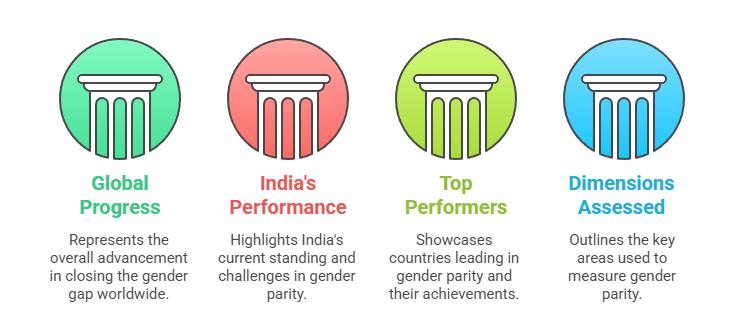
Global Progress:
- 8% of the global gender gap is closed.
- Full gender parity is still 123 years away.
India’s Performance:
- Ranked 131 out of 148 countries (slipped two places).
- Parity score: 1% – among the lowest in South Asia.
- Bangladesh leads South Asia; India lags behind.
Top Performers:
- Iceland tops for the 16th year (92.6% parity).
- Other leaders: Finland, Norway, UK, New Zealand.
Dimensions Assessed:
- Economic participation and opportunity
- Educational attainment
- Health and survival
- Political empowerment
Key Trends
- Women outpace men in educational attainment but remain underrepresented in senior leadership (only 28.8% of roles).
- Political empowerment remains the biggest gap—full parity in this area is 162 years away.
- Economic participation parity is 135 years away at current rates.
- Women face more frequent and longer career breaks due to caregiving.
Sociological Analysis
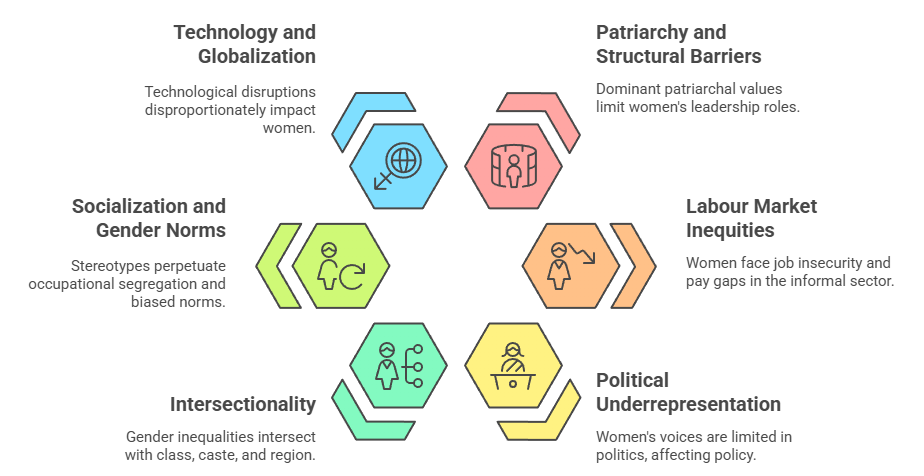
- Patriarchy and Structural Barriers: Patriarchal values still dominate, both in the family and workplace. Despite progress in education, the “glass ceiling” limits women’s entry into decision-making and leadership roles (refer to Ann Oakley, Sylvia Walby).
- Labour Market and the Reserve Army of Labour: Women constitute a large part of the informal sector and face job insecurity, pay gaps, and precarious employment (Guy Standing’s “precariat”). Care work and the care economy remain undervalued.
- Political Underrepresentation: Despite quotas in some countries, women’s voices in politics are limited. Only 22.9% of the global political gender gap is closed. This sustains policy gaps in women’s welfare, representation, and rights.
- Intersectionality: Gender inequalities intersect with class, caste, and region. In India, Dalit, Adivasi, and Muslim women face triple discrimination, further lowering their chances for empowerment (Kimberlé Crenshaw’s intersectionality)
- Socialization and Gender Norms: Gender socialization perpetuates stereotypes about “women’s work” and “men’s work.” Even as education levels rise, occupational segregation and biased social norms restrict women’s opportunities.
- Impact of Technology and Globalization: Technological disruptions, digital divides, and economic shocks (like COVID-19) disproportionately impact women, especially in fragile economies and the global South.
India’s Gender Gap
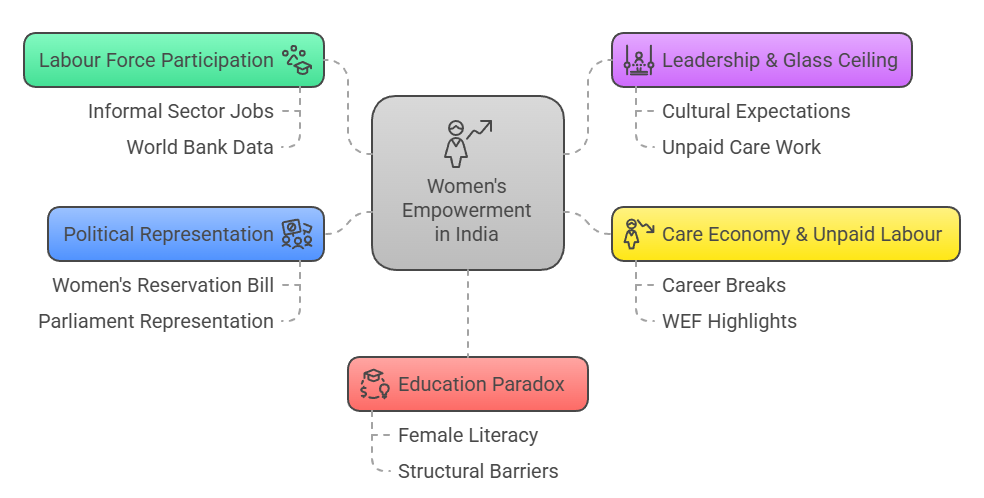
- Labour Force Participation: Despite a rise in women joining the workforce, India’s female labour force participation remains among the lowest globally (World Bank data: ~25%). Informal sector jobs dominate, lacking security and benefits.
- Leadership & Glass Ceiling: Only a small fraction of Indian women occupy senior leadership roles. Cultural expectations and unpaid care work keep most women out of boardrooms and politics.
- Care Economy and Unpaid Labour: Women are 55.2% more likely than men to take career breaks, mainly due to caregiving—a phenomenon the WEF highlights as a key reason for stalled advancement.
- Political Representation: Political empowerment is the biggest gap in India. The Women’s Reservation Bill remains stuck, and representation in Parliament and state assemblies is low.
- Education Paradox: While educational attainment has improved (female literacy rising), this has not translated into commensurate workforce or leadership gains due to structural, cultural, and institutional barriers.
Way Forward
- Legal reforms must be accompanied by attitudinal change.
- Intersectional policies are needed to uplift the most marginalized women.
- Active state, corporate, and community engagement can accelerate progress.
As the WEF rightly notes, “Economies that advance gender parity are poised for more resilient and innovative growth.”
For India and the world, the journey towards gender equality must not just continue—it must speed up.
Conclusion
Despite some global and regional improvements, gender parity remains a distant dream. For India, urgent measures are needed to bridge gaps in economic participation, leadership, and political empowerment. Addressing deep-rooted patriarchy, valuing the care economy, breaking the glass ceiling, and leveraging education for actual empowerment are crucial steps.
PYQs
Paper 1
- How do social movements contribute to the transformation of gender relations in society? Illustrate with suitable examples. (2023)
- Discuss the concept of patriarchy. How does it manifest in contemporary society? (2022)
- Examine how the process of socialisation perpetuates gender inequality in society. (2021)
- Discuss the role of education in addressing gender inequality in society. (2019)
- Critically examine the concept of ‘glass ceiling’ in the context of gender and work. (2018)
- How does work and economic life reinforce social stratification based on gender? (2017)
- Describe the factors responsible for gender-based division of labour in society. (2016)
- Analyse the impact of globalization on gender relations in developing societies. (2015)
- What is sexual division of labour? How does it shape gender roles in society? (2014)
Paper 2
- Discuss the changing status of women in India in the context of social legislation and education. (2023)
- Evaluate the role of the women’s movement in India in addressing gender inequality. (2022)
- Discuss the factors responsible for low female labour force participation in India. (2021)
- Examine the impact of the reservation of seats for women in local bodies on gender parity in political participation. (2020)
- Analyse the reasons for the persistence of gender gap in literacy in India. (2019)
- Discuss the major challenges faced by women in the unorganised sector in India. (2018)
- Discuss the impact of economic reforms on the status of women in India. (2015)
- Evaluate the effectiveness of government policies in reducing gender inequality in India. (2014)
|

One comment