Introduction
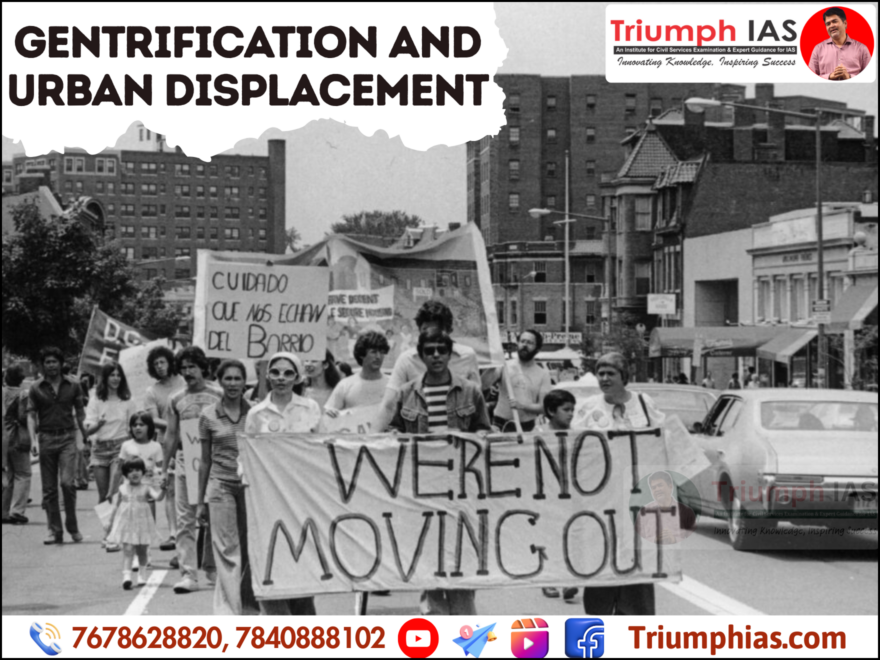
The skyline of Indian cities is rapidly transforming. From metro networks to gated communities, Indian urban spaces are witnessing a visible transition. But beneath this modern makeover lies a pressing issue—gentrification and urban displacement. While cities become “world-class,” the urban poor are often pushed to the margins, both spatially and economically. With over 35% of India’s population now urban (Census 2011; expected to cross 40% by 2036), understanding how cities grow is vital—especially for Sociology aspirants exploring themes under urbanization, inequality, and marginalization. This phenomenon holds immense significance in urban sociology and is increasingly relevant for aspirants seeking to understand contemporary socio-economic challenges in India.
What is Gentrification?
Gentrification refers to the process where deteriorated urban neighborhoods are renovated and upgraded, usually attracting affluent residents while displacing lower-income groups. This term, introduced by sociologist Ruth Glass in the 1960s, has become a global urban trend—including in Indian metros like Delhi, Mumbai, Bengaluru, and Kolkata.
In Indian cities, gentrification takes the form of:

- Redevelopment of slums
- Construction of high-rise apartments
- Privatization of public spaces
- Eviction of street vendors and informal workers
Examples of Urban Displacement in Indian Cities
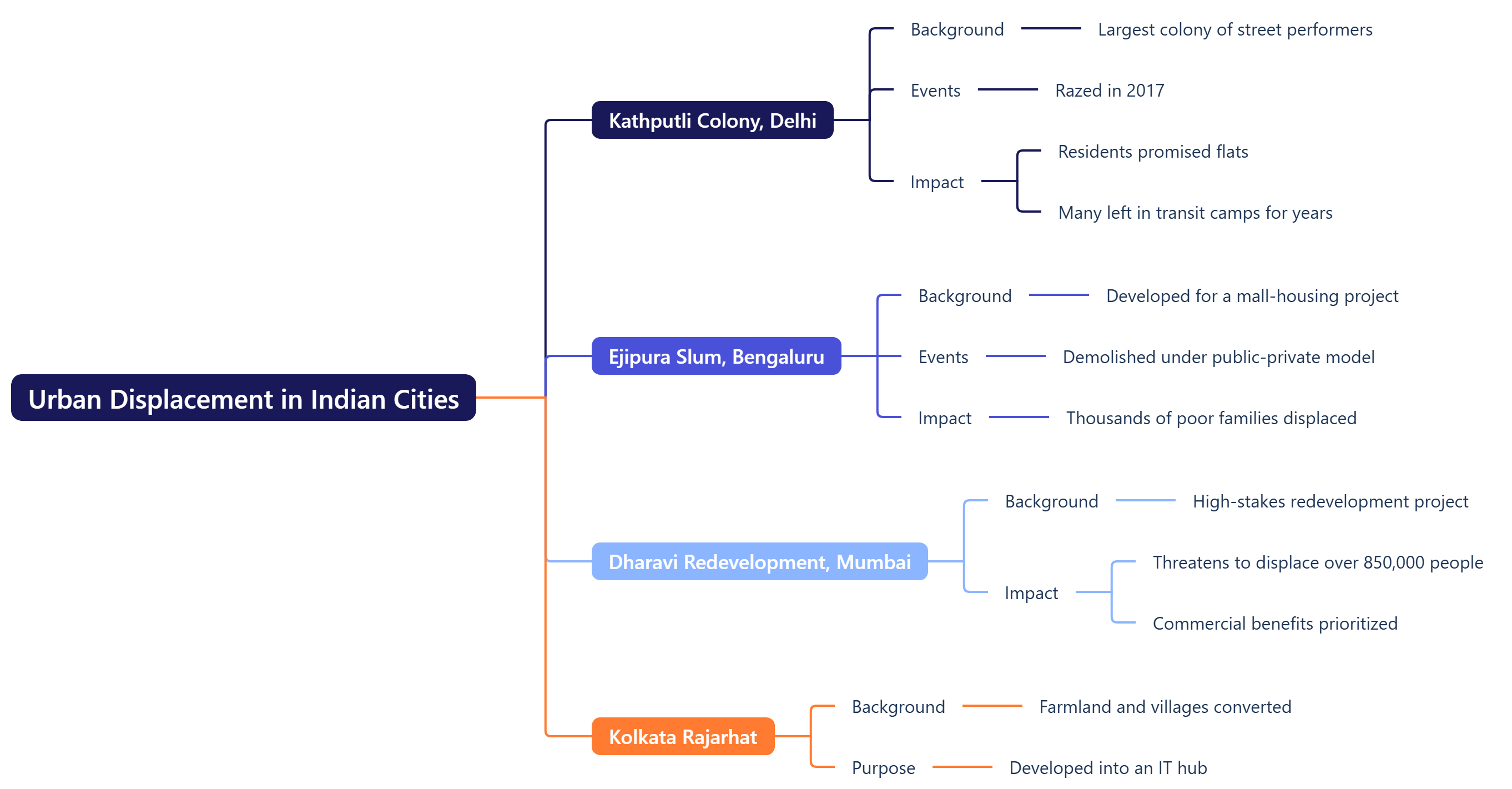
- Kathputli Colony, Delhi: India’s largest colony of street performers was razed in 2017. Residents were promised flats, but many were left in transit camps for years.
- Ejipura Slum, Bengaluru: Demolished for a mall-housing project under a public-private model. Thousands of poor families were displaced.
- Dharavi Redevelopment, Mumbai: A high-stakes redevelopment project threatens to displace over 850,000 people for commercial benefit.
- Kolkata Rajarhat: Farmland and villages converted into IT hub.
These cases show how development-induced displacement and urban evictions are becoming commonplace, despite constitutional guarantees to Right to Shelter and Livelihood.
Urban Displacement: The Human Cost
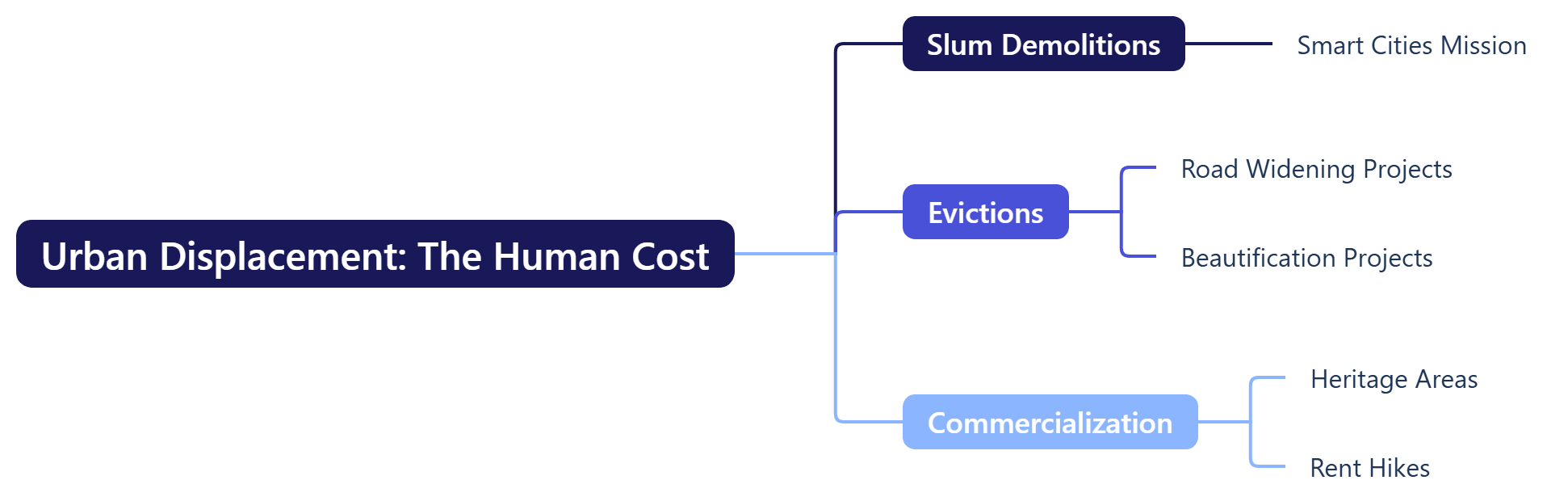
As urban areas gentrify, displacement becomes inevitable. Whether through legal mechanisms (like eminent domain) or informal pressures, marginalized communities are pushed out of central city zones. In India:
- Slum demolitions under schemes like Smart Cities Mission
- Evictions for road widening or beautification projects
- Commercialization of heritage areas, leading to rent hikes
These trends contribute to the growth of urban peripheries, informal settlements, and the loss of social capital for displaced populations.
Sociological Analysis
- Urban Ecology and the Chicago School: The Chicago School of Sociology, particularly Ernest Burgess’s concentric zone model, explains how urban growth leads to the displacement of lower-income groups as the central zones become more commercial and elite-dominated.
In Indian cities, we see this in:
- Displacement of slum dwellers in Mumbai’s Dharavi for redevelopment
- Transformation of Delhi’s Shahjahanabad area into a heritage-tourism hub
- Marxist Perspective: From a Marxist sociology viewpoint, gentrification represents a form of urban class struggle. The capitalist class, in collaboration with the state, reshapes urban spaces to maximize profit—often at the cost of the urban proletariat.
Example: Redevelopment of areas near Mumbai Port Trust lands led to eviction of dock workers and fisherfolk, benefiting real estate giants.
- Right to the City: Henri Lefebvre’s idea of the “Right to the City” stresses the need for inclusive urban planning. In India, marginalized groups like migrant workers, street vendors, and women in the informal sector often lack access to this right. Gentrification violates this principle by prioritizing elite aesthetics over the basic needs of the urban poor.
- Manuel Castells’ Network Society: The digital and global aspirations of cities (Smart Cities Mission, Digital India) lead to gentrification as cities cater to mobile capital and middle classes, sidelining the needs of marginalized communities.
Current Affairs Angle
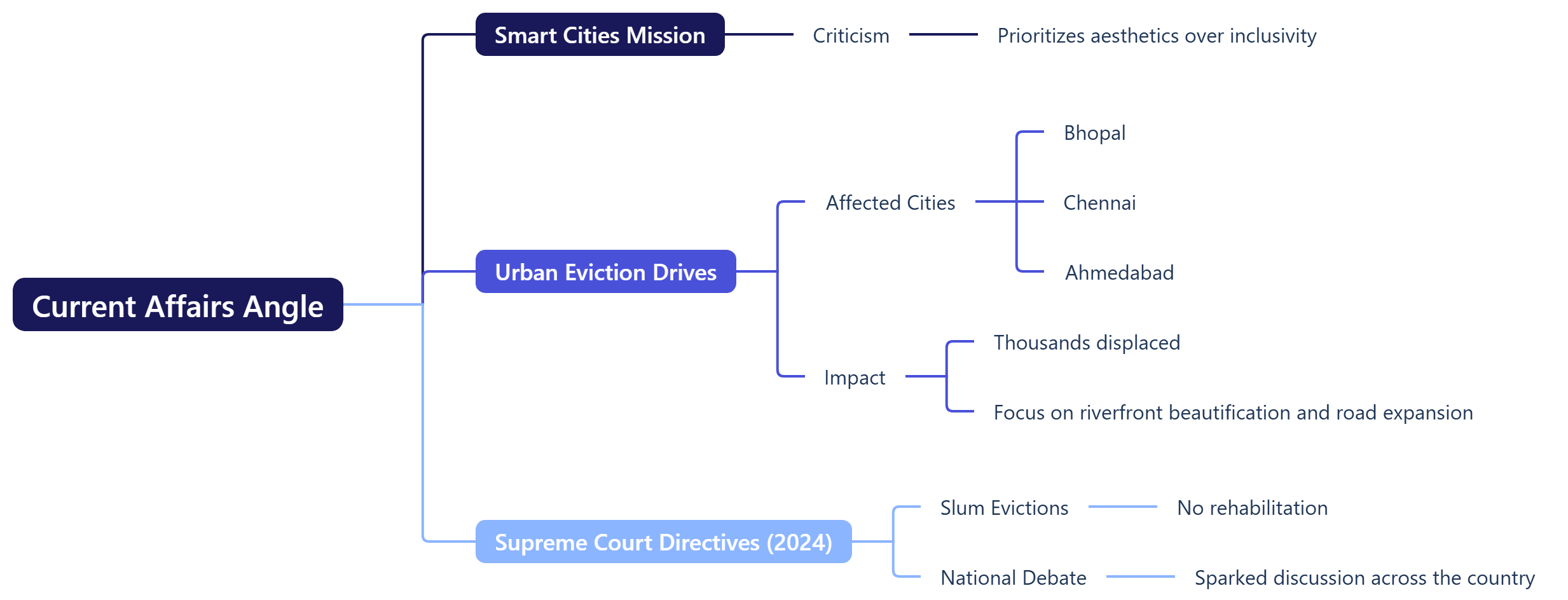
- Smart Cities Mission is under criticism for prioritizing aesthetics over inclusivity.
- Urban eviction drives in cities like Bhopal, Chennai, and Ahmedabad have displaced thousands for riverfront beautification and road expansion.
- Supreme Court directives in 2024 on slum evictions without rehabilitation have sparked national debate.
The Informal Sector: Invisible Casualty of Gentrification
India’s urban poor work in:
- Street vending
- Domestic help
- Construction
- Waste recycling
Gentrification erodes their place of residence and work, leading to:
- Increased commute times
- Income insecurity
- Breakdown of community support systems
This aligns with ILO and NSSO data, highlighting that over 80% of India’s urban workforce is informal, and thus highly vulnerable to displacement.
Policy Suggestions for Inclusive Urban Growth
- In-Situ Slum Upgradation over eviction-led development
- Affordable rental housing for migrant labor
- Urban planning with community participation
- Legal protections for informal workers and hawkers
Conclusion
Gentrification is sociological phenomena that mirror the structural inequalities of Indian society. Understanding these processes is crucial not only for Sociology but also for shaping a more just and inclusive urban India. The question of urban development is not just about infrastructure—it’s about equity, participation, and justice. Gentrification and urban displacement threaten the democratic nature of cities, transforming them into exclusive spaces for the elite. This topic intersects themes of social change, marginalization, urban planning, and inequality—making it a critical issue to understand and analyze.
PYQs
Paper 1 –
- Explain the impact of industrialization and urbanization on caste and class structures in India. (2014)
- How has the process of urbanization affected the family structure and kinship patterns in Indian society? (2015)
- Examine the relationship between urbanization and social disorganization. (2016)
- Explain the concept of ‘urbanism as a way of life’ with reference to the sociological perspective of Louis Wirth. (2017)
- Discuss the role of civil society and NGOs in influencing public policies in urban India. (2018)
- Discuss the interface between globalization and migration and their implications for urban communities. (2019)
- What is ‘space’ in sociology? Discuss how social space is reorganized in the context of migration and urbanization. (2020)
- How do urban settlements impact the social structure and mobility in developing societies? (2021)
- Discuss how urban ecology theories explain the spatial organization of urban areas. (2022)
- Analyze the relationship between migration, urbanization, and the informal economy in the context of developing countries. (2023)
Paper 2 –
- What are the causes and consequences of the growth of slums in urban areas? Suggest sociological solutions to address them. (2014)
- Discuss the impact of development-induced displacement on marginalized communities in India. (2015)
- Examine how liberalization and globalization have affected urban social structure in India. (2016)
- Urbanization in India has led to the marginalization of the urban poor. Explain with suitable examples. (2017)
- How do state policies contribute to the reproduction of social inequality in Indian cities? (2018)
- How far do you agree with the view that urban development schemes in India have failed to address the problem of housing for the poor? (2019)
- Write a sociological note on the effects of infrastructure development projects on tribal and rural communities. (2020)
- Discuss how urban planning policies in India have contributed to the spatial and economic segregation of communities. (2021)
- Analyze how informal sector employment has become central to urban livelihood strategies in India.(2022)
- Critically examine the role of public-private partnerships in urban development and its social consequences. (2023)
|