
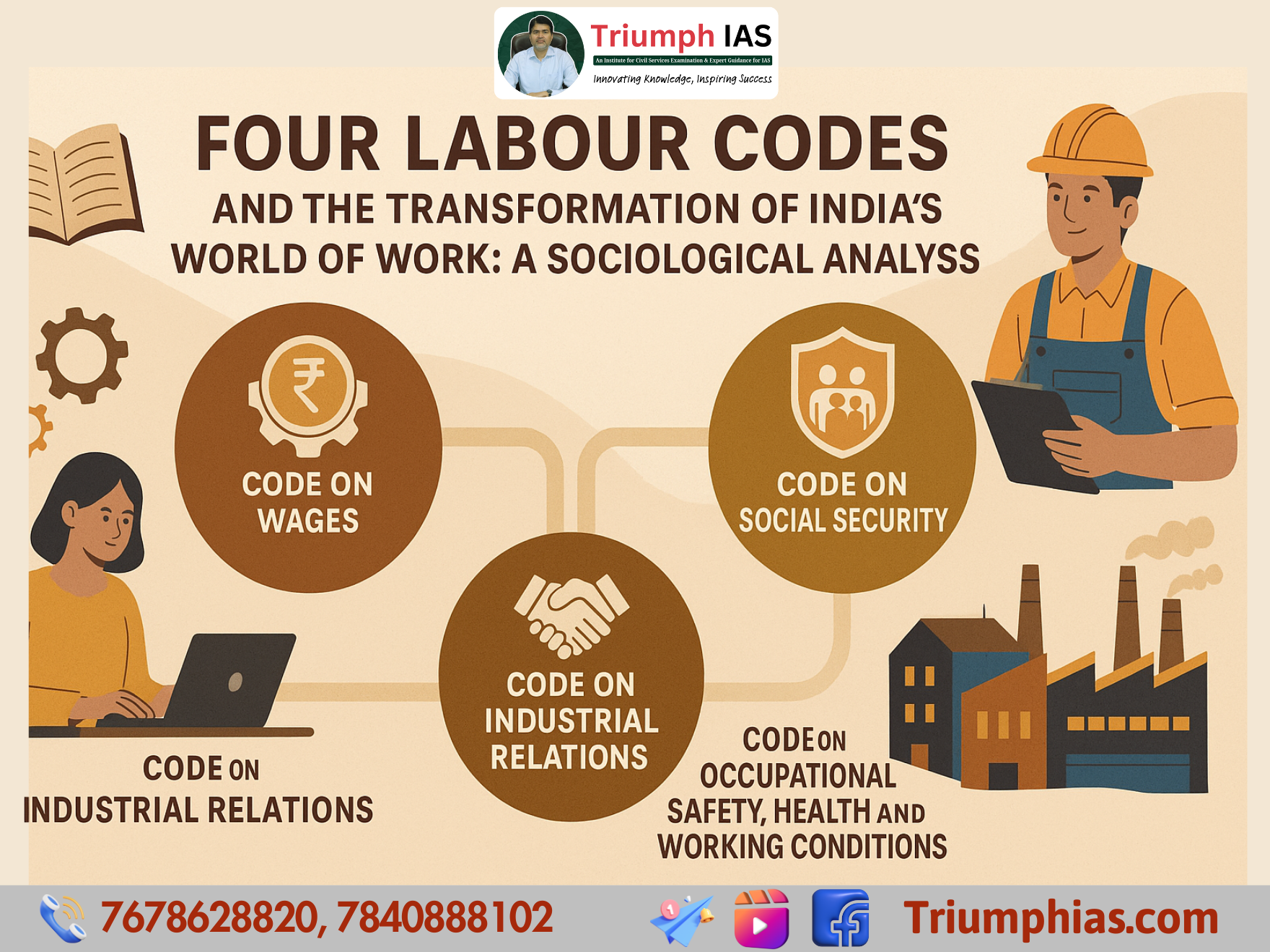
Four Labour Codes and the Transformation of India’s World of Work: A Sociological Analysis
(Relevant for Sociology Paper 1: Works and Economic Life)
IntroductionThe enforcement of the Four Labour Codes—the Code on Wages (2019), Industrial Relations Code (2020), Code on Social Security (2020) and the OSH & Working Conditions Code (2020)—from 21 November 2025 represents a landmark restructuring of India’s labour governance. The consolidation of 29 fragmented laws aims to modernise labour protection, guarantee universal welfare and align India with global standards. However, beyond its legal and economic implications, the reform holds deep sociological significance. It reshapes the relationship between labour, the state and capital, influences class relations, redefines identities of workers, and restructures the nature of citizenship and social justice in contemporary India. From Colonial Labour Control to Welfare-Oriented Labour Governance
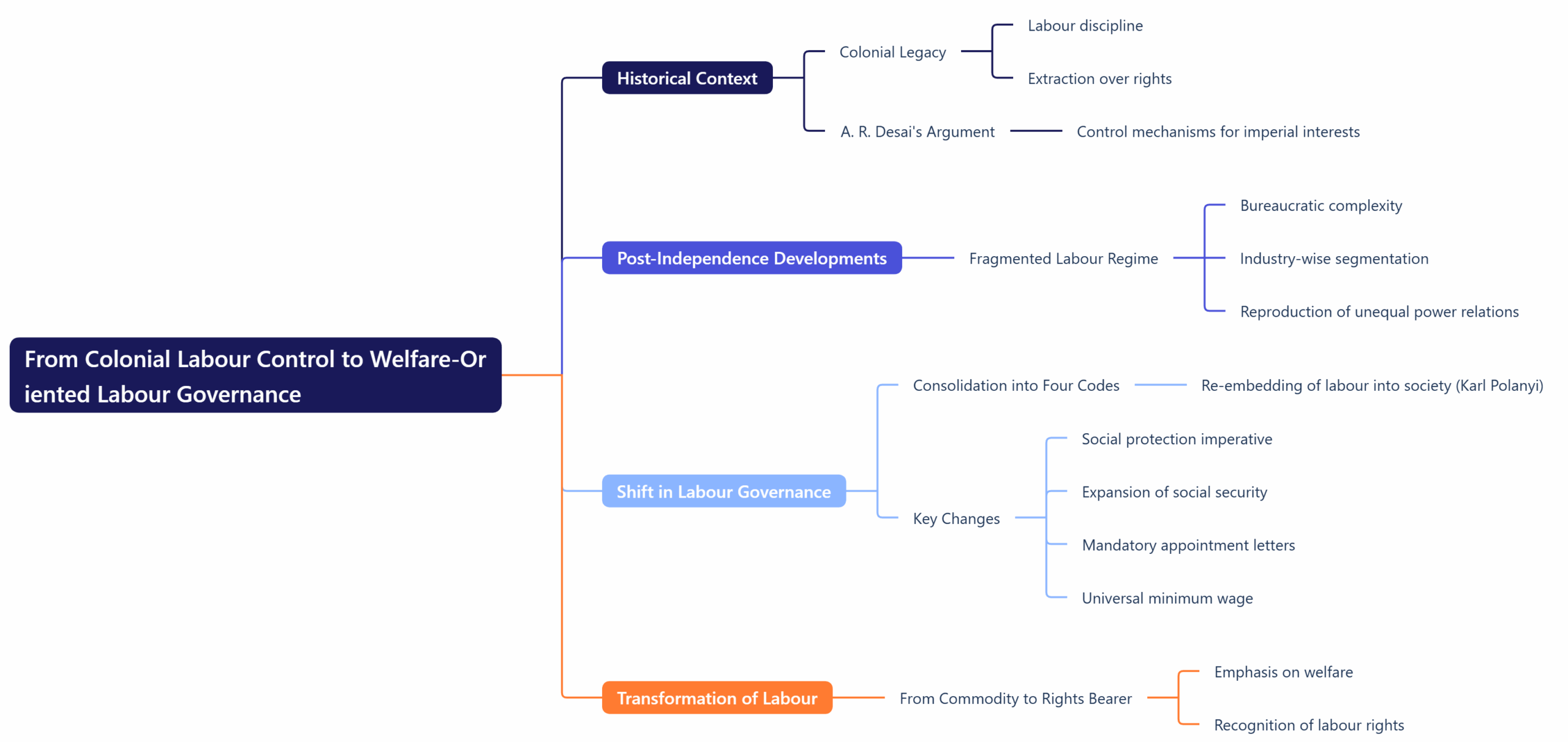
Labour laws in India historically emerged from a colonial legacy of labour discipline and extraction rather than welfare or rights. As argued by A. R. Desai, colonial labour legislation institutionalised control mechanisms to serve imperial industrial interests. The fragmented labour regime that evolved after Independence continued to reproduce unequal power relations through bureaucratic complexity and industry-wise segmentation. The consolidation into Four Codes reflects a shift toward what Karl Polanyi calls the “re-embedding of labour into society”, where markets cannot operate free from social protection. The expansion of social security, mandatory appointment letters and universal minimum wage reflect an attempt to transform labour from a commodity to a bearer of rights. Comparison Table: Pre-Labour Reforms vs Post-Labour Reforms
Class Relations and Redistribution: Marxian InterpretationFrom a Marxist perspective, labour laws are a site of struggle between labour (working class) and capital (employers). The extension of:
represents an institutional strengthening of labour’s bargaining power against exploitative surplus extraction. Recognition of digital platform workers challenges what Guy Standing terms the “precariat”—a rising class suffering from insecurity, informalisation and lack of identity in neoliberal economies. By legally recognising gig labour, the Codes mark a transition from invisibilised labour to acknowledged citizenship within the workforce. Max Weber: Rationalisation and Bureaucratic ModernisationThe simplification from multiple licences, permissions and compliance returns to a single registration and licence system represents Weber’s theory of rationalisation, reducing inefficiency, arbitrariness and uncertainty within economic institutions. Weber argued that predictability and standardisation are essential to industrial capitalism; the Codes aim to create a system governed by rules rather than personal discretion. The new Inspector-cum-Facilitator model reflects Weber’s shift from coercive state authority to legal-rational authority, enabling transparency instead of punitive state policing. Durkheim: Social Solidarity and Worker WelfareÉmile Durkheim viewed labour as a moral institution that integrates individuals into society through cooperation and collective consciousness. The expansion of ESIC coverage, portability of PF and medical protection for hazardous work reinforce organic solidarity, strengthening interdependence among workers, employers and the state. Annual health check-ups, workplace safety committees and insurance benefits integrate welfare into the structure of work, promoting what Durkheim calls moral health of the social body. Bourdieu: From Informal Labour to Legitimised Social Capital
Mandatory appointment letters, minimum wages, performance-linked documentation and formal employment records increase the institutional social capital of workers. According to Pierre Bourdieu, access to capital (economic, cultural, social and symbolic) determines life chances. Formalisation enhances:
Migrant workers, long excluded from welfare networks, gain legitimacy and mobility—reducing structural inequality. Giddens & Beck: Labour Codes and Risk SocietyModern labour markets operate under heightened risks and uncertainties, as explained by Ulrich Beck and Anthony Giddens. Flexible working models, platform work and automation generate insecurity. The Labour Codes introduce risk governance mechanisms through:
Thus, risk is redistributed from the individual worker to society and the state—essential for resilience in globalised economies. Gender, Labour and Social EqualityThe Codes’ gender reforms respond to longstanding patriarchal restrictions on women’s mobility and labour participation. Allowing women to work night shifts and in mining or hazardous industries, alongside mandatory grievance committees and equal wages, reflects feminist sociological critique against sexual division of labour. Heidi Hartmann’s analysis of patriarchal capitalism explains how gendered exclusion benefits employers and preserves domestic dependency. These reforms destabilise gendered hierarchies and expand economic citizenship. Industrial Relations and the Transformation of Worker–State–Capital DynamicsThe Industrial Relations Code aims to shift labour dispute resolution from conflictual confrontation to collaborative dialogue, echoing Gandhian trusteeship and pluralist industrial relations theory (Dunlop & Flanders). Direct tribunal access after conciliation and predictable procedures attempt to balance capital’s need for flexibility with labour’s need for rights. However, Marxist analysts would argue that simplification of layoffs and hiring processes may increase employer dominance unless accompanied by strong union participation. Sociological Significance of the Reform
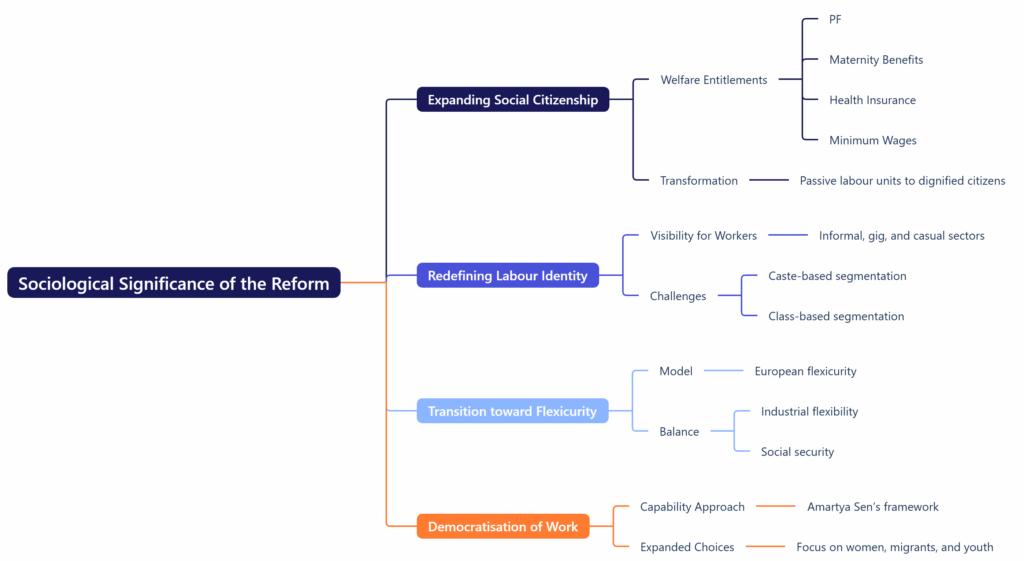
1. Expanding Social CitizenshipReflecting T. H. Marshall’s concept, welfare entitlements like PF, maternity benefits, health insurance and minimum wages transform workers from passive labour units to dignified rights-bearing citizens. 2. Redefining Labour IdentityWorkers of informal, gig and casual sectors gain visibility—challenging caste-based and class-based segmentation of labour markets. 3. Transition toward FlexicurityBalancing industrial flexibility + social security follows the European flexicurity model, merging efficiency with fairness. 4. Democratisation of WorkThe Codes advance Amartya Sen’s capability approach, expanding choices and freedoms of workers, particularly for women, migrants and youth. Beyond the major welfare initiatives already highlighted, the Labour Codes introduce several further reforms that strengthen worker protection and simplify compliance for employers:
Higher factory applicability limits, easing regulatory burden for small units while retaining full safeguards for workers. ConclusionThe Four Labour Codes represent a historic restructuring of India’s labour architecture, shifting from colonial-era fragmentation to a rights-based, inclusive and future-oriented labour ecosystem. Sociologically, they redefine work as a domain of dignity, citizenship and social justice rather than exploitation or survival. They reshape power relations between labour and capital, reduce precarity, and integrate marginalised groups into formal economic structures. Yet, successful realisation of these promises depends on implementation, enforcement, and maintaining balanced social dialogue. The Codes offer a transformative opportunity to create a labour regime that is pro-worker, pro-women, pro-youth and pro-equity, aligning welfare with development and social justice. |

To Read more topics, visit: www.triumphias.com/blogs
Absolutely loved reading this post! It gave me new ideas and inspired me to learn more about this topic. Thanks for spreading knowledge in such a simple way.