India-US Strategic Equation
Over the past decade, the partnership between India and the United States has blossomed into one of the world’s most consequential bilateral relationships—spanning defense, trade, technology, energy, and multilateral cooperation. In 2025, this strategic collaboration is entering a new era.
Strategic & Defence Cooperation
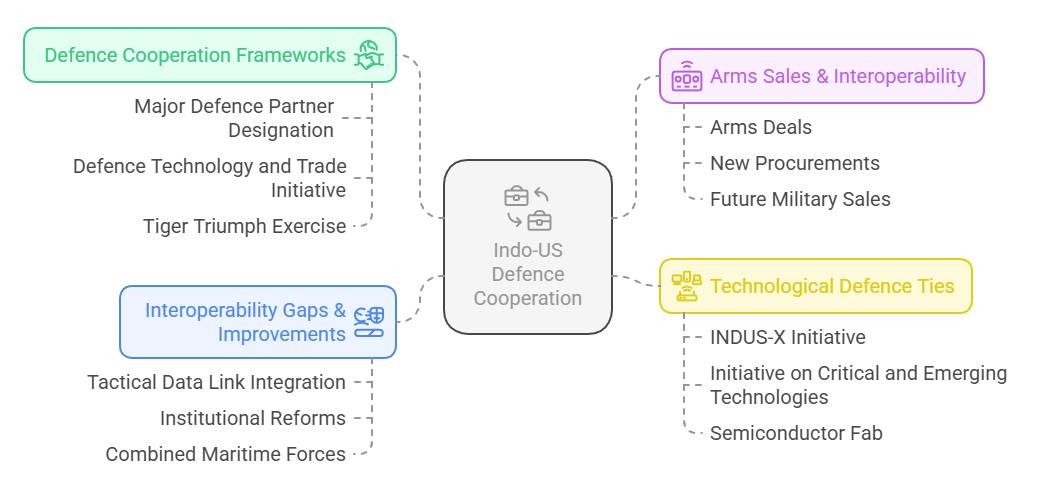
Defence Cooperation Frameworks
- The “Major Defence Partner” designation (2016) and the Defence Technology and Trade Initiative (DTTI) provide formal platforms for co-development of military systems.
- The 2025 Tiger Triumph tri-service exercise, held April 1–13 in Visakhapatnam and Kakinada, involved ~3,000 personnel and, notably, Marks the first participation by the US Space Force, integrating satellite-tech for situational awareness.
- Yudh Abhyas, the largest annual army exchange, continues to enhance tactical interoperability, covering counter-terrorism, artillery, and attack aviation.
Arms Sales & Interoperability
- India remains the world’s largest arms importer; cumulative Indo‑US arms deals have exceeded US $136 billion till 2024.
- New major procurements include additional P-8I maritime patrol aircraft equipped with Harpoon missile and torpedo systems.
- In February–April 2025, U.S. President Trump announced intentions to increase military sales to India, including the F‑35 stealth fighter, though it remains in proposal stage. Analysts estimate India will spend over US $200 billion on military modernization over the next decade.
Technological Defence Ties
- The INDUS‑X initiative (launched June 2023) fosters U.S.–Indian public–private collaboration on advanced defence tech.
- The Initiative on Critical and Emerging Technologies (iCET), initiated in 2022, focuses on AI, semiconductors, cyber, biotech, space, and telecom — supported by joint research and funding
- A semiconductor fab in India, part of iCET, will produce 50k compound chips/year by 2027 with US $500 million investment—marking the U.S. Space Force’s first international semiconductor partnership.
Interoperability Gaps & Improvements
- While equipment compatibility is increasing, tactical data link integration remains a challenge.
- However, institutional reforms—such as the Chief of Defence Staff (CDS) and Theatre Commands—are smoothing pathways toward joint operations.
- India’s growing role in Combined Maritime Forces and interest in joint humanitarian/disaster relief under the Quad context highlight real-world operational coordination.
Trade & Economic Engagement
Trade Trajectory & Targets
- India–US bilateral trade reached approximately US $200 billion in 2024–25, with projections to hit US $238 billion by 2025 at current growth rates; with sustained 10–12.5% growth, trade could reach US $283–327 billion.
- In FY 2023–24, the U.S. recorded a trade deficit in goods and services worth US $45.6 billion to India .
- The aim: doubling trade to US $500 billion by 2030, an objective reiterated in both Trump’s and Vice President Vance’s recent visits.
Recent Developments
- A provisional interim trade agreement is expected in mid-2025, offering mutual tariff reductions. India will boost imports of U.S. natural gas, nuts, fruits, and dairy, while protecting key domestic sectors.
- To reduce trade deficit pressure, India has increased U.S. oil imports by 120% during early 2025, offset by cutting crude flows from Russia, Saudi Arabia, and Iraq by over 70%.
- Vice President Vance’s February 2025 visit finalized the framework for formal trade negotiations, covering food, autos, ecommerce, and energy—backed by tariff suspensions.
Energy & Critical Minerals
Energy Transition & Supply Diversification
- India’s pivot to U.S. energy resources—thermals and LNG—is both economic and strategic .
- Under the Quad Critical Minerals Initiative (April 2025), the U.S., India, Australia, and Japan agreed to collaborate on secure supply chains for lithium, cobalt, nickel, rare earths, and other key materials, countering China’s dominance in high-tech inputs .
Technology & Innovation

Digital Connectivity & Infrastructure
- President Modi and President Trump endorsed investment in undersea cable infrastructure across the Indian Ocean, notably a 50,000 km Meta cable, to deepen digital connectivity.
Research Ecosystem
- Over 300,000 Indian students in the U.S. contribute approximately US $8 billion annually, also catalyzing innovation leadership.
- Scientometric studies show Indo‑US research collaborations account for ~33% of India’s internationally co-authored research—underscoring deep academic ties.
Emerging Technology Consortia
- Initiatives like iCET, INDUS‑X, and the Bio‑5 Biopharmaceutical Supply Chain Consortium embed India into an emerging global high‑tech ecosystem.
Geopolitical & Multilateral Dimensions
Quad Architecture & Indo-Pacific Security
- As Quad partners, the U.S., India, Japan, and Australia reaffirmed commitments in April 2025 to maritime security, crisis response, and freedom of navigation, pushing back against coercive regional actions.
- India’s leadership role in Combined Maritime Forces and hosting of Quad airlift and disaster response capacity reinforce its “net security provider” status.
Counter-Terrorism & Strategic Stability
- The 2025 Joint Leaders’ Statement emphasized cooperation against terrorism from groups including Al-Qaeda, ISIS, Jaish‑e‑Mohammad, and LeT—and care over unstable neighbors.
- The U.S. approved India’s extradition request for Tahawwur Rana, associated with the 2008 Mumbai attacks, signaling judicial and diplomatic collaboration.
Economic & Industrial Collaboration
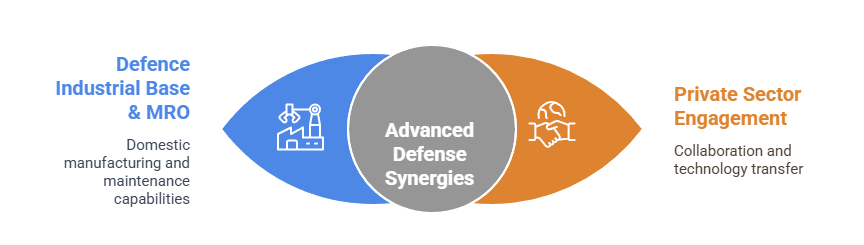
Defence Industrial Base & MRO
- Reliance Defence–Coastal Mechanics partnership launched a ₹20,000 crore MRO facility in Nagpur targeting military aircraft and helicopters—a boost to Make in India and global defense exports.
Private Sector Engagement
- India is now purchasing nearly all U.S.-made defense equipment except fighter jets and submarines
- Inclusion of satellite, AI, and autonomous tech via TTI and INDUS‑X is deepening bilateral industrial synergies .
This strategic synergy is not accidental: it is driven by converging interests—containing China’s influence, enhancing security and supply chain resilience, and mutual economic gains. The India–US partnership now spans the full gamut of modern statecraft: from foundational diplomacy and defense to energy diplomacy and frontier tech. |


One comment