Introduction
The firecracker ban in India exemplifies the sociological tension between environmental sustainability and socio-economic equity. The Supreme Court’s call for a “balanced approach” highlights the challenges of policy-making in a diverse society, where environmental imperatives intersect with livelihoods, culture, and social justice. Beyond legal and health debates, this issue reflects structural inequalities, labour vulnerability, cultural traditions, and governance challenges in contemporary India.
Historical and Cultural Context
- Sivakasi, Tamil Nadu: The hub of India’s firecracker industry, employing ~5 lakh workers, mainly from marginalized backgrounds.
- Cultural Significance: Fireworks are integral to Diwali, weddings, and festivals, reinforcing collective identity and ritual solidarity.
- Embedded Economy: According to Polanyi, economic activities are embedded in social and cultural life, making bans socially complex.
The industry’s regulation thus cannot ignore livelihood, identity, and cultural significance.
Environmental and Public Health Concerns
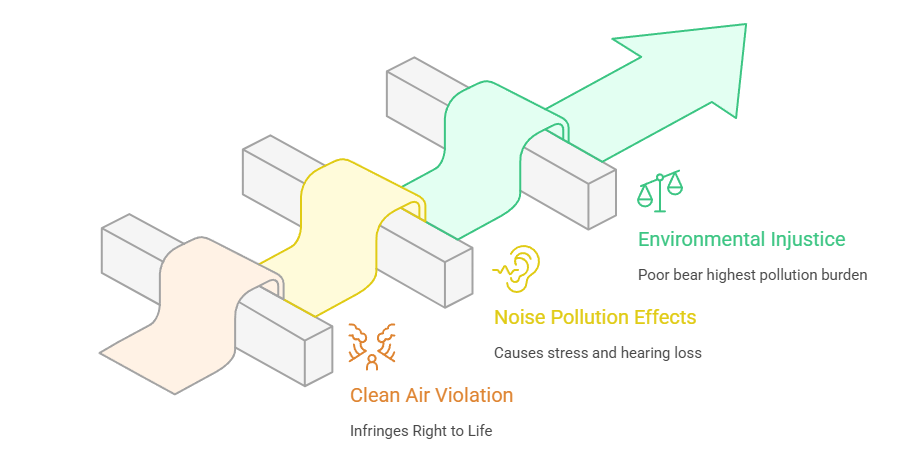
- Right to Clean Air:
- Under Article 21 and cases like M.C. Mehta v. Union of India (1987), clean air is part of the right to life.
- Pollution from crackers contributes to respiratory diseases, cardiovascular stress, and disproportionately affects children and the elderly.
- Noise Pollution: Chronic exposure causes stress, sleep disturbances, and hearing loss, particularly among vulnerable populations.
- Environmental Justice Perspective:
- The poor bear the highest burden of pollution.
- This illustrates the environmental justice paradox: marginalized groups suffer most from risks they did not create.
Economic and Social Implications
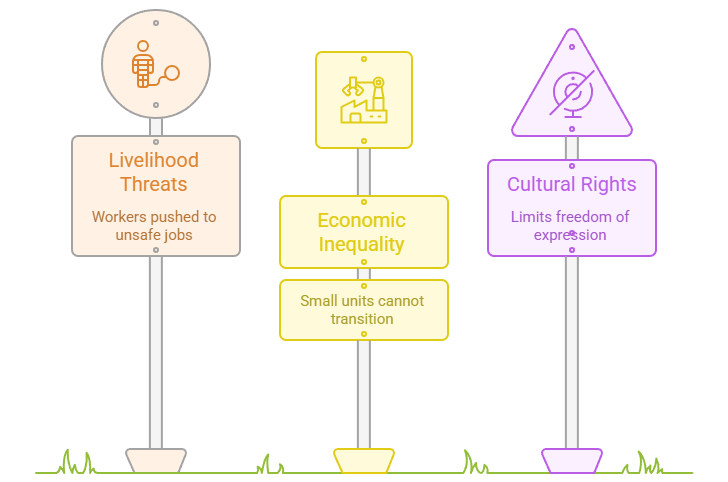
- Livelihood Threats:
- Blanket bans endanger the income of workers, pushing them toward informal, unsafe jobs or poverty.
- Economic Inequality:
- Large firms can transition to green crackers, but small-scale units often cannot, potentially leading to market monopolisation.
- Marxist analysis would interpret this as capital accumulation at the expense of marginalized labor.
- Cultural Rights:
- Fireworks are central to social rituals; bans can limit freedom of religion and cultural expression, reflecting a tension between rational-legal norms and traditional practices (Weber).
Policy and Governance
- Supreme Court & NGT: Allowed green crackers, limited timings, and emphasized environmental protection.
- MoEFCC & CSIR-NEERI: Developed eco-friendly crackers.
- Sociological Insight: State intervention reflects the challenge of managing common-pool resources, requiring participation of stakeholders to prevent informal economies (Ostrom).
Balancing Environmental and Social Dimensions
- Promotion of Green Crackers:
- Reduces emissions while maintaining some economic activity.
- Licensing and Monitoring:
- Certification for eco-friendly variants prevents exploitation of workers and consumers.
- Skill Diversification:
- Retraining in renewable energy, LED production, toy-making, or packaging supports social mobility and economic resilience.
- Financial Support:
- Soft loans and subsidies prevent small entrepreneurs from collapsing, reflecting the state’s redistributive role.
Sociological Perspectives

- Environmental Sociology:
- Risk society (Beck): Pollution is a socially stratified hazard, disproportionately affecting marginalized populations.
- Conflict Theory:
- Marxist lens highlights the tension between capital, labor, and regulation, with small-scale workers bearing the brunt of economic transitions.
- Functionalist Perspective:
- Parsons: Policies like green crackers and skill development maintain social equilibrium, balancing health, environmental safety, and livelihoods.
- Subaltern and Feminist Lens:
- Firecracker workers are often women and children, highlighting gendered labor exploitation and intersectional vulnerabilities.
Challenges and Critiques
- Enforcement Gaps: Poor monitoring risks illegal toxic cracker sales.
- Economic Exclusion: Small-scale units may lack resources for green technology, leading to inequality.
- Cultural Resistance: Traditional practices may conflict with bans.
- Long-Term Sustainability: Even green crackers cannot entirely eliminate noise or chemical pollution.
Conclusion
The firecracker ban reflects a socio-ecological dilemma, where environmental protection, public health, cultural rights, and economic livelihoods intersect. A middle-path approach is essential:
- Promote green crackers and regulate toxic ones.
- Retrain workers and provide financial support.
- Respect cultural practices while ensuring environmental compliance.
From a sociological standpoint, this case underscores the integration of environmental policy with social justice, emphasizing that ecological sustainability must consider structural inequalities, cultural norms, and livelihood concerns. It exemplifies India’s broader development paradox: economic growth, cultural continuity, and environmental preservation must coexist to ensure equity, sustainability, and social cohesion.
|

2 comments