Introduction
Around the globe, countries are witnessing a sharp decline in marriage rates and a surge in divorce rates. From Japan and South Korea to Germany and the United States, the traditional institution of marriage is undergoing a transformation. This trend is contributing to a demographic crisis marked by ageing populations, shrinking labor forces, and low birth rates. In response, anxious parents are flocking to matchmaking markets, especially in Asia, hoping to find suitable spouses for their adult children. This blog delves into the sociological significance of these trends and their implications for society.
Global Trends in Marriage and Divorce
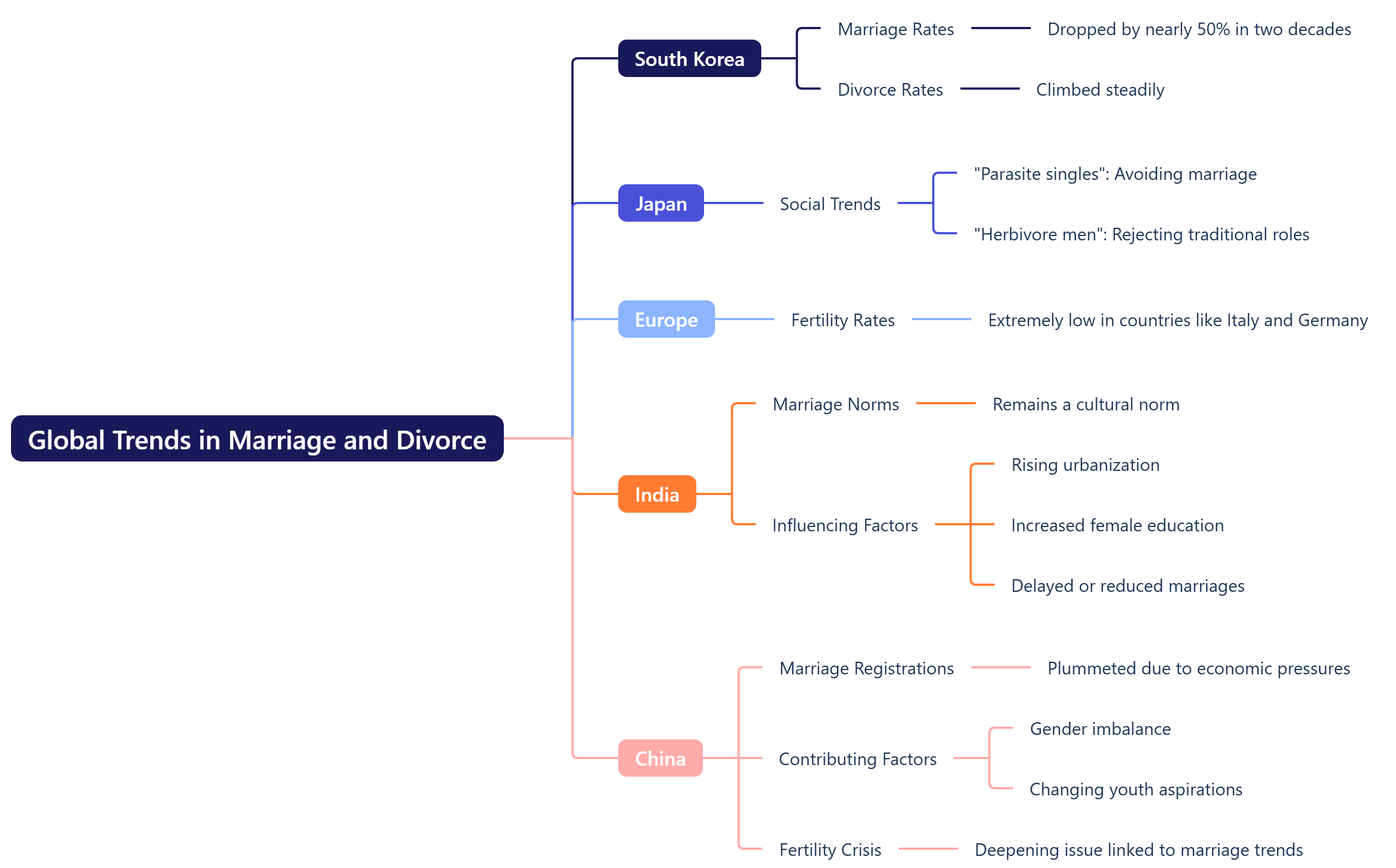
- South Korea: Marriage rates dropped by nearly 50% over the last two decades; divorce rates have climbed steadily.
- Japan: “Parasite singles” and “herbivore men” are avoiding traditional marital roles.
- Europe: Countries like Italy and Germany are experiencing extremely low fertility rates.
- India: While marriage remains a norm, rising urbanization and female education are delaying or reducing marriages.
- China: Marriage registrations have plummeted amid economic pressures, gender imbalance, and changing youth aspirations, contributing to a deepening fertility crisis.
Why Are Marriages Declining?
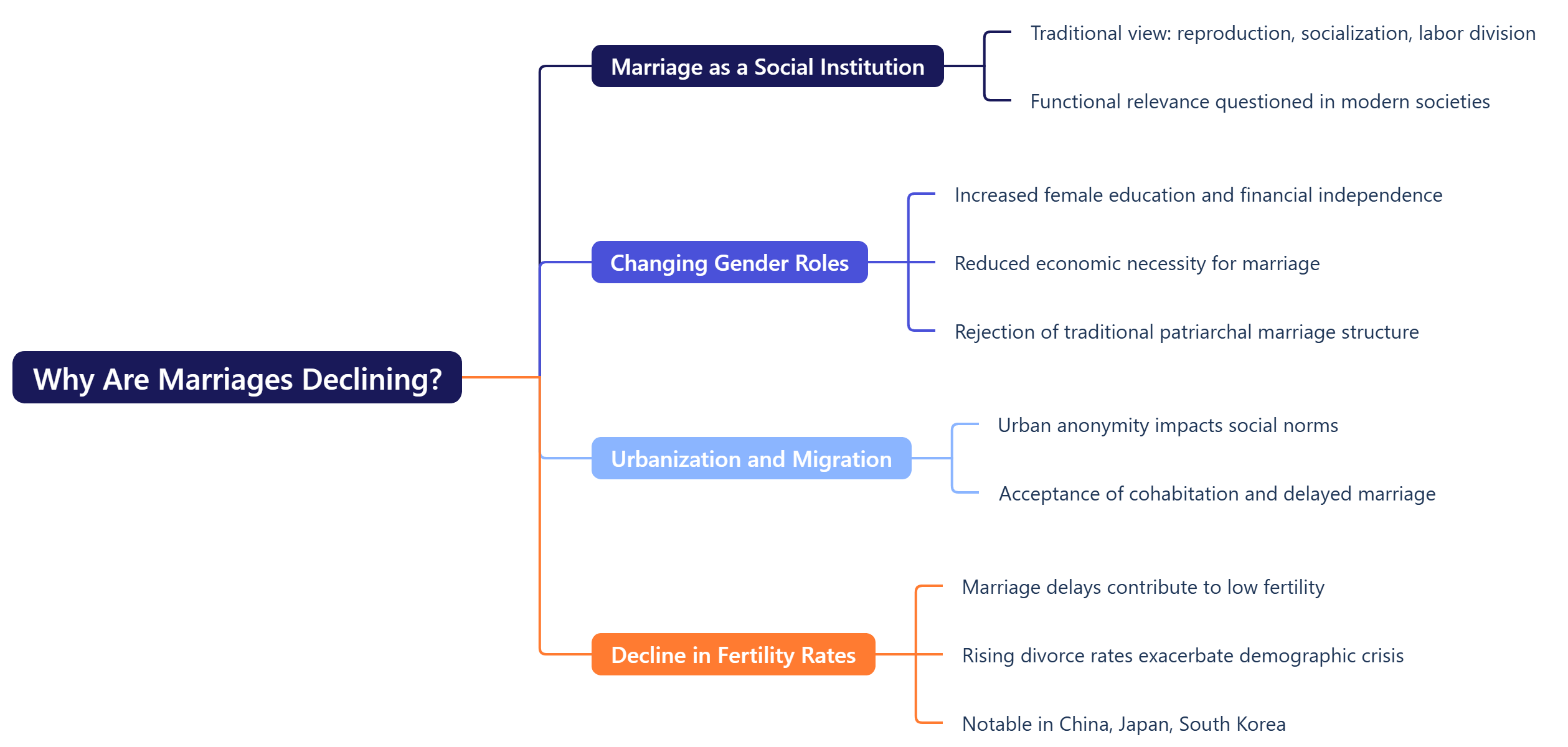
- Marriage as a Social Institution: Marriage is traditionally seen as a social institution that ensures reproduction, socialization of children, and division of labor. However, in modern societies, its functional relevance is being questioned.
- Changing Gender Roles: With increasing female education and financial independence, women are no longer compelled to marry for economic security. Moreover, the traditional patriarchal structure of marriage is being rejected by many.
- Urbanization and Migration: Urban spaces offer anonymity and break traditional kinship networks. This makes cohabitation and delayed marriage socially acceptable.
- Decline in Fertility Rates: Marriage delays and rising divorces contribute directly to low fertility rates, accelerating the demographic crisis in countries like China, Japan, and South Korea.
Sociological Analysis:
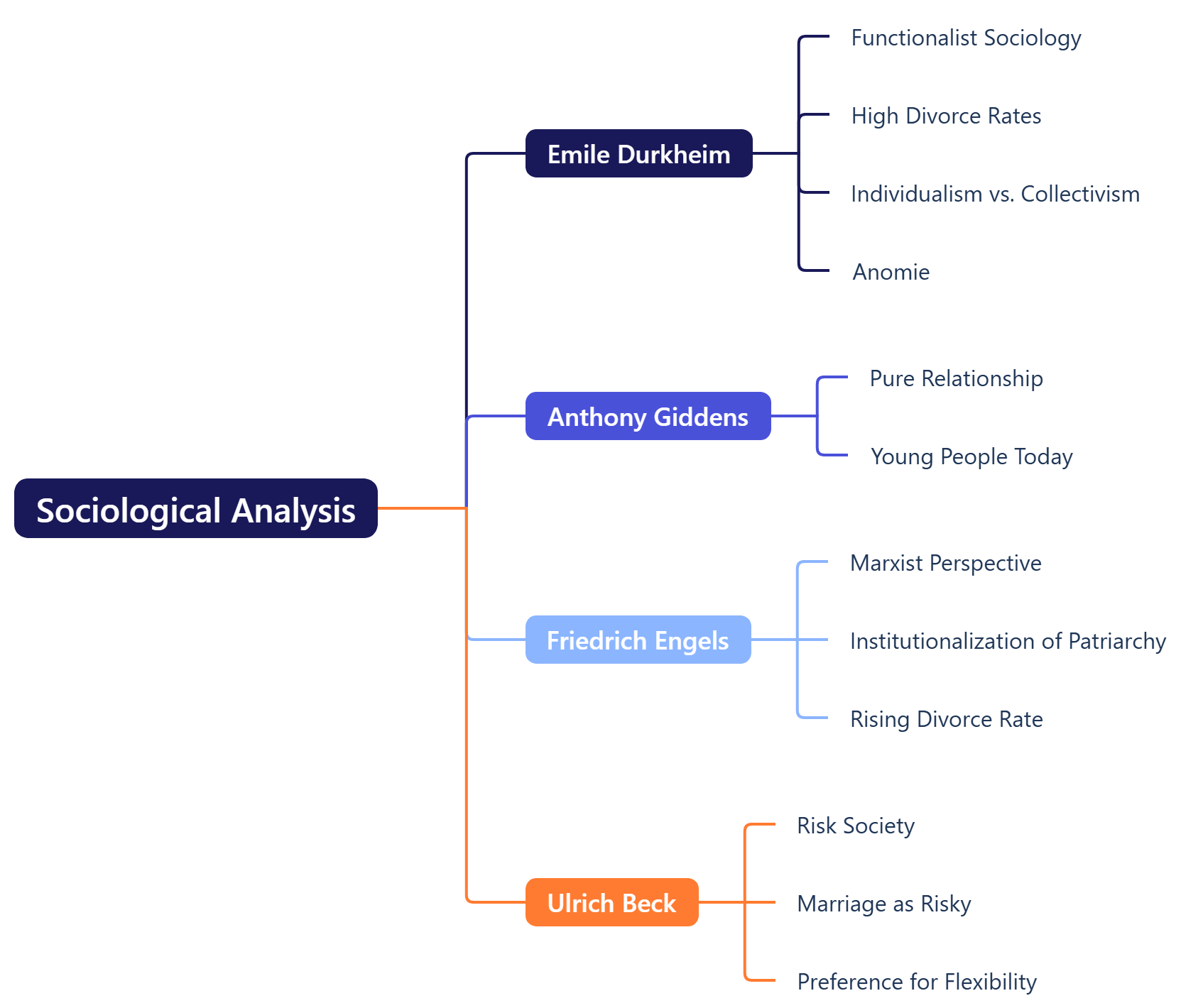
- Emile Durkheim, a pioneer of functionalist sociology, viewed marriage as a vital institution that contributed to social integration and cohesion. He believed that high divorce rates reflect a weakening of the collective conscience, meaning shared values and norms are eroding in modern societies. As individuals prioritize personal happiness over collective responsibilities, social solidarity—especially mechanical solidarity found in traditional societies—deteriorates. For Durkheim, this is symptomatic of anomie, a state of normlessness caused by rapid social change.
- Sociologists like Anthony Giddens argue that we are entering the age of the “pure relationship”, where personal satisfaction outweighs social obligation. Young people today prioritize personal freedom, career, and self-fulfillment over traditional marital roles.
- From a Marxist perspective, Friedrich Engels argued that the institution of marriage emerged alongside the rise of private property and class society. In his work The Origin of the Family, Private Property and the State, Engels suggested that monogamous marriage was created to ensure the inheritance of property through male lineage, thereby institutionalizing patriarchy. According to him, traditional marriage restricts women’s autonomy and serves the interests of the ruling class by reinforcing capitalist norms. The rising divorce rate today, in this view, could be interpreted as a challenge to patriarchal and class-based structures.
- Ulrich Beck, a contemporary sociologist, introduced the concept of the “risk society”, where individuals constantly navigate uncertainties in their personal and professional lives. In modernity, long-term commitments like marriage are seen as risky endeavors due to rising expectations, emotional instability, and career demands. Beck suggests that people increasingly prefer flexible relationships, such as cohabitation or live-in partnerships, over the perceived burden of lifelong commitment. This explains the growing trends of delayed marriages and voluntary singlehood.
Matchmaking Markets:
In countries like China, India, and South Korea, parents are returning to traditional forms of spouse-hunting via matchmaking markets. These are often held in public parks or matrimonial expos where bio-data (educational background, income, caste, and physical attributes) are exchanged. Sociologically, this reflects a tension between tradition and modernity. While young adults embrace modern values of choice and autonomy, families are still deeply embedded in kinship obligations.
Conclusion
The global decline in marriage and rise in divorces is not just a demographic concern, but a sociological transformation. It reflects changing values, gender roles, and social expectations. For countries battling population decline, the challenge is to balance individual freedom with societal stability. As societies evolve, so must our understanding of the institution of marriage—not as a relic of the past, but as a dynamic structure adapting to modern realities.
PYQs
Paper 1
- Examine the relationship between individualism and weakening of traditional social institutions. (2022)
- How do the concepts of ‘functional prerequisites’ and ‘functional alternatives’ explain the changes in the institution of marriage? (2021)
- What is patriarchy? How does it impact gender relations within the family? (2020)
- Discuss the changing patterns of family structure in modern society. (2019)
- Analyse the relevance of the concept of anomie in understanding the changing nature of social relationships. (2018)
- Explain how modernization has affected the institution of family. (2017)
- Distinguish between mechanical and organic solidarity. Which type of solidarity is found in modern societies and why? (2016)
- Examine the feminist critique of the institution of marriage and family. (2015)
- Discuss Emile Durkheim’s theory of suicide in the context of modern family breakdown. (2014)
Paper 2
- Discuss the growing trend of singlehood and live-in relationships in India. What are its sociological implications? (2023)
- How is the institution of marriage adapting to challenges posed by modern education and women’s employment? (2022)
- Describe the factors contributing to the increasing incidence of divorce in urban India. (2021)
- How do inter-caste and inter-religious marriages impact the traditional kinship system in India? (2020)
- Examine the changing nature of marriage and family in India in the context of globalisation. (2019)
- Critically analyse the role of patriarchy in shaping family and kinship relations in India. (2018)
- Analyse the demographic consequences of delayed marriages in India. (2017)
- Examine the influence of media and consumerism on the institution of marriage in India. (2016)
- Discuss the impact of urbanization on the institution of marriage and family in India. (2015)
- Is the Indian joint family system declining? Discuss with reference to recent trends. (2014)
|