Introduction: Feminisation of Indian Agriculture
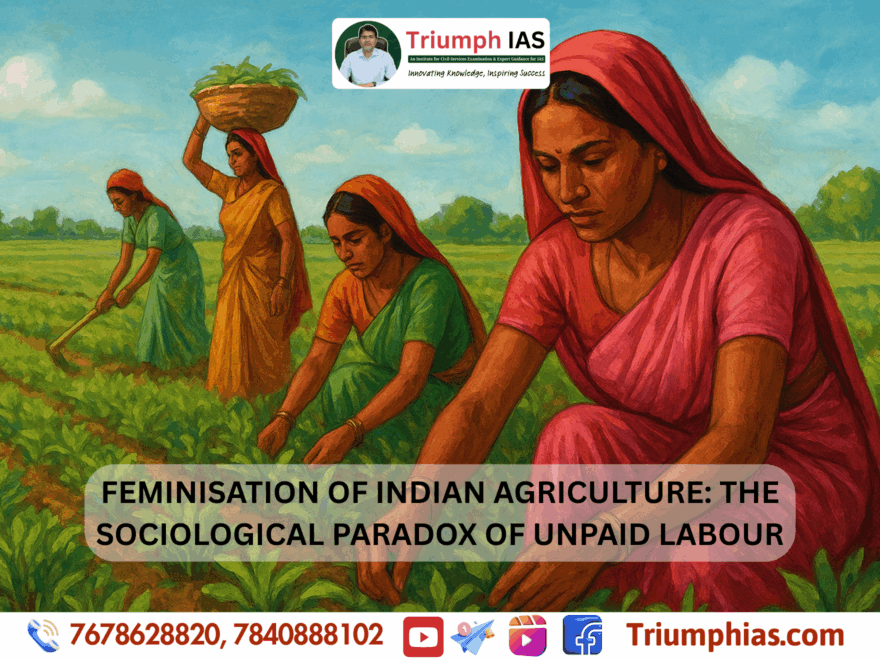
The “Feminisation of Agriculture” is now an established reality, with women constituting over 42% of the agricultural workforce. This trend is accelerated by pervasive male out-migration and the preference for female labour in sectors like contract farming. However, this demographic shift masks a severe injustice: nearly half of these women are classified as “unpaid family workers.” This non-remuneration, particularly acute in states like Bihar and Uttar Pradesh, is compounded by the denial of fundamental rights, such as land ownership (women own only 13-14% of land), and systematic exclusion from decision-making forums. This creates a fundamental sociological paradox: women are indispensable to the farm economy yet are invisible in its formal economic and political structures. The latest Periodic Labour Force Survey (PLFS) data highlights a critical shift in India’s agrarian economy:
Sociological Analysis and Perspectives: Linking Theory to Reality
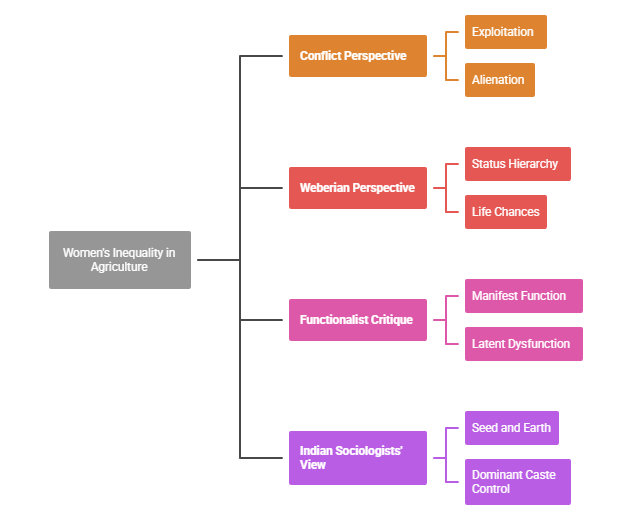
- The Conflict Perspective: Exploitation and Alienation
From a Marxist standpoint, the high rate of unpaid female labour is a mechanism of exploitation and the primitive accumulation of capital within the family.
- The non-payment of women’s work provides a source of cheap, flexible labour that subsidises the agrarian system’s profitability. This ensures that the surplus value is concentrated in the hands of the male head of the household or the broader capitalist agro-sector.
- As per Karl Marx’s theory of alienation ,These women are alienated not only from the product of their labour but also from their economic identity (being recognized as a ‘farmer’). This lack of recognition reinforces them as part of the agrarian proletariat facing dual oppression based on class and gender.
- The Weberian and Status Perspective: Authority and Life Chances
Max Weber’s multidimensional stratification theory offers insight into the non-economic dimensions of inequality, focusing on status and authority.
- The denial of land titles (Negation of Land and Identity Rights) is a function of the prevailing status hierarchy based on gender. Without formal land deeds, women lack legal-rational authority and are excluded from formal institutions like credit, insurance, and decision-making bodies.
- Weber’s concept of “life chances mentions The unequal distribution of property and authority severely limits women’s “life chances,” confining them to traditional roles and precluding them from becoming full-fledged economic entrepreneurs, regardless of their work output.
- The Functionalist and Feminist Critique: Latent Dysfunction
The functionalist school, critically assessed by feminist theory, reveals the hidden purpose of this phenomenon.
- Merton’s View: The feminisation of agriculture serves the manifest function of ensuring farm continuity amidst male migration. However, the accompanying unpaid labour has the latent dysfunction of reinforcing the patriarchal status quo by confining women to the double burden of domestic and farm work without economic reward.
- Feminist Critique (Sylvia Walby): The societal expectation that farm work is just “assisting men” is a manifestation of patriarchy in the sphere of production. As Sylvia Walby argued, the sexual division of labour ensures that women are segregated into low-wage or unpaid roles, systematically reproducing gender inequality even within a seemingly modernizing economy.
- The Perspective of Indian Sociologists: Kinship and Property
Indian sociological studies highlight how local social structure and cultural ideology prevent women’s empowerment.
- Leela Dube’s Analysis: Dube’s concept of “Seed and Earth” provides a powerful critique of the denial of land rights. Women are symbolically the “Earth” (cultivators and reproducers) but do not control the “Seed” (property and economic resources), which is controlled by the male lineage. This cultural logic underpins the systemic barriers to land ownership.
- N. Srinivas’s View: The exclusion of women from decision-making in Gram Panchayats and cooperatives reflects the control exercised by the dominant caste males, whose land-based power extends to controlling local institutions and the flow of modern agricultural knowledge.
The Way Forward: Transitioning from Cultivator to Economic Agent
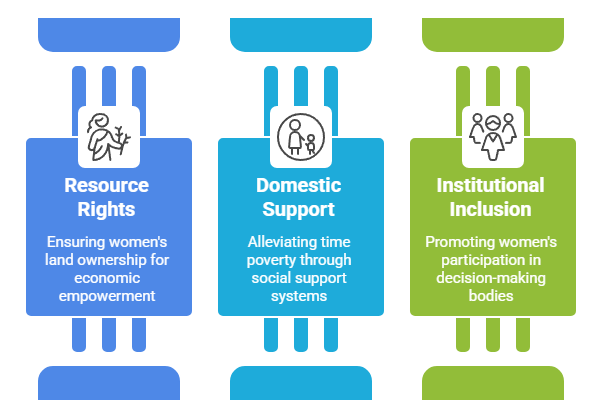
To harness the potential of feminising agriculture, India must transition from a functional dependence on women’s labour to a commitment to their full economic agency. This requires:
- Resource Rights and Reforms: Immediate legislative action to promote and enforce joint or individual land ownership for women. This is the foundation for accessing formal credit and government schemes.
- Addressing the Domestic Double Burden: Implementing measures for Well-being and Social Support, such as mandatory creche facilities near farms and improved rural energy/water infrastructure, to alleviate time poverty.
- Institutional Inclusion: Mandating reservation and ensuring active participation of women in Farmer Producer Organisations (FPOs) and local administrative bodies to counter the historical Omission from Decision-Making.
Ultimately, as sociologists would argue, this is not merely an economic issue but a core issue of social stratification and justice. Granting women full rights and recognition is a prerequisite for achieving genuine, sustainable, and inclusive agrarian development.
|

2 comments