Federalism: Pillar of Democratic Governance and Contemporary Relevance in India

Federalism: Pillar of Democratic Governance and Contemporary Relevance in India

Federalism: Pillar of Democratic Governance and Contemporary Relevance in India

(Relevant for GS paper-2, Federalism)

Introduction

Federalism lies at the heart of India’s constitutional architecture. It is a system of governance that divides powers between a central authority and constituent political units — in India’s case, the Union and the States. Dr. B. R. Ambedkar, the chief architect of India’s Constitution, described the Indian federation as “an indestructible union of destructible states,” balancing unity and diversity. Over the decades, Indian federalism has evolved significantly, adapting to dynamic political, social, and economic challenges.

Features of Indian Federalism

Features of Indian Federalism

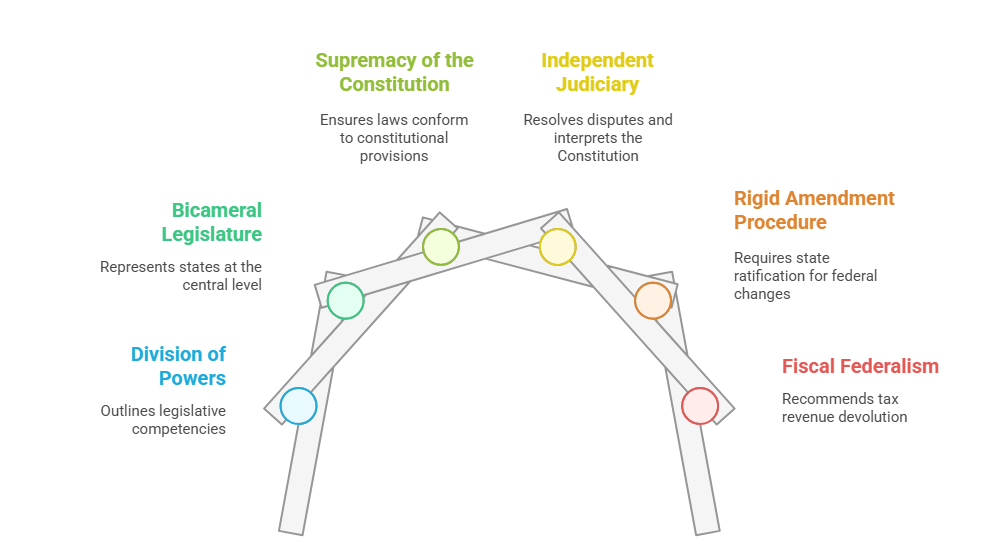
The Indian federal structure combines both federal and unitary characteristics. Its main features include:

  • Division of Powers: The Seventh Schedule of the Constitution outlines the Union, State, and Concurrent Lists that demarcate legislative competencies.
  • Bicameral Legislature: The Rajya Sabha (Upper House) provides representation to states at the central level.
  • Supremacy of the Constitution: The Constitution is the supreme law, and all laws must conform to its provisions.
  • Independent Judiciary: The Supreme Court acts as the final interpreter of the Constitution, resolving center-state disputes.
  • Rigid Constitutional Amendment Procedure: Under Article 368, amendments affecting the federal structure require ratification by at least half of the states.
  • Fiscal Federalism: Constitutionally instituted Finance Commissions recommend the devolution of tax revenues between the Centre and states, maintaining fiscal balance.

Current Status of Fiscal Federalism in India

The 15th Finance Commission (2021-26) recommended vertical tax devolution at 41% — one of the most generous shares ever given to states. However, there are growing concerns about shrinking fiscal autonomy.
GST (Goods and Services Tax), introduced in 2017 as “One Nation, One Tax,” increased cooperative federalism but also made states dependent on the GST Council for indirect tax decisions. Post the expiry of GST compensation to states in June 2022, states fear a decrease in revenue.
Meanwhile, the Union Government continues to control substantial surcharges and cesses that do not form part of the divisible tax pool. According to RBI data for 2023-24, surcharges and cesses accounted for nearly 18% of Gross Tax Revenue, bypassing the states’ share and raising questions about fiscal justice in India’s federal setup.

Challenges to Indian Federalism

Challenges to Indian Federalism

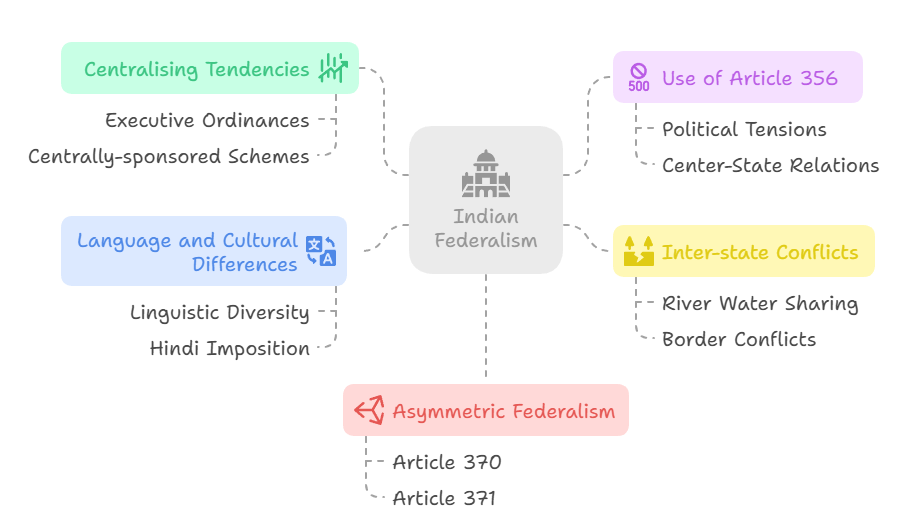
Despite its constitutional strength, Indian federalism faces multiple challenges:

  1. Centralising Tendencies:

The Union Government increasingly resorts to executive ordinances and centrally-sponsored schemes, reducing states’ policy space. Examples include the imposition of agricultural reform laws in 2020-21, which led to widespread protests by farmers, especially in Punjab and Haryana.

  1. Use of Article 356:

Although Supreme Court judgments like S.R. Bommai v. Union of India (1994) have restricted its misuse, Article 356 (President’s Rule) continues to be invoked in politically tense states, often igniting debates on center-state relations.

  1. Inter-state Conflicts:

Issues like river water sharing (e.g., Cauvery dispute between Tamil Nadu and Karnataka, Mahadayi between Goa and Karnataka) and border conflicts highlight the need for cooperative solutions.

  1. Language and Cultural Differences:

Linguistic diversity — with 22 officially recognized languages and hundreds of dialects — is a testament to India’s pluralism but also a cause for occasional friction, evident in debates around Hindi imposition.

  1. Asymmetric Federalism and Special Provisions:

Article 370 (now effectively abrogated in Jammu & Kashmir) and special status under Article 371 for certain North-Eastern states show asymmetry in Indian federalism. These measures often generate debates over the uniformity of the federal structure.

Strengthening Cooperative Federalism

Despite these challenges, India has also witnessed a growing emphasis on cooperative federalism — a partnership model that fosters dialogue and negotiation between the Centre and states:

  • NITI Aayog: Established in 2015 to replace the Planning Commission, NITI Aayog promotes cooperative and competitive federalism by engaging states in policy-making.
  • Goods and Services Tax (GST) Council: A constitutional body (Article 279A) that embodies cooperative decision-making between the Centre and states on tax matters.
  • Inter-State Council: Established under Article 263, the council acts as a forum for resolving inter-state conflicts and strengthening center-state collaboration.

Additionally, the success of central schemes like Swachh Bharat Abhiyan and the Jal Jeevan Mission depends on effective state-level implementation — underscoring the need for cooperative governance.

Judicial Interpretation and Landmark Judgments

The Supreme Court of India has played a pivotal role in protecting federalism. Some notable judgments that shaped Indian federalism include:

  • S.R. Bommai v. Union of India (1994) — curtailed arbitrary use of Article 356.
  • Kesavananda Bharati v. State of Kerala (1973) — upheld the federal structure as part of the Constitution’s basic structure.
  • State of West Bengal v. Union of India (1963) — recognized the legal autonomy of states.

Contemporary Developments Impacting Federalism

Contemporary Developments Impacting Federalism

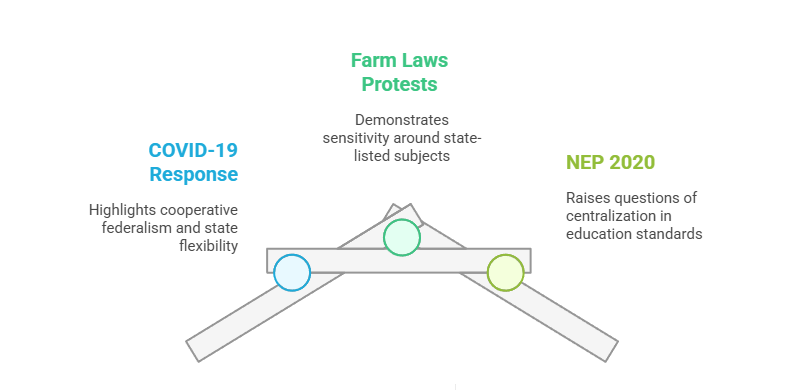
Some recent trends and policies reflect the evolving face of Indian federalism:

  • COVID-19 Response: The pandemic highlighted cooperative federalism as states and the Centre coordinated policies. However, different states adopted diverse lockdowns, containment measures, and vaccine strategies, showcasing flexibility.
  • Farm Laws Protests (2020-21): Farmers, mainly from Punjab and Haryana, protested against central farm laws passed without substantial state consultations. These laws were eventually repealed, underlining the sensitivity around subjects under the State List.
  • NEP 2020: The National Education Policy, while progressive, raised questions of centralization as it introduced standards across the states.

Way Forward

For Indian federalism to thrive, continuous dialogue, mutual respect, and adherence to constitutional spirit are critical. Steps to enhance fiscal transfers, greater autonomy to states under centrally sponsored schemes, and regular functioning of the Inter-State Council can help address center-state tensions.
Further, states must also focus on transparent governance, better utilization of devolved funds, and inter-state cooperation on shared challenges like pollution, water management, and industrial policy.

Conclusion

Federalism in India is dynamic — shaped by its diverse socio-cultural fabric and complex political landscape. Recent challenges such as the COVID-19 pandemic, fiscal constraints, agricultural protests, and inter-state disputes underline the need for robust cooperative federalism. Going forward, a balance between national interests and regional aspirations will ensure the resilience of Indian democracy and help preserve the spirit of federalism enshrined in the Constitution.

To Read more topicsvisit: www.triumphias.com/blogs

Read more Blogs:

Empowering Startups for a Stronger India | Sociology Optional Coaching | Vikash Ranjan Classes | Triumph IAS | UPSC Sociology Optional

Ground Water Crises in India | Sociology Optional Coaching | Vikash Ranjan Classes | Triumph IAS | UPSC Sociology Optional

One comment

Leave a Reply

Your email address will not be published. Required fields are marked *