

Faith, Privacy, and the Self: The Supreme Court’s Moral Turn in Defending Religious Autonomy
(Relevant for Sociology Paper 1: Religion and Society)
|
In a landmark ruling, the Supreme Court of India has reaffirmed that the freedom of religion under Article 25 and the right to privacy under Article 21 are not separate silos of constitutional liberty but two facets of the same moral universe. The judgment, delivered while reviewing provisions of the Uttar Pradesh Prohibition of Unlawful Conversion of Religion Act, reimagines religious freedom as a deeply personal and private domain—shielded from the coercive gaze of the state. By declaring privacy a “condition precedent” to the exercise of faith, the Court has not merely expanded the zone of liberty under Article 21 but also redefined the social meaning of religion in India’s democracy—from a collective identity to an individual conscience. The Constitutional Core: When Faith Becomes a Private RightArticle 25 of the Constitution guarantees the freedom of conscience and the right to profess, practice, and propagate religion—subject to public order, morality, and health. Article 21, which protects life and personal liberty, has over time been interpreted to include the right to privacy—first in Justice K.S. Puttaswamy (Retd.) v. Union of India (2017) and later reinforced in Navtej Johar (2018) and Joseph Shine (2019). The present judgment fuses these two doctrines. It argues that belief is born within the private sphere of conscience, and any forced disclosure, prior approval, or surveillance of religious conversion amounts to a violation of that inner sanctum. The state, it observes, may prevent coercion or fraud, but it cannot demand justification for faith. This reasoning resonates with Shafin Jahan v. Asokan K.M. (2018), where the Supreme Court restored a woman’s right to choose her faith and partner, rejecting the paternalistic notion that the state—or even family—could act as moral guardian. In short, the Court affirms that to believe is to be free, and that freedom is meaningless without privacy. The Sociological Dimension: Religion as an Inner Space
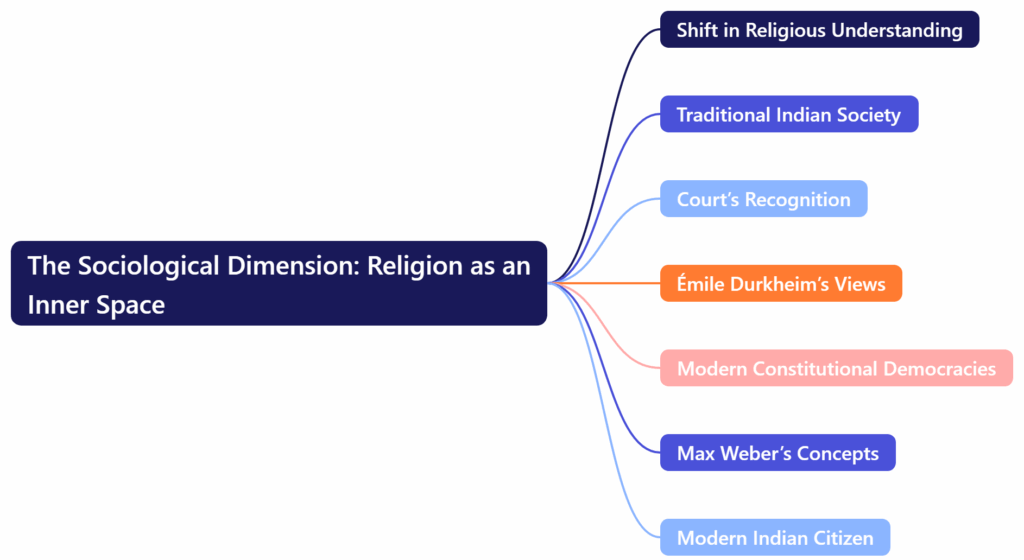
Sociologically, this verdict represents a crucial shift from religion as a public institution to religion as a private experience. In traditional Indian society, religion has functioned as a collective identity marker, shaping caste hierarchies, community boundaries, and social belonging. The Court’s recognition of faith as a private matter disrupts this communitarian model by foregrounding individual conscience over collective control. Here, Émile Durkheim’s distinction between the sacred and the profane becomes relevant. For Durkheim, religion binds communities through shared rituals and norms. But in modern constitutional democracies, the sacred is internalized—it resides not in temples or rituals but in the moral autonomy of the self. The Court’s insistence that privacy is integral to belief thus reflects the transition from ritualistic religion to reflective spirituality. Similarly, Max Weber’s idea of inner-worldly asceticism—where individuals rationalize their faith through personal conviction rather than institutional authority—finds resonance here. The modern Indian citizen, the Court implies, must be free to engage in this moral self-definition without state interference. The Political Paradox: State Power vs. Spiritual Autonomy
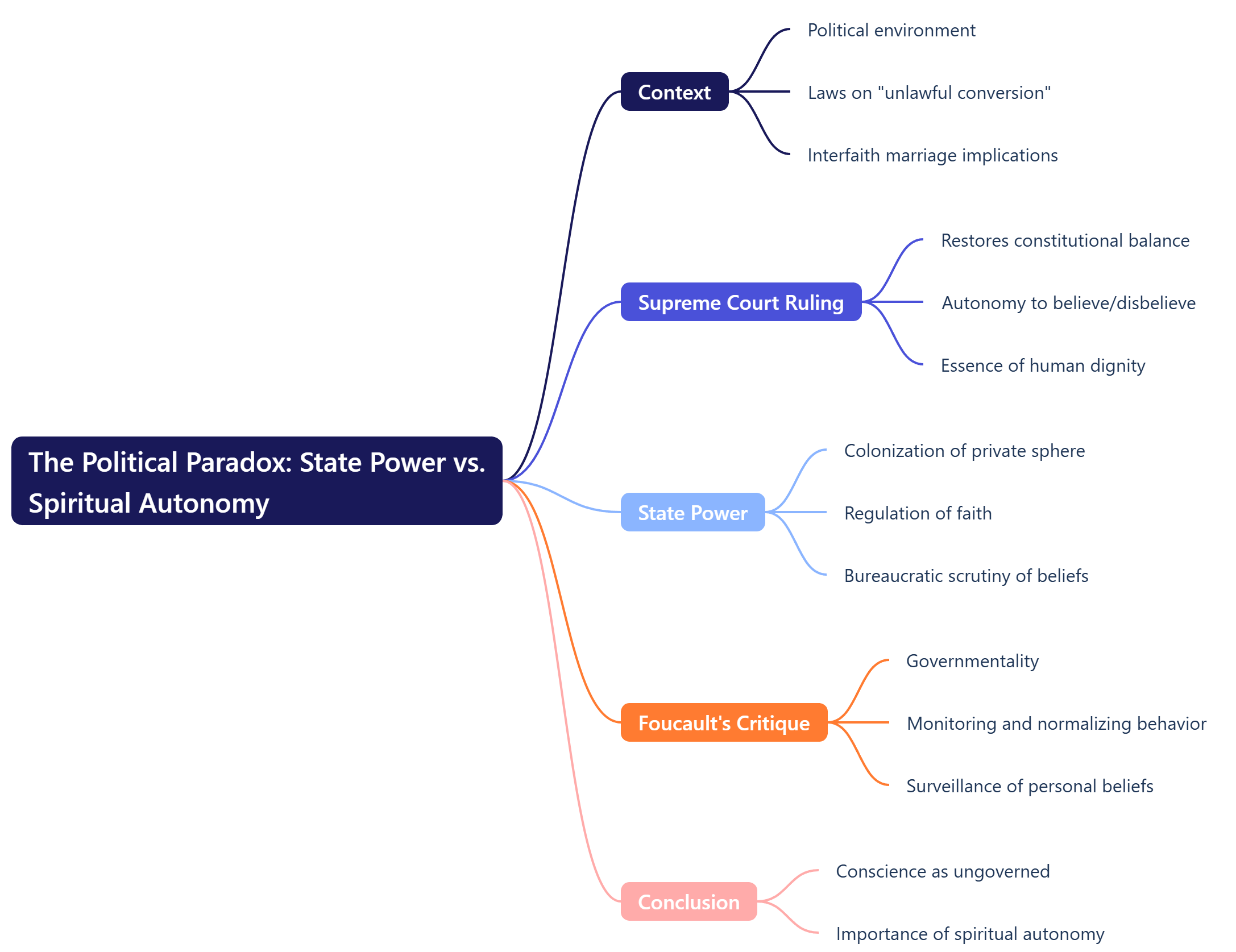
The judgment arrives in a politically charged context. Several state laws on “unlawful conversion” mandate prior notice to district authorities or seek to criminalize interfaith marriages alleged to involve “forced” conversions. While such laws claim to protect vulnerable groups, they often invert the logic of protection by subjecting personal belief to bureaucratic scrutiny. The Supreme Court’s ruling restores constitutional balance by recognizing that the autonomy to believe—or disbelieve—is the essence of human dignity. In doing so, it challenges the tendency of the modern state to colonize the private sphere, turning faith into an object of regulation. This idea finds echo in Michel Foucault’s critique of governmentality—the subtle ways in which power operates by monitoring and normalizing personal behavior. When the state demands disclosure of religious conversion, it extends its surveillance into the most intimate zone of selfhood. The Court, by contrast, insists that conscience must remain ungoverned. Interlinking Rights: Speech, Belief, and IdentityThe judgment also implicitly ties Article 19(1)(a)—freedom of speech and expression—to this matrix. The freedom to express one’s religion necessarily includes the freedom to withhold or conceal it. Just as the right to free expression includes the right to silence, the right to faith includes the right to spiritual privacy. This reasoning is consistent with global constitutional thought. The European Court of Human Rights, in Kokkinakis v. Greece (1993), held that “freedom of thought, conscience, and religion is one of the foundations of a democratic society.” By echoing this sentiment, India’s Supreme Court situates itself within the evolving global jurisprudence that sees personal belief as an aspect of informational self-determination. The Sociological Stakes: Modernity, Pluralism, and ToleranceAt a deeper level, this judgment is not merely about religion or privacy—it is about what kind of moral community India aspires to be. In a society where identity is often collective and coercive, the Court’s vision defends pluralism through individual moral autonomy. By making faith a matter of choice rather than inheritance, the Court strengthens social mobility and moral modernity. It allows citizens to move across belief systems without fear—replacing community surveillance with personal reflection. This marks a decisive turn from what Dr. B.R. Ambedkar called the “social tyranny of custom” to what he envisioned as liberty of conscience—the true foundation of democracy. Conclusion: The Republic of ConscienceThe Supreme Court’s ruling redefines the architecture of religious freedom. It reminds us that faith and privacy are two sides of the same constitutional coin—both anchored in the idea of human dignity. In a time when public morality often demands conformity and identity is politicized, the judgment restores the moral interiority of the citizen as the ultimate site of liberty. As Justice Chandrachud once observed, “The Constitution exists not to create moral uniformity but to protect moral diversity.” This ruling carries that insight forward—it tells us that in a democracy, the most sacred space is not the temple or mosque, but the conscience of the individual. |
To Read more topics, visit: www.triumphias.com/blogs
Read more Blogs:
Poverty Beyond Numbers: A Sociological Reading of the Updated Rangarajan Poverty Line
Strengthening Rural Growth with Enhanced Agricultural Credit: A Pathway to Inclusive Development
One comment