Introduction
In a country as diverse and culturally rooted as India, the extended family system has long been a hallmark of the social structure. Defined by a network of kin that includes not just parents and children but also grandparents, uncles, aunts, cousins, and in-laws, the extended family plays a central role in shaping social relations, preserving culture, and supporting economic life.
With increasing urbanization, industrialization, individualism, and globalization, this traditional family structure is witnessing transformation. However, it continues to remain relevant in various forms, especially in rural India and among business communities. Analysing the extended family through theoretical frameworks and sociological lenses provides deep insight into social change in Indian society.
What is an Extended Family?
An extended family is a family unit that extends beyond the nuclear household, comprising three or more generations and often including horizontal kin such as siblings and cousins. In Indian sociology, this often aligns with the joint family system, a social arrangement where co-residence, shared property, and collective decision-making are common.
This structure is typically patriarchal, with property and authority vested in the eldest male member. The family is not just a residential and economic unit but also a religious, emotional, and cultural hub for its members.
Sociological Analysis
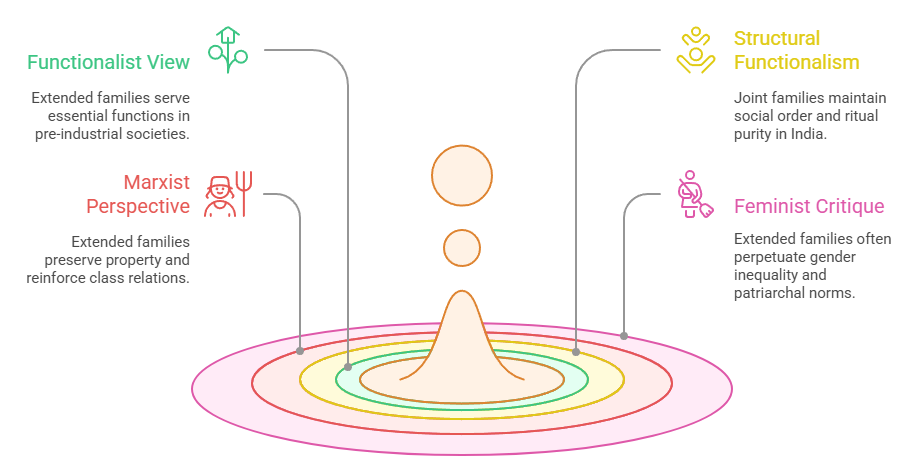
- Functionalist Perspective: Talcott Parsons argued that the nuclear family evolved in response to the needs of industrial societies. However, in pre-industrial and agrarian contexts, extended families served essential functions such as economic cooperation, education, socialization, and care for the elderly.
- Structural Functionalism in India: Indian sociologist M.N. Srinivas highlighted the significance of joint families in maintaining ritual purity, social order, and caste solidarity. He saw extended families as adaptive and responsive to socio-economic changes.
- Marxist View: From a Marxist perspective, extended families are seen as units that preserve property and reinforce class relations, especially in agrarian economies. They are responsible for maintaining patriarchal and capitalist structures.
- Feminist Critique: Feminist scholars argue that the extended family often becomes a site of gender inequality, where women’s labor is exploited, and patriarchal norms are enforced. Leela Dube and Patricia Uberoi have highlighted how women, particularly daughters-in-law, face subordination within joint households.
Importance of Extended Family in Indian Society
- Emotional and Social Security: Extended families provide a strong emotional support system, especially for children, women, and the elderly. The shared network allows for care in illness, support during crises, and mental well-being through companionship and interdependence.
- Economic Cooperation: Especially in rural areas, extended families act as units of production and consumption. Collective farming, business ownership, and household labor division are sustained through shared responsibilities and pooled resources.
- Child-Rearing and Value Transmission: Elders in extended families play a vital role in the socialization process, transmitting cultural values, traditions, language, and religious practices to younger generations. Grandparents often become primary caregivers in dual-income households.
- Elder Care: In the absence of robust public welfare systems, extended families bear the burden of elderly care, offering dignity, companionship, and basic needs to aging members.
Transformation of Extended Families in Contemporary India
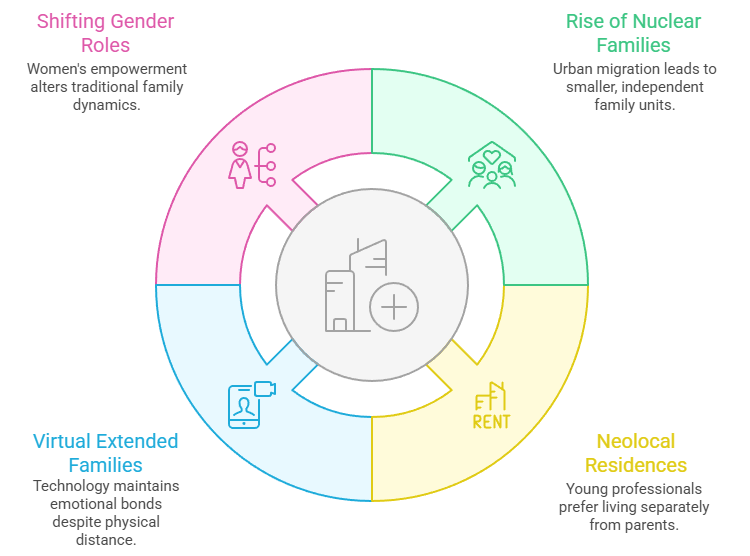
- Impact of Urbanization and Migration: As families migrate to urban areas for employment, housing limitations and lifestyle changes lead to the rise of nuclear families. This physical separation often weakens the influence and day-to-day involvement of the extended family.
- Rise of Individualism and Career Aspirations: With growing emphasis on personal space, autonomy, and career mobility, younger generations increasingly prefer neolocal residences, especially in urban middle-class settings. This has changed the nature of family obligations.
- Role of Technology: While the traditional joint family setup may decline physically, digital platforms like WhatsApp, Zoom, and video calls have helped maintain emotional bonds, creating a virtual extended family experience.
- Changing Gender Roles: Women’s increasing participation in the workforce has led to a shift in power dynamics, enabling more egalitarian structures or encouraging women to move out of traditional households that restrict autonomy.
Case Studies and Examples
- Matrilineal Extended Families – The Nairs of Kerala
The Nair community traditionally followed matriliny, where property was passed through the mother’s line, and the maternal uncle had authority. Though now in decline, it represents an alternative model of extended family.
- Marwari and Chettiar Business Families
In communities like the Marwaris of Rajasthan and Chettiars of Tamil Nadu, extended families are instrumental in maintaining economic continuity across generations. Business is often family-owned, and trust is reinforced through kinship.
- COVID-19 Pandemic and Return to Extended Families
During the 2020 lockdown, mass return of urban migrants to their villages revived extended family living. The family acted as a resilient support system, offering housing, food security, and emotional strength during crises.
Contemporary Data and Trends
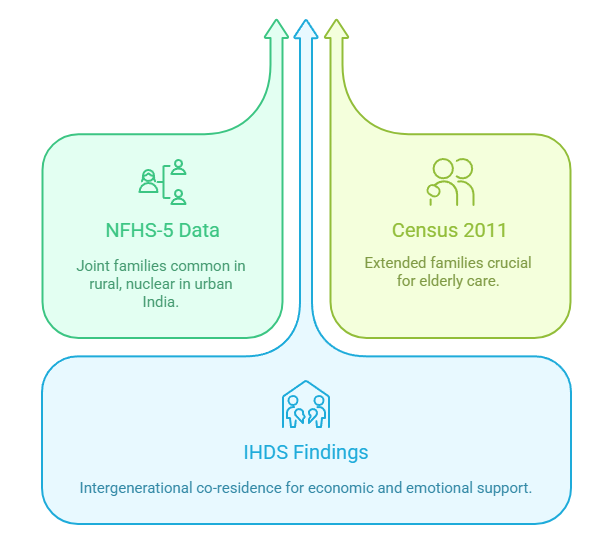
- According to NFHS-5 (2019-21), joint or extended families continue to be common in rural India, while nuclear families are dominant in urban India.
- Census 2011 showed that over 70% of elderly people lived with extended families, highlighting their role in elder care.
- The India Human Development Survey (IHDS) indicates that intergenerational co-residence still holds significance for economic and emotional reasons.
Government Schemes and Social Impact
- National Social Assistance Programme (NSAP) and Indira Gandhi National Old Age Pension Scheme reduce pressure on families for elder care.
- Pradhan Mantri Awas Yojana (PMAY) promotes independent housing, indirectly pushing nuclear setups.
- ICDS, Mid-Day Meal Scheme, and MGNREGA support extended family households in rural areas.
Way Forward and Policy Suggestions
- Recognize extended family as social capital in rural development and welfare schemes.
- Promote intergenerational dialogue through community centers and NGOs.
- Encourage gender-sensitive reforms in inheritance and property rights.
- Support technology-enabled virtual kinship networks to bridge geographical gaps.
- Introduce elder care infrastructure that works in tandem with family support.
Conclusion
While the structure and functions of the extended family in India are undergoing significant transformations, it remains deeply embedded in the cultural, emotional, and economic life of Indian society. From providing a resilient safety net during crises to being a vehicle for cultural reproduction, the extended family continues to adapt and evolve. Understanding the nuances of extended family systems—through theoretical frameworks, empirical data, and contemporary examples—offers valuable insights into the broader patterns of social change, kinship, and community life in India.
PYQs
Paper 1
- Examine the factors responsible for the changing structure of family in modern societies. (2023)
- What is the relevance of the functionalist perspective in understanding the changes in the institution of family in contemporary societies? (2022)
- Evaluate the role of family in the process of socialization in both traditional and modern societies. (2021)
- Discuss the impact of urbanization and industrialization on the structure and functions of family. (2020)
- Explain how feminist perspectives critique the family as a patriarchal institution. (2019)
- Differentiate between nuclear family and joint family. Is the joint family disintegrating or transforming in the contemporary Indian context? (2018)
- Examine the role of kinship in maintaining family ties in modern society. (2016)
- Discuss the relevance of descent and alliance theory in the understanding of kinship systems. (2017)
Paper 2
- Evaluate the changes in the institution of family under the influence of globalization in India. (2021)
- Has the joint family system retained its structure and function in modern India? Explain with suitable examples. (2020)
- How far do you agree that the contemporary Indian family is undergoing structural changes? Substantiate your answer with sociological insights. (2019)
- How has women’s education and employment contributed to the transformation of the Indian family? (2018)
- Explain the features and persistence of matrilineal kinship systems in certain parts of India. (2017)
- Examine how caste and kinship play a role in determining family and marriage patterns in India. (2016)
- Discuss the impact of legislation and social reforms on the institution of family and marriage in India. (2015)
- Examine the interface between family, caste, and community in rural India. (2014)
|

One comment