Introduction: Exposure to Pornographyand Online Safety
The Children’s Commissioner for England’s 2025 report has revealed a worrying trend: children’s exposure to online pornography has actually increased since the Online Safety Act 2023 was passed. Despite new rules meant to safeguard young people, children as young as six years old are being exposed to explicit and often violent sexual content.
This finding raises critical questions for policymakers, educators, and sociologists alike. How effective are legal frameworks in protecting children online? Why are accidental exposures so high? What impact does this have on young people’s socialization, gender attitudes, and future relationships?
This blog explores the sociological analysis of children’s online porn exposure, linking the findings of the report with theories of deviance, media influence, gender socialization, and digital sociology.
Key Findings of the Report
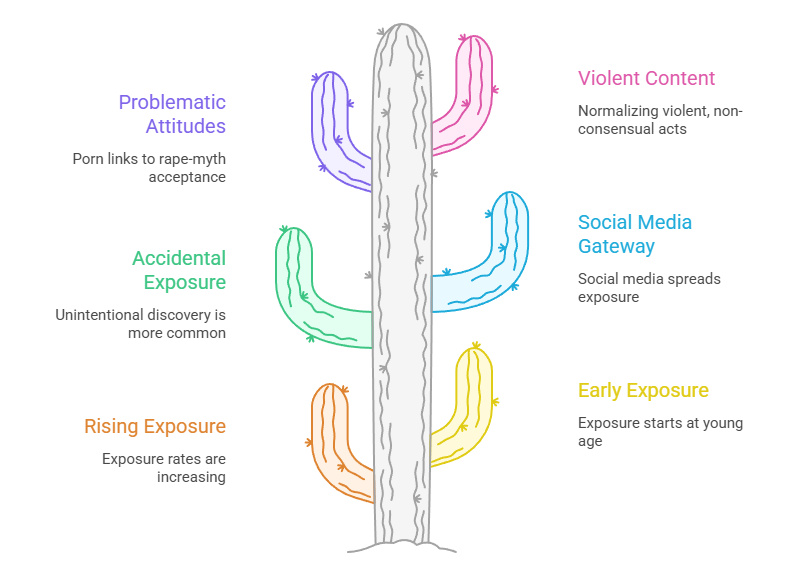
- Rising exposure despite new law: 70% of young people reported seeing porn before turning 18 in 2025, compared to 64% in 2023.
- Early exposure: More than 27% saw porn by the age of 11, with some reporting exposure as early as six years old.
- Accidental over intentional exposure: 59% came across pornography unintentionally, a sharp increase from 38% in 2023.
- Social media as a gateway: Networking sites like X (formerly Twitter) now outpace dedicated porn sites as the main source of exposure.
- Problematic attitudes: Nearly half of respondents (44%) agreed with the statement, “Girls may say no at first but then can be persuaded to have sex,” showing a link between porn exposure and rape-myth acceptance.
- Violent content normalization: More than half (58%) had seen depictions of strangulation, and many had viewed content showing non-consensual acts.
Why Laws Alone Aren’t Enough
- The Online Safety Act 2023 aimed to make porn sites implement strict age verification. While this did lead to a 47% drop in Pornhub traffic in the UK, children simply shifted to other platforms.
- This highlights a key sociological issue: structural gaps in digital governance. The law regulates porn sites, but social media algorithms and networking platforms remain powerful forces in content circulation. Children don’t have to search; explicit content is pushed to them.
- This aligns with Ulrich Beck’s “Risk Society” thesis—modern risks, unlike traditional ones, are global, invisible, and often unintended by-product of technology. The unintended effect of digital openness is children’s vulnerability to harmful media.
Sociological Analysis
- Socialization and Gender Norms
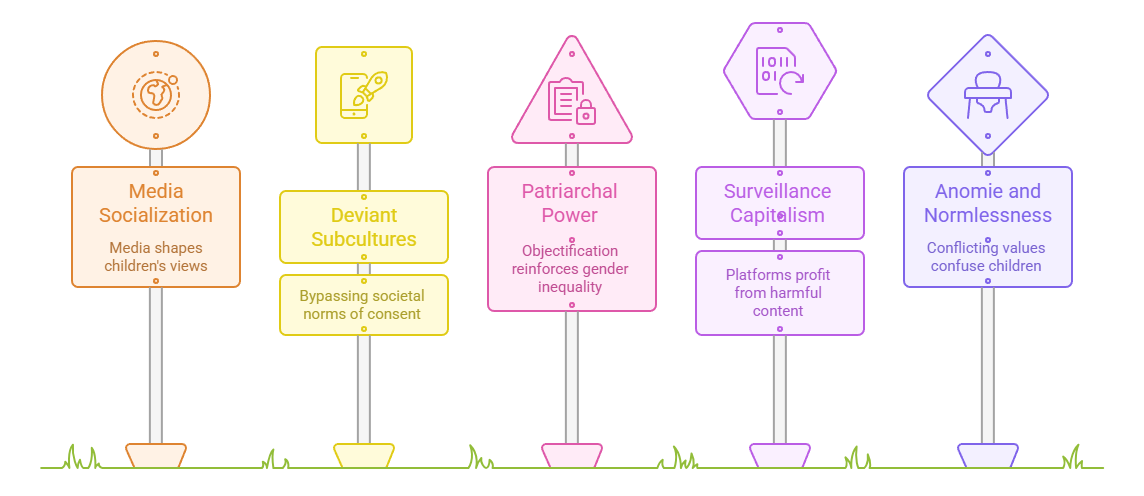
Pornography is becoming a hidden agent of socialization, shaping how children learn about sex, consent, and relationships.
- Talcott Parsons saw family and school as primary socializers, but in the digital age, media has become a powerful parallel socializer.
- The normalization of violent porn encourages toxic masculinity and acceptance of coercion in relationships.
- Deviance and Media
From a Robert Merton strain theory perspective, pornography can be seen as part of deviant subcultures that bypass societal norms of sex and consent. Its easy accessibility creates a blurred line between mainstream and deviant content.
- Feminist Sociology
Feminist scholars argue pornography often objectifies women and reinforces patriarchal power relations. The survey finding that many girls believe they can be “persuaded” into sex shows internalization of such norms.
- Andrea Dworkin and Catherine MacKinnon famously critiqued pornography as institutionalized subordination of women.
- The exposure of children to these scripts makes the cycle of gender inequality stronger.
- Digital Sociology
Children’s digital lives are shaped by algorithms, not just by choice. As sociologist Shoshana Zuboff’s concept of “surveillance capitalism” explains, platforms profit by maximizing engagement, even if that means exposing children to harmful sexual content.
- Merton’s Anomie and Normlessness
When societal rules about sexuality are weak or inconsistent, children face anomie—a state of confusion about norms. The clash between what schools teach (consent, respect) and what online pornography shows (violence, coercion) leaves children vulnerable to conflicting values.
Vulnerable Children at Higher Risk
- The report also shows that children from marginalized backgrounds—those on free school meals, with disabilities, or in care—were more likely to be exposed to porn earlier.
- This ties into Pierre Bourdieu’s concept of social capital: children with fewer protective networks and parental supervision are more exposed to risks. The digital divide is not only about access but also about unequal exposure to online harm.
Impact on Youth Behavior and Beliefs
- Normalization of Violence: High exposure to violent porn desensitizes children, leading to acceptance of abusive practices.
- Consent Misunderstood: With 44% accepting coercive narratives, pornography undermines education around consent.
- Mental Health Issues: Early exposure is linked with anxiety, guilt, and distorted body image.
- Distorted Sexual Scripts: Children may adopt unrealistic expectations about relationships and intimacy.
The Way Forward
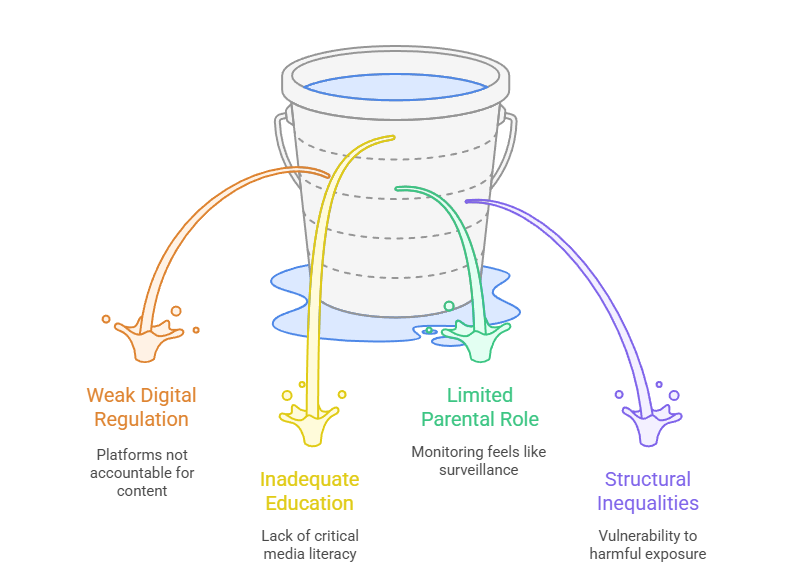
- Strengthening Digital Regulation: The Online Safety Act should not stop at porn websites alone. Social media platforms, where most accidental exposure happens, must also be held accountable for harmful content promoted through algorithms. Stronger monitoring and heavy penalties for non-compliance are needed to make children’s safety a non-negotiable priority.
- Education and Awareness: Schools must go beyond basic sex education and implement the Relationships, Health and Sex Education (RHSE) curriculum in a practical way. Teaching children critical media literacy—how to question and decode harmful sexual messages online—will empower them to resist negative influences.
- Parental and Community Role: Parents play a crucial role in monitoring digital use without making it feel like surveillance. Open conversations about internet risks can reduce stigma and secrecy. Community-based awareness programs can also help families deal with these challenges collectively rather than in isolation.
- Sociological Interventions: Sociologists highlight the need to address the structural inequalities—like class, disability, and gender—that make some children more vulnerable to harmful exposure. Policies and interventions should be designed keeping these social factors in mind, ensuring that solutions are inclusive and not one-size-fits-all.
Conclusion
The Children’s Commissioner’s report shows that laws alone cannot shield children from online pornography. Exposure is accidental, widespread, and often violent. From a sociological perspective, this is not just a legal issue but one tied to socialization, patriarchy, deviance, and digital capitalism.
Protecting children requires multi-layered interventions—effective laws, ethical tech design, media literacy education, and parental guidance. Otherwise, we risk allowing a generation to grow up with distorted ideas about sex, consent, and relationships.
As sociologists remind us, technology is not neutral. The values embedded in media content shape society itself. If children’s online spaces normalize violence and objectification, those patterns will inevitably spill into real-world gender relations and social behavior.
|


2 comments