Introduction
Urban planning is meant to create inclusive, sustainable, and efficient spaces for all. However, in practice, urban exclusion—the systematic marginalization of certain social groups from the benefits of city development—is a recurring reality, especially in a rapidly urbanizing country like India.
Whether its slum evictions, lack of access to basic amenities, or gentrification pushing the poor to city margins, exclusion in urban planning deepens social inequality, fosters spatial segregation, and marginalizes vulnerable communities.
What is Exclusion in Urban Planning?
Urban exclusion refers to the denial of access to urban resources, spaces, infrastructure, and decision-making processes to marginalized populations. This occurs due to:
- Socio-economic status (e.g., informal workers, migrants)
- Caste and religion (e.g., Dalits, Muslims)
- Gender (e.g., lack of women-friendly infrastructure)
- Disability (e.g., absence of inclusive architecture)
While master plans and “smart city” projects claim to be universal, urban planning often privileges the elite, formal sector, and capitalist interests—further entrenching spatial inequality.
Recent Trends and Data
- As per Census 2011, 377 million people live in urban areas—projected to rise to 600 million by 2030.
- NITI Aayog reports that over 25% of India’s urban population lives in slums or informal settlements.
- The Delhi Master Plan 2041 and Smart Cities Mission have faced criticism for being exclusionary towards the urban poor, especially informal workers and slum dwellers.
- In 2023, multiple court-led demolitions (g., Tughlakabad and Khori Gaon in Delhi) displaced thousands without adequate resettlement, sparking a debate on forced evictions and urban cleansing.
Major Forms of Urban Exclusion
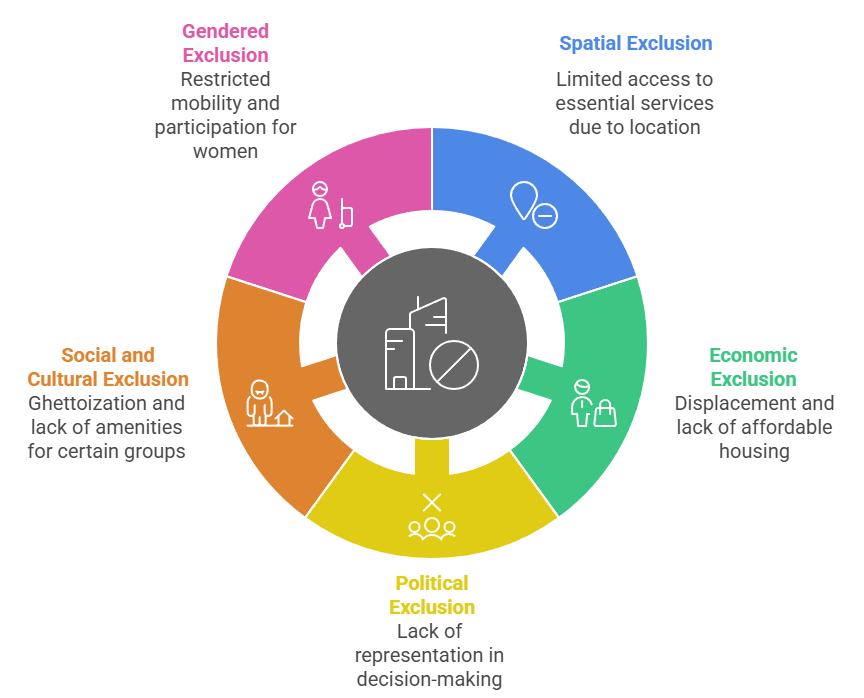
- Spatial Exclusion
- Slums and informal settlements are pushed to city peripheries.
- Example: Mumbai’s Dharavi vs. South Mumbai’s luxury apartments.
- Result: Denial of access to transportation, healthcare, education.
- Economic Exclusion
- Urban plans focus on middle and upper-class needs: malls, highways, gated communities.
- Street vendors, hawkers, and informal workers face displacement.
- No provision for affordable housing or rental regulation.
- Political Exclusion
- Urban poor lack representation in planning bodies.
- Decisions are technocratic and top-down.
- Smart Cities Mission has minimal community consultation.
- Social and Cultural Exclusion
- Certain caste and religious groups face ghettoization.
- Example: Muslim localities in Gujarat post-2002 riots still lack civic amenities.
- Gendered Exclusion
- Public transport, public toilets, street lighting often ignores women’s needs.
- Women’s mobility and participation in urban economy is restricted.
Sociological Analysis
- Marxist Perspective
Urban planning reflects class conflict and capitalism. According to David Harvey, cities are shaped by the logic of capital accumulation—resulting in spatial inequalities and displacement of the working class for real estate interests.
Example: SEZs, luxury infrastructure projects displace poor communities to make way for profit-driven development.
- Henri Lefebvre’s Right to the City
Lefebvre argues that every citizen has a right to inhabit, use, and participate in shaping urban spaces. In India, however, this right is largely denied to slum dwellers, migrants, and informal workers.
- Pierre Bourdieu’s Social Capital
Marginalized communities lack social and cultural capital to influence decision-making or access elite neighborhoods—leading to reproduction of urban inequality.
- Gentrification Theory
Urban beautification often leads to gentrification—where poor populations are displaced to make way for wealthier residents. Example: The redevelopment of Bandra Kurla Complex in Mumbai.
- Castro’s Urban Marginality
Loïc Wacquant and Teresa Caldeira discuss how urban segregation and criminalization of poverty create permanent exclusion zones—seen in India’s treatment of migrant laborers and beggars.
Government Policies and Their Pitfalls
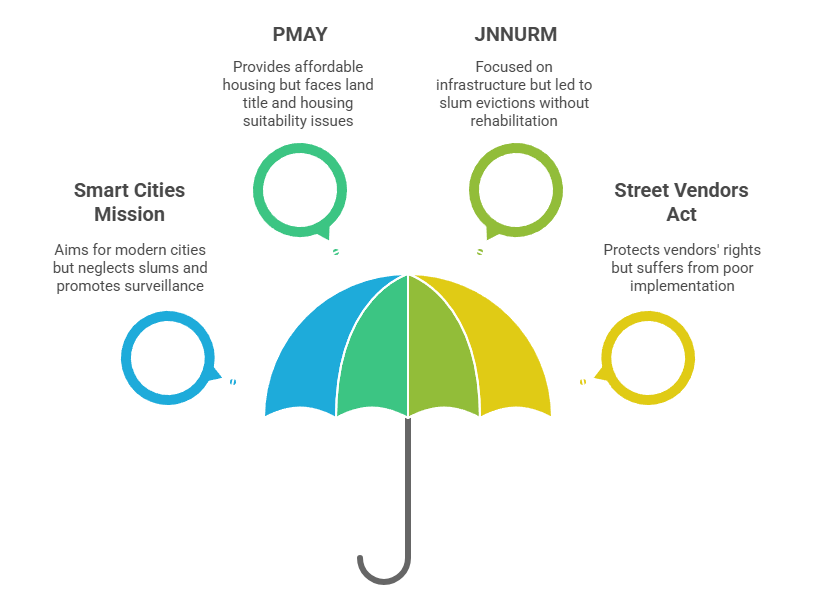
1. Smart Cities Mission:
Aims to create 100 modern cities using technology.
Criticized for:
- Neglecting slums
- Promoting privatized, surveillance-heavy models
- Ignoring participatory planning
2. PMAY – Pradhan Mantri Awas Yojana:
Provides affordable housing, but:
- Many eligible poor lack land titles
- Women-headed households are underrepresented
- Often promotes vertical housing unsuitable for informal workers
3. JNNURM (Jawaharlal Nehru National Urban Renewal Mission):
Focused on infrastructure, but its urban renewal approach led to many slum evictions without proper rehabilitation.
4. Street Vendors Act, 2014:
Protects vendors’ rights but poor implementation in cities like Delhi and Bangalore leads to continued harassment and exclusion.
Constitutional and Legal Dimensions
- Article 21: Right to life includes the right to housing and livelihood.
- Article 15 and 16: Prohibit discrimination.
- National Urban Policy Framework (NUPF) 2018 recognizes inclusivity but lacks legal backing.
- Judicial pronouncements like Olga Tellis vs. Bombay Municipal Corporation (1985) affirm the right to shelter for the poor.
Case Studies:
- Delhi’s Khori Gaon Demolition (2021)
- Over 1,000 homes bulldozed citing forest encroachment.
- No proper resettlement; loss of school access, jobs.
- Violates UN’s Basic Principles on Development-Based Evictions.
- Ahmedabad’s Riverfront Project
- Sabarmati Riverfront beautification displaced over 14,000 families.
- Gated communities benefited while slums were relocated far from work zones.
- Bangalore’s Lake Encroachments and Evictions
- Evictions often target poor settlements near lakes, while elite violators escape scrutiny.
Consequences of Urban Exclusion
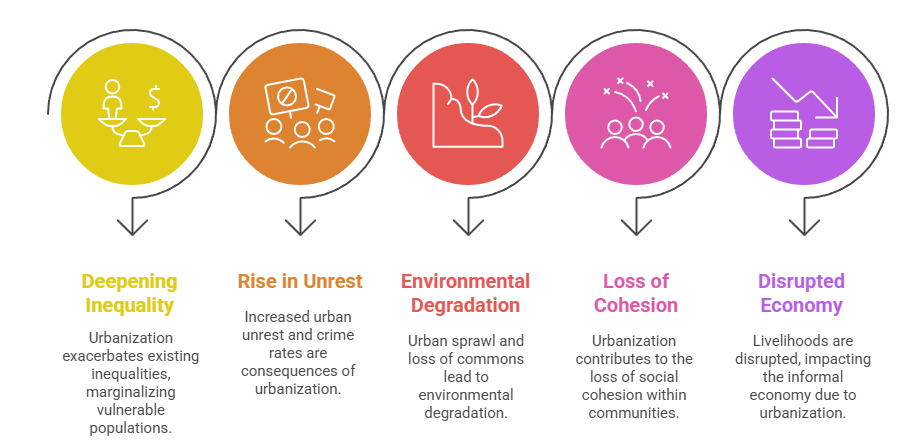
- Deepening inequality and marginalization
- Rise in urban unrest and crime
- Environmental degradation (urban sprawl, loss of commons)
- Loss of social cohesion
- Disruption of livelihoods and informal economy
Way Forward:
- Participatory Governance: Involve community groups, women’s collectives, street vendors, slum associations in planning.
- Affordable Housing and Tenure Rights: Recognize informal settlements; provide land tenure, services, legal recognition.
- Inclusive Urban Design: Gender-sensitive transport, universal access architecture, inclusive zoning.
- Urban Employment and Livelihood Planning: Recognize the role of informal sector in urban economy and Provide skill development, market access, and social security.
- Judicial Oversight and Accountability: Strengthen RTI, public interest litigation (PILs), and monitoring of resettlement policies.
Conclusion
Exclusion in urban planning is not just a failure of policy—it is a structural injustice rooted in unequal access to resources, power, and representation. As India urbanizes further, sociologically informed and inclusive urban governance must replace technocratic, top-down planning.
A just city is not one with gleaming skylines and smart infrastructure, but one where every citizen—rich or poor, male or female, Dalit or Muslim—has a stake and space in its future.
PYQs
Paper 1:
- How does the structure of urban space reinforce class and caste divisions? (2018)
- Discuss the role of space and planning in the reproduction of social inequality in cities. (2021)
- Explain the concept of the ‘Right to the City’ in the context of global urbanization. (2022)
Paper 2:
- Discuss the relevance of participatory urban planning for inclusive development. (2016)
- Evaluate the impact of urban development policies on the informal sector in Indian cities. (2017)
- How does spatial segregation reflect socio-religious exclusion in Indian cities? (2020)
|



One comment