India–EU Relations
The India–European Union strategic partnership is evolving rapidly, underscored by decisive diplomatic, economic, and security milestones in 2025. As both cater to global governance and multi-alignment strategies, a strengthened bilateral relationship carries profound significance for India’s UPSC-level understanding of international affairs.
Trade & Economics: Free Trade Agreement (FTA) on the Horizon
A major breakthrough is the nearing India–EU Free Trade Agreement (FTA). After two decades of negotiations, optimism is high:
- May 12–16, 2025: The 11th round of talks in New Delhi concluded five key chapters—intellectual property, customs, and trade facilitation—signalling momentum.
- June 16, 2025: PM Modi expressed strong confidence that the FTA would be finalised by end‑2025, concurrent with progress on the India–Middle East–Europe Corridor (IMEC).
- Commerce Minister Piyush Goyal echoed this optimism, indicating that the agreement could be concluded even sooner .
Upon enactment, the FTA would reduce tariffs, expand market access, align regulatory standards, and cement the EU’s position as India’s top trading partner—currently worth over US $130 billion (2023–24).
Challenges Ahead:
- The EU’s Carbon Border Adjustment Mechanism (CBAM) could levy tariffs on Indian steel and aluminium unless compliance is ensured.
- Reluctance around stringent agriculture/environmental safeguards and data privacy harmonisation remain sticking points.
Trade & Technology Council (TTC): A Digital Alliance Blueprint

First launched in April 2022, the India–EU Trade & Technology Council (TTC) convened its second ministerial meeting on 28 February 2025 in New Delhi, yielding impressive outcomes:
- Digital Governance & Strategic Tech:
- Commitment to interoperable digital public infrastructures (DPIs), recognized e‑signatures, and global digital trade facilitation.
- Joint R&D in AI (especially large language models), high-performance computing, 6G, semiconductor supply-chain resilience, backed by EU‑India 6G Alliance MoU.
- Green & Clean Energy Collaboration:
- EU‑India mobilize approx. €60 million for battery recycling R&D, e‑vehicle charging standards, marine plastic management, and renewable hydrogen projects .
- Aligned with India’s net-zero by 2070 and EU’s 2050 carbon-neutral goals
- Resilient Value Chains:
- Collaborative frameworks for agricultural resilience, API (Active Pharmaceutical Ingredient) supply, and clean-tech value chain stability, addressing disruptions from CBAM and WTO reform
These efforts establish a robust digital, green, and economic infrastructure for a future-ready strategic alliance.
Strategic Cooperation: Security, Defence & Maritime
India–EU security ties have been strengthening:
- The EU Indo‑Pacific Strategy (ESIWA+) and designation of a liaison officer at India’s Information Fusion Centre in Gurugram highlight maritime cooperation
- Counter-terrorism cooperation is amplified by dialogue and intelligence sharing—Bolstered by India–EU condemnation of the June Pahalgam terrorist attack
- The first joint naval exercise in the Gulf of Guinea (Oct 2023) underscores the partnership’s growing naval footprint
- Recent discussions are exploring a defence & security cooperation agreement, with possible Indian entry into PESCO (Permanent Structured Cooperation) under a Security of Information Agreement
- June 2025: At the India–Cyprus summit, Modi announced cooperation in maritime security, cybersecurity, and defense-industrial partnerships—including enhanced naval visits and maritime training
This multi-domain integration positions the India–EU partnership as a unified security pillar in the Indo‑Pacific and beyond.
IMEC – New Geopolitical & Economic Corridor
The proposed India–Middle East–Europe Corridor (IMEC) has gained renewed attention:
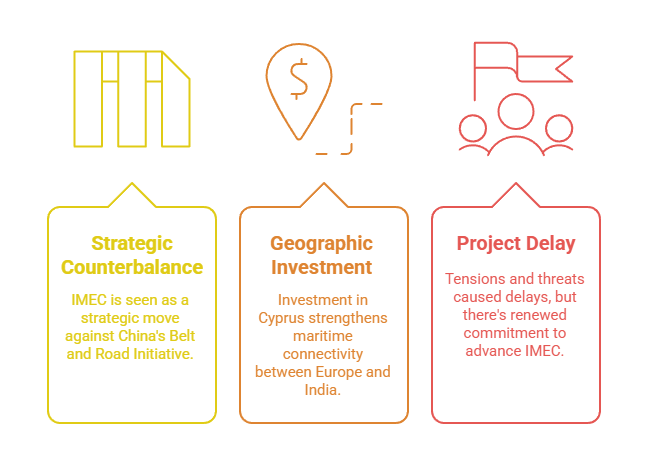
- Delhi and Brussels view IMEC as a strategic counterbalance to China’s Belt and Road Initiative, a multimodal corridor via the Middle East to Europe.
- Geographic investment in Cyprus as a EU-transshipment hub reinforces Europe–India maritime connectivity
- Tensions in the Gaza blockade and Houthi threats delayed IMEC, but renewed political will in June 2025 aims to advance the project
IMEC’s success would advance trade diversification, regional stability, energy security, and India–EU connectivity objectives.
Science & Energy: Green Tech, Space & Innovation
India–EU engagements go beyond trade:
- Green Transition: The EU‑India Green Hydrogen Cooperation Initiative spearheads joint pilot projects and EIB’s €1 billion funding commitment towards India’s hydrogen future.
- Circular Economy: Collaborations on battery recycling and e‑vehicle infrastructure reflect deep commitment to sustainable industrial ecosystems .
- Space Partnerships: Multiple joint missions underscore high trust:
- ISRO launched the EU’s PROBA‑3 satellite (Dec 2024).
- Joint endeavours spanning Chandrayaan‑3, Aditya‑L1, and Gaganyaan
The quadruple focus on green energy, AI, clean tech, and space signifies an advanced, future-centric collaborative vision.
People-to-People & Mobility
Human capital remains a cornerstone:
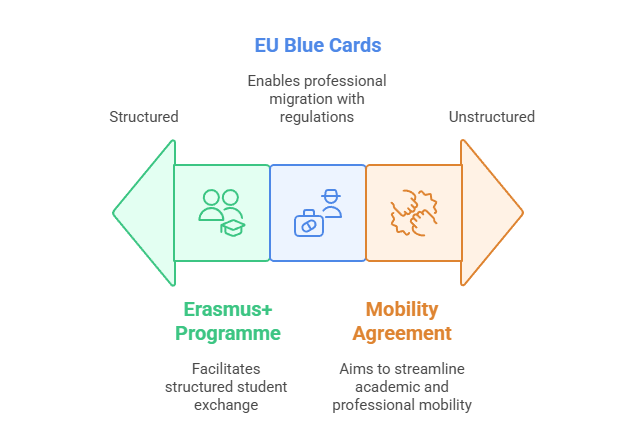
- The Erasmus+ programme has benefited over 6,000 Indian students, while >2,700 have participated in Marie Sklodowska-Curie fellowships
- Indian professionals secured ~20 % of EU Blue Cards (2023–24), though visa and regulatory impediments remain a challenge
- Calls are growing for an Mobility & Migration Partnership Agreement (MMPA) to streamline academic and professional mobility.
Enhanced educational, research, and skill exchanges nurture the strategic and people-focused depth of India–EU ties.
Strategic Autonomy & Global Governance
- In a shifting geopolitical order marked by new Weimar+ and Readiness 2030 EU strategic initiatives, India—champion of multi-alignment—finds a kindred framework in EU strategic autonomy
- Both seek to bolster multilateral institutions (UN, WTO, G20), advocating rules-based global order .
- A defense cooperation framework in areas like PESCO, OCCAR, and shared Indo-Pacific engagement signals convergence in strategic objectives
Road Ahead: Challenges & Opportunities
| Challenge |
Opportunity |
| FTA roadblocks: CBAM, data adequacy, intellectual property, labour/environment issues |
Resilient FTA: Regulatory harmonisation, sustainable trade, GI recognition |
| Defense integration: Sensitive negotiations needed for security accords |
Deep security partnership through PESCO, joint naval missions, cyber cooperation |
| Mobility gaps: Visa barriers limit academic & professional flows |
MMPA & Blue Card enhancements to foster human capital |
| Geopolitical alignment: India’s neutrality vs EU’s stances on Russia‑Ukraine raise tensions |
Strategic autonomy push fosters independent cooperation without dependency |
Strategic Imperatives:
- Finalise the FTA by end‑2025, balancing market access with sustainable and regulatory safeguards.
- Leverage the TTC roadmap to coordinate future priorities in digital, tech, green energy, and supply‑chain resilience.
- Secure a defence and security agreement, participating in EU programs while protecting sovereign interests.
- Implement visa and mobility reforms via MMPA or Blue Card alignment.
- Greenlight core infrastructure and connectivity hubs in IMEC, especially through Cyprus and Mediterranean logistics.
Conclusion
India–EU engagement today transcends transactional diplomacy, forming a comprehensive strategic partnership. Anchored in economic integration, digital innovation, energy transition, and strategic solidarity, it aligns seamlessly with UPSC themes on foreign policy, global governance, and technology diplomacy. Provided challenges are addressed, 2025–26 could herald a definitive shift in India’s global strategy through a mature and multi-faceted EU partnership.
|


The blog insightfully captures the growing strategic depth of India–EU relations, especially with the FTA negotiations and the launch of the Trade & Technology Council. It would be interesting to see how these developments shape India’s broader pursuit of strategic autonomy while balancing ties with other global powers. The mention of IMEC also adds a timely layer to understanding shifting geopolitical alignments.