Ethnic Conflicts, Communalism & Identity Politics | Sociology UPSC Notes

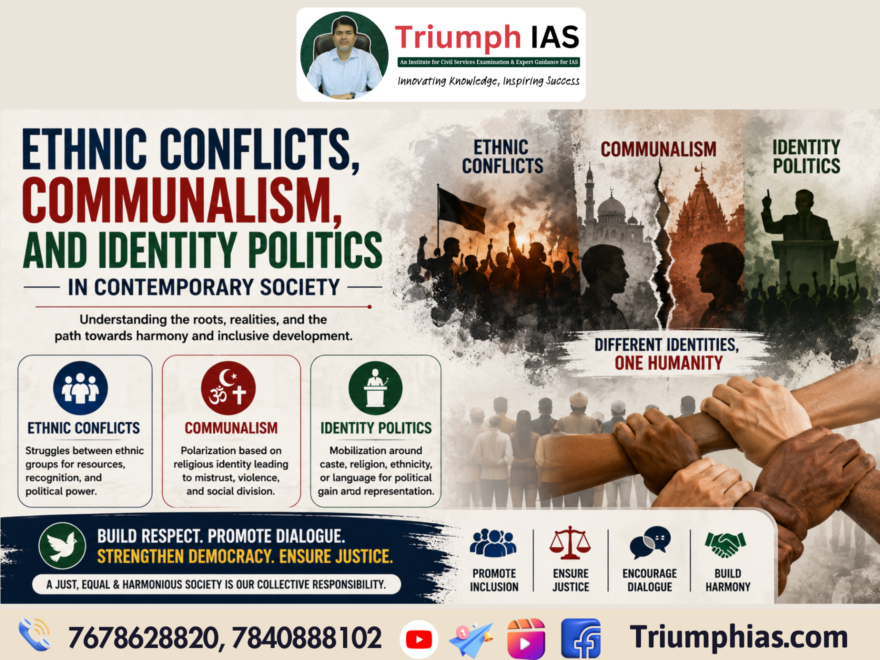
Ethnic Conflicts, Communalism, and Identity Politics in Contemporary Society

Relevant for Sociology Optional Paper 1, Paper 2, and GS Paper I (Indian Society)

Introduction

Contemporary societies are characterized by increasing cultural diversity, migration, political mobilization, and competing claims over identity and resources. While diversity enriches societies, differences based on ethnicity, religion, language, and culture can sometimes become sources of conflict and social division. Ethnic conflicts, communalism, and identity politics represent significant challenges to social cohesion, democratic values, and national integration.

Sociology examines these phenomena not as inevitable outcomes of cultural differences but as products of historical processes, political interests, unequal distribution of resources, and struggles for recognition and power. Understanding the social roots of identity-based conflicts is essential for creating inclusive and pluralistic societies.

Understanding Ethnic Conflicts: Competition, Identity, and Resources

Ethnicity refers to a shared sense of identity based on common ancestry, language, culture, history, or territorial association. Ethnic conflicts arise when groups perceive threats to their identity, political representation, economic opportunities, or cultural rights.

From the conflict perspective, social tensions emerge due to competition over scarce resources, unequal access to power, and struggles between dominant and subordinate groups. Modernization, migration, globalization, and changing political structures often transform ethnic identities into instruments of collective mobilization.

Sociologists argue that ethnic identities are socially constructed and continuously shaped by historical experiences and contemporary political circumstances. Therefore, ethnic conflicts are not simply ancient rivalries but are often linked with issues of inequality, discrimination, and exclusion.

Communalism as a Social and Political Phenomenon

Communalism refers to the politicization of religious identities where members of different religious communities perceive their interests as fundamentally opposed to each other. It transforms religious differences into social and political divisions, often resulting in prejudice, discrimination, and collective conflicts.

From a sociological perspective, communalism develops through historical narratives, political mobilization, economic insecurities, and social polarization. It is sustained by stereotypes, misinformation, and the construction of the “other” as a perceived threat.

Theories of social identity explain how individuals derive self-esteem and belonging from group memberships, sometimes leading to in-group favoritism and out-group hostility. Therefore, promoting inter-group dialogue and inclusive institutions becomes essential for maintaining social harmony.

Identity Politics and the Politics of Recognition

Identity politics refers to political mobilization based on shared identities such as ethnicity, religion, caste, gender, region, or language. In contemporary democratic societies, identity-based movements have become important tools for marginalized communities to demand representation, dignity, and social justice.

The philosopher Charles Taylor emphasized the politics of recognition, arguing that recognition of cultural identities is essential for individual dignity and social equality. Similarly, multicultural perspectives support the accommodation of diverse identities within democratic societies.

However, identity politics also has complex consequences. While it can empower historically disadvantaged groups, excessive politicization of identities may intensify social fragmentation, group rivalries, and collective antagonism.

Globalization, Media, and Emerging Forms of Polarisation

Globalization and digital communication have transformed the nature of identity-based conflicts. Social media platforms provide spaces for marginalized voices and democratic participation but can also facilitate misinformation, hate speech, and the rapid spread of divisive narratives.

Economic inequalities, migration, and cultural anxieties in the era of globalization have contributed to the resurgence of ethnic nationalism and identity-based political movements in many societies.

A sociological understanding highlights the need to balance cultural recognition with universal democratic principles of equality, citizenship, and social justice.

Conclusion

Ethnic conflicts, communalism, and identity politics reveal the complex relationship between diversity, power, and social change in contemporary societies. These phenomena are not merely cultural disagreements but are connected with historical grievances, social inequalities, political mobilization, and struggles for recognition.

A democratic and inclusive society requires strengthening constitutional values, promoting intercultural dialogue, reducing inequalities, and creating institutions that respect diversity while maintaining social solidarity. The challenge is to transform identity from a source of conflict into a foundation for pluralism and peaceful coexistence.

UPSC Civil Services (Mains) Question

Q. “Ethnic conflicts and communalism are not simply expressions of cultural differences but manifestations of struggles over identity, recognition, resources, and power.” Critically examine the statement with suitable sociological perspectives. (250 Words)

To Read more topicsvisit: www.triumphias.com/blogs

Read more Blogs:

Caste Conflicts and Social Polarisation in Contemporary society

Water disputes between States in federal India – Triumph IAS & Vikash Ranjan Sir


🔥 YOUR FINAL UPSC RANK CAN BE DECIDED BY JUST TWO PAPERS — ESSAY & OPTIONAL!

Most aspirants study hard.
But very few know how to convert knowledge into MARKS.

That’s where Triumph IAS creates the difference. 🚀

✍️ EMTS – Essay Mentorship & Test Series (CSE Mains 2026–27)

Under the mentorship of Vikash Ranjan Sir, master the art of writing structured, philosophical, multidimensional, and topper-level essays.

Scientific Essay Writing Approach
Knowledge Matrix Framework
5 Exclusive Essay Approach Classes
2 Thematic Tests + 4 UPSC Mock Tests
Detailed Model Essay Hints
Flexible Writing & Discussion Sessions
Personal 1-to-1 Mentorship

🏆 Trusted by UPSC Essay Toppers
━━━━━━━━━━━━━━━━━━

📚 SMTS – Sociology Mentorship & Test Series + Quick Revision Session (QRS)

🎯 SCORE 300+ MARKS IN SOCIOLOGY OPTIONAL

A structured, analytical, and result-oriented mentorship program designed to maximize your Sociology score under the guidance of Vikash Ranjan Sir.

Program Highlights:

26 Full-Length Tests with Detailed Evaluation
PYQ–NYQ Trend Analysis
Quick Revision Sessions on Unconventional Questions
Brainstorming & Concept Enrichment Sessions
1-to-1 Personal Mentorship Discussions
Topic-wise Answer Writing Practice
Current Social Issues Compilation
Home-based Practice Tests with Model Hints
Thinkers Integration & Value Addition Notes
Essay & GS Enrichment through Sociology

  • 🏆 Legacy of High Scores Continues:
  • 🌟 G.R. Raghavendra, IPS – 318
  • 🌟 Medha Anand, IAS – 310
  • 🌟 Sandesh Jain, IPS – 309
  • 🌟 Gauravjeet Singh, IPS – 309
  • 🌟 Deepanshu Khurana, IFS – 303
  • 🌟 Pradeep Singh, IAS – 302
  • 🌟 Swati Sharma, IAS – 296
  • 🌟 Gunjita Agarwal, IAS – 295

…and many more successful aspirants.

━━━━━━━━━━━━━━━━━

Batch Starts: 01 June

  • 📍 Available in OFFLINE & ONLINE Mode
  • 📞 Call/WhatsApp: 7678628820 | 7840888102
  • 🌐 triumphias.com
  • 📍 Triumph IAS
  • 23-B, 3rd Floor, Pusa Road
  • Near Karol Bagh Metro Pillar No. 114, New Delhi
EMTS – Essay Mentorship & Test Series (CSE Mains 2026–27)


Leave a Reply

Your email address will not be published. Required fields are marked *