Introduction: Empowering Women Farmers
In a historic move, the United Nations General Assembly has designated 2026 as the International Year of the Woman Farmer. This landmark resolution, supported by over 100 nations, recognizes the pivotal role women play in agriculture—contributing to nearly half of the world’s food production. Yet, women farmers face persistent challenges such as lack of property rights, limited market access, and gender-based discrimination. As the world gears up to celebrate the International Year of the Woman Farmer, it is crucial to focus on empowering women in agriculture to achieve food security, sustainable development, and gender equality.
Why Women Farmers Matter
- Global Impact: Women account for 43% of the agricultural workforce in developing countries, and their contributions are critical for food production, processing, and distribution (FAO).
- In India: Women perform over 60% of the agricultural work, especially in sowing, transplanting, weeding, and harvesting, but own less than 13% of land.
- Food Security: Empowering women in agriculture directly improves household nutrition, food security, and poverty reduction—key priorities for SDG 2 (Zero Hunger) and SDG 5 (Gender Equality).
Sociological Analysis
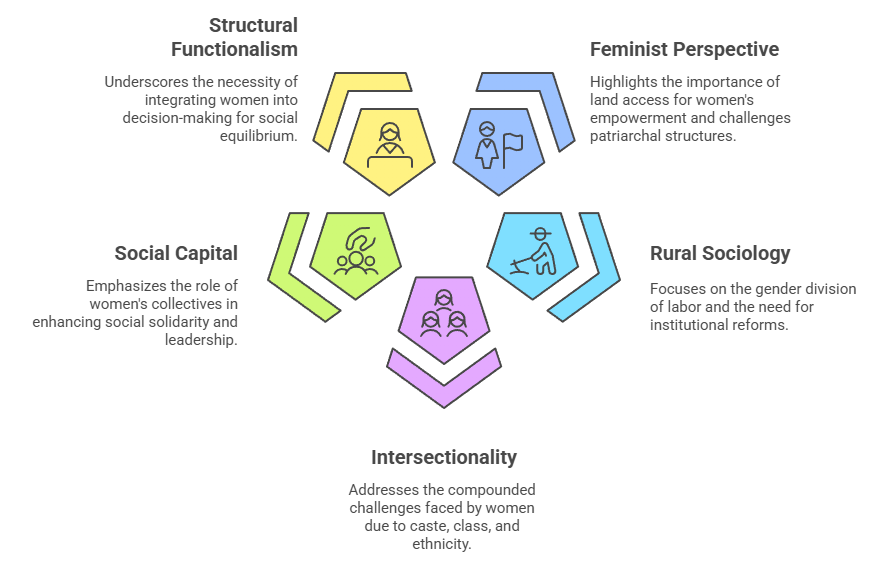
- Feminist Perspective: Scholars like Bina Agarwal argue that access to land is central to women’s empowerment and bargaining position within the family and community. Patriarchy, as a structural barrier, must be addressed for real change.
- Rural Sociology: The gender division of labor in agriculture reinforces traditional gender roles. Women’s agency remains suppressed unless institutional reforms are implemented.
- Intersectionality: Rural women’s challenges are compounded by caste, class, and ethnicity, as seen in India’s Dalit and Adivasi communities.
- Social Capital: Women’s collectives (e.g., Self Help Groups) enhance social solidarity, bargaining power, and create new leadership opportunities for rural women.
- Structural Functionalism: According to Emile Durkheim, the integration of women into decision-making roles in agriculture is essential for social equilibrium and community development.
Key Challenges Faced by Women in Agriculture
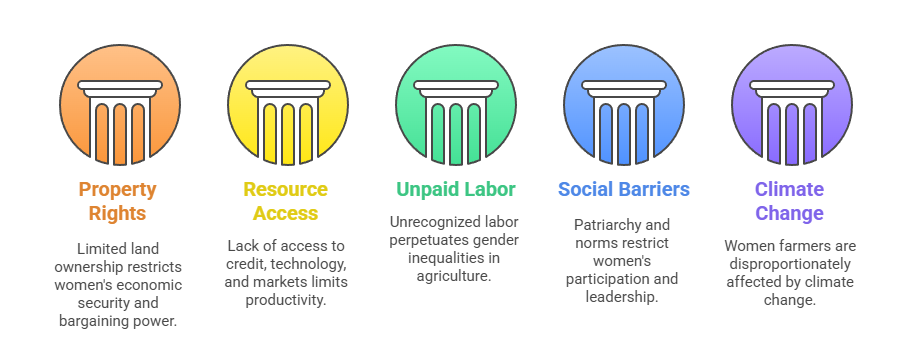
- Property Rights and Land Ownership: Women have limited or no ownership of agricultural land, undermining their bargaining power and economic security. Inheritance laws and patriarchal customs often restrict women’s legal rights to land.
- Access to Resources and Markets: Female farmers receive less than 10% of available credit and only 5% of agricultural extension services. Lack of access to seeds, fertilizers, technology, and formal markets restricts productivity and income.
- Unpaid and Unrecognized Labor: Women’s labor in family farms often goes unpaid and unrecognized in statistics, perpetuating gender-based inequalities.
- Social and Cultural Barriers: Deep-seated patriarchy and social norms restrict women’s mobility, decision-making, and participation in leadership roles within agricultural cooperatives and institutions.
- Exposure to Climate Change: Women farmers, especially in the Global South, are disproportionately affected by climate change due to dependence on rain-fed agriculture and limited adaptive capacity.
From Recognition to Real Empowerment
International Year of the Woman Farmer 2026 is more than a symbolic gesture—it is a call to action. Governments, international organizations, and civil society must:
- Legally empower women through land and property rights.
- Invest in women-centric extension services and credit facilities.
- Mainstream gender in policy and institutional reforms.
- Raise awareness to challenge gender stereotypes and encourage male allies.
Other Pathways to Women’s Empowerment
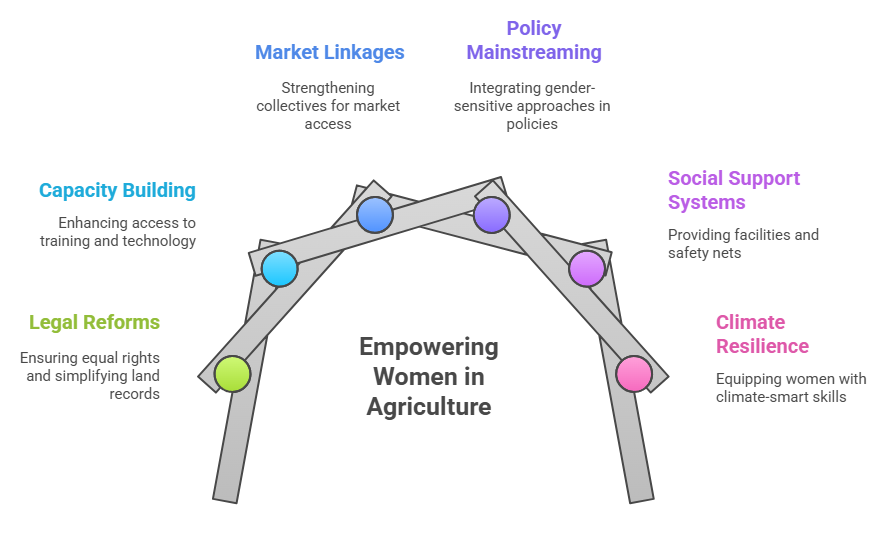
- Legal Reforms: Ensure equal property and inheritance rights for women; digitize and simplify land records.
- Capacity Building: Enhance access to training, technology, and financial services.
- Market Linkages: Strengthen women’s collectives and cooperatives to enable direct market access and better bargaining power.
- Policy Mainstreaming: Integrate gender-sensitive approaches in all agricultural policies and rural development programmes (g., National Rural Livelihoods Mission, Mahila Kisan Sashaktikaran Pariyojana).
- Social Support Systems: Provide crèche facilities, health insurance, and safety nets for women agricultural workers.
- Climate Resilience: Equip women with skills and tools for climate-smart agriculture.
Conclusion
Empowering women in agriculture is not just a matter of justice—it is the cornerstone of global food security and sustainable rural development. The International Year of the Woman Farmer offers a unique opportunity to accelerate gender equality in agriculture, foster social change, and ensure a more equitable and food-secure world. As future policymakers and sociologists, UPSC aspirants must understand and champion these issues for a more inclusive society.
PYQs
Paper 1:
- Examine the intersection of gender and rural class structure in India. How does the feminization of agriculture affect rural society? (2023)
- How do gender roles in agrarian societies impact the division of labour and social mobility? Illustrate with suitable examples. (2021)
- Discuss the changing nature of the family as an institution with reference to rural women’s participation in agricultural work. (2020)
- Critically analyse the role of Self Help Groups (SHGs) in empowering rural women in India. (2018)
- What is ‘feminization of poverty’? Discuss its implications for women in the informal and agrarian sectors in India. (2017)
- Examine how land ownership patterns influence gender relations and power structure in rural India. (2016)
- Discuss the role of women in sustaining food security in rural areas. What are the main obstacles faced by women farmers? (2015)
Paper 2:
- Analyse the impact of agrarian transformation on the status of women in rural India. (2023)
- Discuss the significance of government schemes such as Mahila Kisan Sashaktikaran Pariyojana (MKSP) for gender equality in Indian agriculture. (2022)
- How has the process of globalization affected rural women’s livelihoods and work participation rates in India? (2020)
- Discuss the challenges faced by women in accessing land rights and agricultural credit in contemporary India. (2019)
- Assess the effectiveness of various policies aimed at addressing gender disparity in the agricultural sector of India. (2018)
- Explain the term ‘feminization of agriculture’. What factors have contributed to this phenomenon in India? (2017)
- Evaluate the contribution of women in Green Revolution and post-Green Revolution rural economy. (2016)
- How do caste and gender intersect to shape the experiences of Dalit women agricultural labourers in India? (2015)
|


One comment