Education has long been regarded as the most powerful instrument for individual advancement and social transformation. From Plato’s Academy to modern universities, societies have invested immense faith in education as a means to cultivate reason, productivity, and progress. Yet, the quoted assertion—“Education without values, as useful as it is, seems rather to make a man more clever devil”—poses a profound moral warning. It suggests that education, when stripped of ethical grounding, may sharpen intellect without civilising conscience, enhance capability without humanising purpose. Consequently, instead of nurturing enlightened citizens, such education risks producing individuals who are technically proficient but morally hollow.
Therefore, while acknowledging the undeniable utility of education in developing skills, innovation, and material prosperity, this essay argues that education devoid of values can become socially corrosive. It can empower individuals to exploit rather than serve, dominate rather than empathise, and manipulate rather than uplift. Hence, the true measure of education lies not merely in the accumulation of knowledge but in the cultivation of wisdom, responsibility, and moral restraint.
MAIN BODY:
To begin with, education in its modern form is often conceived as a value-neutral enterprise focused on efficiency, employability, and competitiveness. Scientific knowledge, technological expertise, and managerial skills are treated as instruments that can be applied across contexts. In itself, such instrumental education is immensely useful; it fuels economic growth, technological advancement, and administrative efficiency. However, precisely because it is powerful, education without ethical direction can be dangerously indifferent to consequences.
History provides stark illustrations of this paradox. The architects of genocides, nuclear weapons, and exploitative financial systems were often highly educated individuals. Hannah Arendt’s notion of the “banality of evil” reminds us that technical rationality divorced from moral judgment can facilitate immense harm. Thus, while education enhances one’s capacity to act, it does not automatically refine one’s capacity to judge what ought to be done.
Moreover,when education prioritises instrumental rationality alone, it encourages a mindset where success is measured by outcomes rather than ethics. Max Weber warned of this in his analysis of modernity, where rationalisation leads to an “iron cage” of efficiency devoid of values. In such a system, individuals may become adept at achieving goals without questioning their moral legitimacy.
Consequently, education without values may produce professionals who are excellent engineers but indifferent to environmental destruction, skilled bureaucrats but insensitive to human suffering, or brilliant technocrats who prioritise profit over public good. In this sense, education sharpens intellect while leaving conscience underdeveloped, creating what the quotation metaphorically describes as a “clever devil.”
Philosophically, the distinction between knowledge and wisdom is central to this debate. Socrates famously argued that true knowledge is inseparable from virtue, asserting that an unexamined life is not worth living. Similarly, Indian philosophical traditions emphasise vidya (knowledge) as incomplete without viveka (discernment) and dharma (moral duty). Education, in these traditions, is meant to liberate the self and harmonise individual conduct with cosmic and social order.
However, when education is reduced to information acquisition and skill training, it risks becoming superficial. T.S. Eliot poignantly asked, “Where is the wisdom we have lost in knowledge?” This question underscores the danger of mistaking accumulation of facts for moral maturity. Without reflective and ethical dimensions, education may enable individuals to rationalise immoral actions rather than restrain them.
In the contemporary world, this dilemma has become even more acute due to rapid technological advancement. Artificial intelligence, genetic engineering, surveillance technologies, and financial algorithms are products of advanced education. While they offer immense benefits, they also pose ethical challenges related to privacy, inequality, and human dignity.
Notably, many ethical crises today—data misuse, environmental degradation, corporate fraud—are not caused by ignorance but by educated actors operating within value-deficient frameworks. Thus, the problem is not lack of education but the absence of moral anchoring within education. As a result, intelligence becomes a tool for exploitation rather than emancipation.
Furthermore, education confers power—economic, political, and social. With power comes responsibility, a principle emphasised by thinkers from Aristotle to Mahatma Gandhi. Gandhi explicitly warned that education without character is one of the seven social sins. For him, true education was holistic, integrating head, heart, and hand.
When values are absent, education may reinforce social inequalities rather than challenge them. Elite education, For example:- can be used to perpetuate privilege and marginalise the vulnerable. Pierre Bourdieu’s concept of cultural capital illustrates how education can reproduce domination if not guided by egalitarian values. Thus, education without ethics does not merely fail individuals; it undermines social justice.
In contrast, value-based education seeks to humanise knowledge by embedding empathy, integrity, and social responsibility into learning processes. Values such as honesty, compassion, respect for diversity, and commitment to the common good act as moral compasses guiding the use of knowledge. They ensure that intellectual capability is aligned with humane ends.
Importantly, values do not stifle critical thinking; rather, they provide an ethical framework within which critical thinking operates. A doctor guided by medical ethics, a civil servant committed to constitutional morality, or a scientist mindful of ecological balance exemplifies how values elevate professional competence into public service.
From a democratic perspective, education without values poses serious risks. Democracies depend not merely on informed citizens but on responsible ones. If education produces individuals skilled in argumentation but devoid of respect for truth, tolerance, and pluralism, democratic discourse degenerates into manipulation and polarisation.
The spread of misinformation, hate speech, and ideological extremism often involves educated actors exploiting cognitive skills without ethical restraint. Hence, civic values—constitutionalism, secularism, and social harmony—must be integral to education. Otherwise, education may weaken rather than strengthen democratic culture.
Admittedly, one may argue that education should remain value-neutral to preserve freedom of thought, and that values are subjective or culturally relative. Indeed, indoctrination in the name of values can be dangerous. However, this argument confuses ethical education with moral authoritarianism.
Value-based education need not impose dogma; rather, it can cultivate ethical reasoning, empathy, and critical reflection. Teaching students how to think morally is different from telling them what to think. Universal values such as human dignity, justice, and responsibility are not restrictive; they are enabling principles that allow plural societies to coexist.
Therefore, the challenge before modern societies is not to choose between education and values but to integrate the two. Holistic education recognises that intellectual development and moral growth are mutually reinforcing. UNESCO’s vision of education for the twenty-first century—learning to know, to do, to be, and to live together—captures this integrative approach.
Curricula must include ethics, philosophy, environmental consciousness, and civic education alongside science and technology. Equally important is the role of teachers as moral exemplars and institutions as ethical communities. Without such integration, education risks becoming a sophisticated tool in the hands of morally unanchored individuals.
CONCLUSION:
In conclusion, the assertion that education without values makes a man more clever devil is neither hyperbolic nor anti-intellectual; rather, it is a sober reflection on the moral responsibilities that accompany knowledge. Education undoubtedly enhances human capability, but capability without conscience can be destructive. History, philosophy, and contemporary experience all testify that intelligence divorced from ethics can magnify harm rather than reduce it.
Therefore, the true purpose of education is not merely to produce skilled professionals but to nurture responsible human beings. Values give direction to knowledge, restraint to power, and meaning to progress. Only when education is rooted in ethical wisdom does it fulfil its civilisational role—transforming not just minds, but character; not just individuals, but society itself. In this sense, education with values does not merely prevent the making of “clever devils”; it cultivates enlightened citizens capable of using knowledge in the service of humanity.
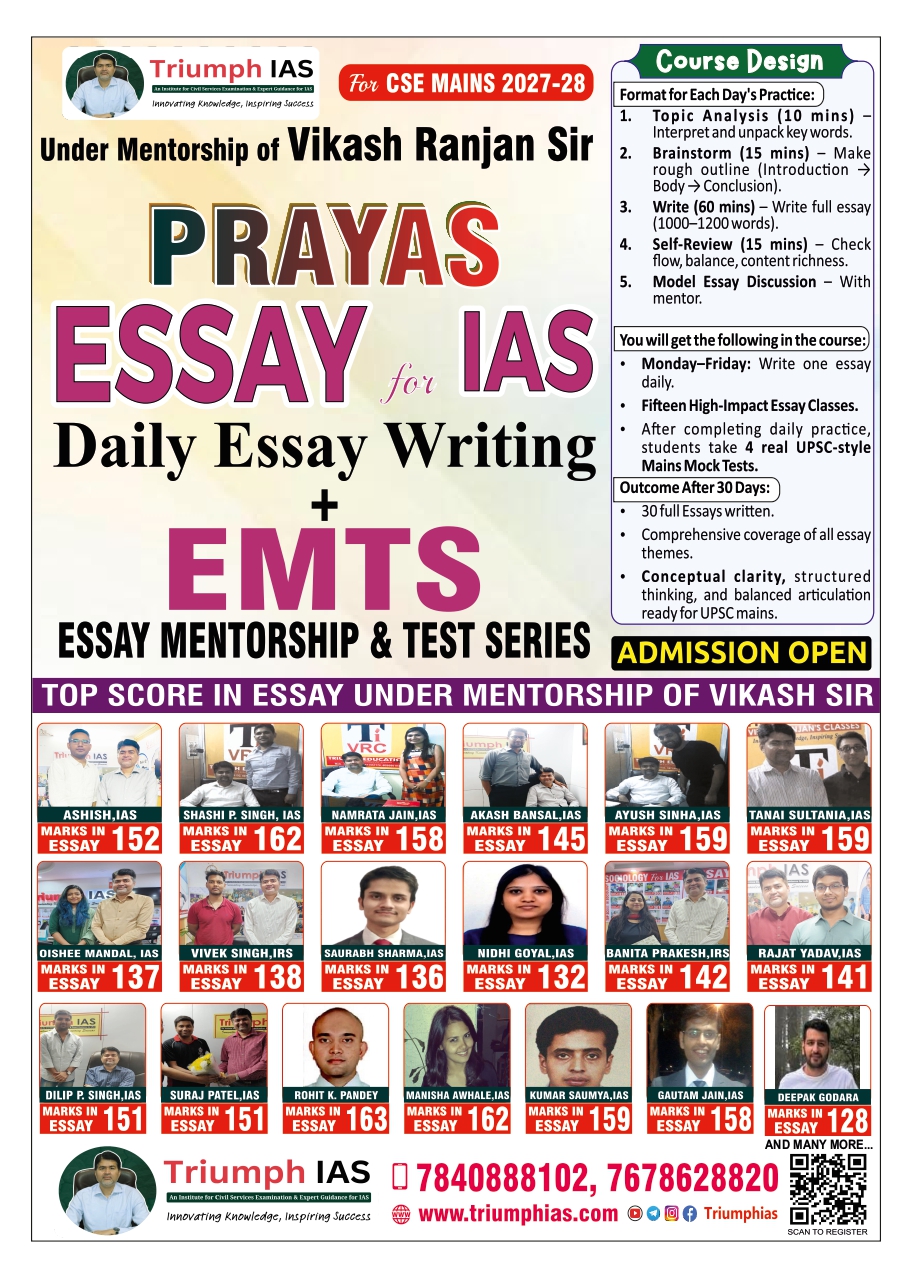
If you’re preparing for the UPSC Civil Services Examination (CSE), one paper that can unlock exceptional scores and a top rank is the Essay Paper. While General Studies and Optional Subjects are structured and syllabus-driven, the Essay writing segment is where individuality, critical thinking, and articulation truly shine.
Among various Essay programs available across India, Triumph IAS, under the expert mentorship of Vikash Ranjan Sir, offers the Best Essay writing Course for UPSC CSE. This comprehensive guide explores what makes this program unparalleled and why it should be part of every serious aspirant’s preparation strategy.



One comment