
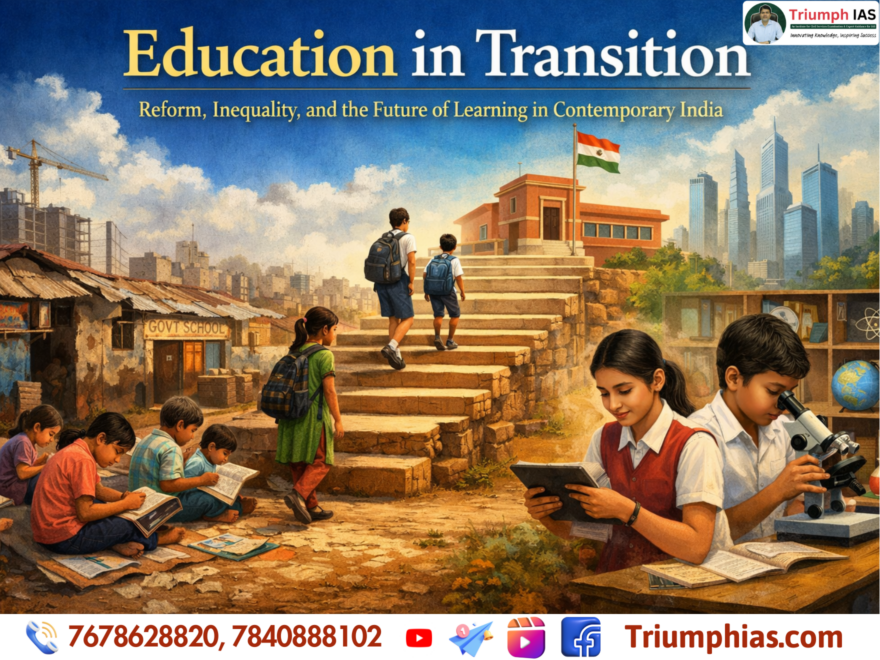
Education in Transition: Reform, Inequality, and the Future of Learning in Contemporary India
(Relevant for Sociology Paper I and II)
|
Education has always been a central pillar of social transformation. In early 2026, education in India stands at a critical juncture, shaped by policy reforms, technological integration, demographic pressures, and persistent inequalities. While the state emphasizes innovation, digital learning, and skill development, deeper structural challenges continue to influence who learns, how learning occurs, and what education ultimately achieves in society. This blog examines education as a current affairs issue, connecting policy developments with sociological, economic, and political dimensions to understand the future of learning in India. Education as a Tool of Social ChangeEducation is not merely about knowledge transmission; it is a powerful instrument of social mobility, nation-building, and economic development. In contemporary India, education policy reflects competing objectives:
These goals often overlap but sometimes contradict one another, creating tensions within the education system. Policy Reforms and Governance of EducationStructural Changes in Education GovernanceRecent years have witnessed a shift in how education is governed. Emphasis has moved toward:
This governance model aims to improve quality and global competitiveness but also raises concerns about regional diversity, linguistic plurality, and local autonomy. Curriculum Reforms and Knowledge PrioritiesCurriculum reforms seek to balance:
While this marks a departure from rote learning, critics argue that curricular choices also reflect ideological priorities, influencing how history, society, and citizenship are taught. Digital Education and Technological TransformationExpansion of Digital LearningTechnology has become integral to education delivery. Online platforms, digital classrooms, and AI-based tools are increasingly common in schools and universities. Key advantages include:
However, these benefits are unevenly distributed. The Digital Divide in EducationOne of the most pressing challenges in 2026 is the digital divide. Access to devices, reliable internet, and digital literacy varies sharply across:
As education becomes more digitized, these divides risk transforming into educational exclusion, reinforcing existing inequalities rather than reducing them. Higher Education and Global CompetitionInternationalization of Indian UniversitiesIndian higher education increasingly seeks global recognition. Partnerships with foreign institutions, international students, and research collaborations are being encouraged. This reflects:
Yet, global competitiveness often prioritizes elite institutions, leaving many public universities underfunded and overcrowded. Research, Innovation, and Funding ConstraintsResearch output remains uneven across institutions. Limited funding, administrative burdens, and teaching overloads restrict innovation. The challenge lies in creating an ecosystem where:
Education, Employment, and the Skills QuestionEmployability vs EducationOne of the most debated issues in 2026 is the gap between education and employment. Many graduates struggle to find suitable jobs, raising questions about:
This has led to a strong push for vocational education, apprenticeships, and skill-based programs. The Risk of Over-Skilling and UnderemploymentWhile skill development is important, an excessive focus on market-ready skills may narrow education’s broader purpose. Education also fosters:
Reducing education to employability alone risks creating technically skilled but socially disengaged citizens. Inequality, Access, and Social JusticeCaste, Class, and Educational OutcomesDespite expansion, education in India continues to reflect social hierarchies. Students from marginalized backgrounds face barriers such as:
Affirmative action policies aim to address these gaps, but implementation challenges persist. Gender and EducationWhile female enrollment has improved significantly, gender gaps remain in:
Education systems must address not just access but also retention, safety, and empowerment. Teachers, Pedagogy, and Institutional CapacityTeachers as Agents of ChangeTeachers play a central role in educational transformation. However, they face challenges including:
Improving education quality requires investing in teachers as professionals, not merely implementers of policy. Pedagogical ShiftsThere is increasing emphasis on:
Yet, without adequate training and infrastructure, pedagogical reform often remains aspirational rather than practical. Education and National IdentityLanguage, Culture, and LearningLanguage policy in education remains a sensitive issue. Promoting mother-tongue instruction improves learning outcomes but must coexist with aspirations for global connectivity through English. Balancing cultural rootedness with global participation is a key challenge for India’s education system. Education as a Site of Ideological ContestationEducation shapes how citizens understand history, society, and the state. Debates over textbooks, syllabi, and institutional autonomy reflect broader struggles over national identity and political power. Thus, education is not a neutral domain—it is deeply political. Sociological Perspective on Education in 2026From a sociological lens, contemporary education reveals:
Classical sociologists viewed education as both a means of integration and stratification—a tension that remains highly relevant today. The Future of Education: Challenges and PossibilitiesLooking ahead, education in India must address multiple challenges simultaneously:
The future of learning cannot be shaped by policy alone. It requires collaboration between the state, teachers, students, families, and society at large. Conclusion: Education Beyond the ClassroomIn 2026, education stands as one of the most significant arenas of social change. It reflects the aspirations, anxieties, and contradictions of contemporary India. Whether education becomes a force for inclusion and empowerment—or a mechanism of exclusion and stratification—depends on the choices made today. Education must remain more than a pathway to employment. It must nurture informed citizens capable of critical thought, empathy, and democratic participation in an increasingly complex world. |
To Read more topics, visit: www.triumphias.com/blogs
Read more Blogs:
Modernity, Social Change in Europe, and the Emergence of Sociology
One comment