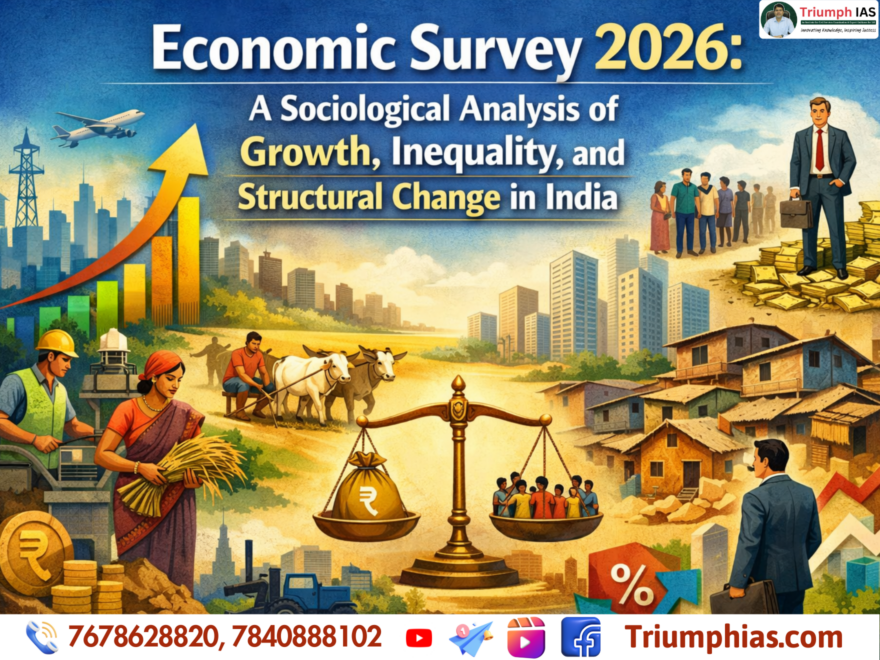
What the Economic Survey Is
The Economic Survey is an annual analytical report prepared by the Ministry of Finance that reviews India’s economic performance over the past year and sets an evidence base for policy decisions in the upcoming Union Budget. It does not itself announce policies; rather, it frames the economic narrative based on data and trends.
From a sociological perspective, this document functions as:
- A state-produced knowledge system that legitimizes certain interpretations of social and economic reality.
- A boundary object between policymakers, social scientists, media, and the public — shaping discourse on growth, inequality, employment, and welfare.
- A reflection of what the government prioritizes as significant social-economic problems.
Growth, Employment, and Structural Change
Growth Performance & Labour Implications:
The Survey projects India’s real GDP growth at robust levels (around 7.4% for FY26 with projections of 6.8–7.2% for FY27).
From a sociological lens:
- Rapid growth can create structural opportunities for labour markets, but the quality of jobs — informal vs formal — matters critically.
- India’s large informal workforce (which includes daily wage workers, contract workers, gig workers) may not immediately benefit from headline GDP growth if structural transformations in employment don’t keep pace.
- Sociologists would ask: who is accessing new opportunities? Are benefits distributed equitably across castes, regions, genders, and class positions?
This also intersects with existing income inequality challenges — groups such as the urban poor or socially marginalised communities may be left behind despite overall growth.
Agriculture, Rural Livelihoods & Social Structures
The Survey highlights that agriculture and allied activities contribute significantly to national income but also harbor nearly half of India’s workforce.
Sociological implications include:
- Dual economy dynamics: Large subsistence-based labour in agriculture vs rising productivity and capital-intensive sectors.
- Persistence of rural–urban divides that shape access to social services, technology, and formal employment.
- The agrarian workforce often consists of socially disadvantaged groups (e.g., OBCs, SCs, STs); inequalities in land ownership and social capital reinforce structural disadvantages.
These patterns affect migration flows, educational outcomes, and urban informal sectors — core areas of sociological inquiry.
Technology, Skills, and Inequality
The Survey explicitly flags skill gaps and structural risks in the era of rapid AI and technological adoption.
Sociological analysis here focuses on:
- The digital divide — unequal access to technology and skill-building between urban elites and rural/marginalised populations.
- The potential to widen existing social inequalities if technological change disproportionately benefits those with higher education, social capital, and network access.
Sociologists might critique policy emphasis on tech without equally emphasizing inclusive technological diffusion and equity in education and training.
Social Dimensions of Prices & Inflation
Although inflation is often discussed economically, it has deep social components:
- Food inflation — a key part of overall inflation — disproportionately affects lower-income households, who spend a larger share of income on food.
- Even with controlled headline inflation, price volatility in essentials can erode living standards for the poor, increasing vulnerability.
This connects to sociological concerns about everyday experiences of economic hardship beyond GDP statistics.
Inequality, Tax Base Expansion & Social Redistribution
The Survey notes substantial growth in the taxpayer base (e.g., 9.2 crore taxpayers).
Sociological reflections:
- An expanding tax base might indicate increased formalization of the economy, but how much real redistribution occurs through progressive taxation is a separate question.
- Tax base expansion could reflect rising incomes in middle classes, while the poorest may remain outside the formal tax net — raising questions of equity and redistribution.
AI, Regulation, and Social Surveillance Risks
The Economic Survey calls for clear AI safety boundaries, including in areas like predictive policing and facial recognition.
From a sociological standpoint:
- This implicates concerns about state power, surveillance, and social control.
- Historical inequalities might be replicated or amplified through opaque data systems unless safeguards are equitable and rights-oriented.
Policy Framing & Social Priorities
Sociologists would observe that the Economic Survey:
- Frames social issues (employment, inequality, skills shortfall) largely in economic growth or efficiency terms.
- Places macroeconomic stability and investment climate above social welfare issues.
- Often treats poverty, gender inequality, caste disparities as secondary unless tied explicitly to growth outcomes.
Thus, while the Survey provides a comprehensive economic overview, its social policy orientation is shaped by growth-first frameworks.
Gender and the Political Economy of Growth
Survey Emphasis
The Economic Survey stresses high growth, capital formation, and labour productivity but treats gender outcomes as derivative, not foundational.
Application of Sociological Perspective
- Female Labour Force Participation Rate (FLFPR) has improved numerically, yet:
- Much of this increase is in informal, low-paid, home-based, or unpaid family work.
- Patriarchal norms still define women as secondary earners.
- Growth without care economy recognition (childcare, eldercare, domestic work) reinforces gender inequality.
Theoretical Link
- Feminist Political Economy argues that GDP-centric growth ignores reproductive labour, disproportionately performed by women.
- The Survey’s silence on time poverty reflects a male breadwinner bias in economic policy framing.
Caste, Class, and Unequal Economic Mobility
Survey Observation
The Survey highlights formalisation, tax base expansion, and entrepreneurship.
Sociological Reality
- Caste mediates access to economic opportunity:
- Upper castes dominate high-skill, capital-intensive, and digital sectors.
- SCs/STs remain concentrated in:
- Casual labour
- Low-end services
- Agrarian distress zones
- Market reforms do not automatically dismantle caste hierarchies.
Theoretical Link
- N. Srinivas’ concept of “Dominant Caste” explains how economic growth often consolidates power rather than redistributes it.
- Bourdieu’s social capital: Networks, cultural confidence, and institutional access matter more than mere skill availability.
Tribal Economy and Developmental Exclusion
Survey Focus
- Infrastructure expansion
- Mining
- Logistics
- Green energy transition
Sociological Critique
- Tribal regions are resource-rich but livelihood-poor.
- Development projects lead to:
- Displacement without adequate rehabilitation
- Cultural erosion
- Proletarianisation of tribal labour
- Survey frames tribals as beneficiaries, not agents of development.
Theoretical Link
- Internal Colonialism Theory: Peripheral regions supply resources while remaining underdeveloped.
- Andre Béteille: Tribal marginalisation is institutional, not accidental.
Rural–Urban Divide and Circular Migration
Survey Data
- Growth driven by urban manufacturing, services, and infrastructure.
- Agriculture still absorbs ~45% of the workforce.
Sociological Insight
- Circular migration becomes a survival strategy:
- Rural distress pushes workers to cities
- Urban informal sector absorbs them without social security
- Welfare portability remains incomplete → urban poverty invisibilised.
Theoretical Link
- Lewis Dual Sector Model (sociological critique): Labour transfer occurs without dignity or stability.
- Jan Breman: Informal labour is not transitional but structural.
Digital Economy, AI, and New Inequalities
Survey Position
- Emphasis on AI, digital public infrastructure, and skill upgrading.
Sociological Risks
- Digital divide is social, not technical:
- Gendered access to devices
- Rural-urban internet asymmetry
- English-centric skill ecosystems
- AI risks algorithmic caste and class bias if datasets reflect historical inequalities.
Theoretical Link
- Ulrich Beck – Risk Society: Technological progress generates new social risks.
- Surveillance sociology: Predictive governance can stigmatise marginal communities.
State, Market, and Welfare Retrenchment
Survey Orientation
- Fiscal prudence
- Private investment
- Reduced welfare dependency narrative
Sociological Reading
- Shift from rights-based welfare to efficiency-based targeting:
- Exclusion errors increase
- Citizenship becomes conditional on data visibility
- Welfare increasingly framed as temporary support, not social justice.
Theoretical Link
- Karl Polanyi: Market disembedding creates social dislocation unless countered by social protection.
- Amartya Sen: Development is freedom, not income alone.
Conclusion
A sociological reading of the Economic Survey 2026 reveals that while India’s macroeconomic fundamentals appear robust, growth remains socially uneven, institutionally mediated, and hierarchically distributed. Gender, caste, tribe, and region continue to shape access to opportunity, reminding us that economic development without social justice risks deepening structural inequalities in India.
|