
Dowry System and Violence against Women in India
(Relevant for Sociology Paper I: Sociological Thinkers; Stratification and Mobility and Sociology Paper II: Social Problems)
Introduction: Dowry System and Violence against WomenDowry deaths continue to plague Indian society despite multiple legal safeguards, awareness campaigns, and social reforms. The issue of bride burning, dowry-related suicides and harassment for dowry are not isolated incidents but reflect deep-seated structural inequalities rooted in patriarchy, caste, and class dynamics. As per the National Crime Records Bureau (NCRB), India still witnesses thousands of dowry-related deaths each year — a grim reminder that the practice is alive despite being criminalized. Understanding Dowry Deaths:Dowry death refers to the death of a woman caused by any burns or bodily injury or occurs otherwise than under normal circumstances within seven years of her marriage, and it is shown that she was subjected to cruelty or harassment by her husband or any relative of her husband in connection with the demand for dowry. According to Section 304B of the Indian Penal Code (IPC), such deaths are punishable by a minimum sentence of seven years and up to life imprisonment. NCRB Statistics
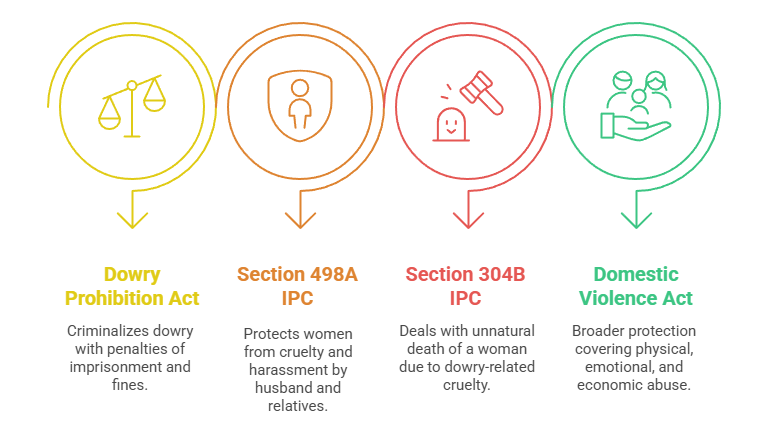
Legal Framework against Dowry Harassment
Sociological Analysis
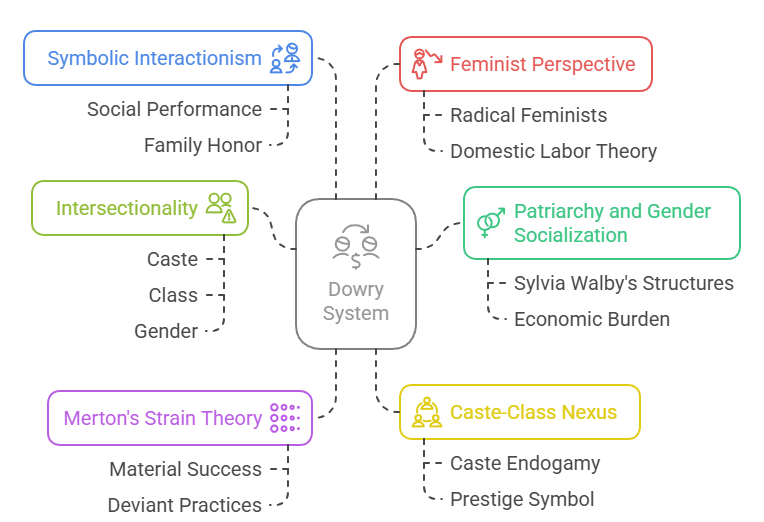
The dowry system is a manifestation of deep-rooted patriarchal values, where women are perceived as economic burdens and men as providers. Sociologist Sylvia Walby’s structures of patriarchy (household, paid work, state, violence, sexuality, culture) help explain how control over women is systemically enforced through practices like dowry.
In the context of Robert Merton’s strain theory, individuals and families who fail to achieve material success through legitimate means may resort to deviant practices like dowry harassment. The material expectations from marriage (like dowry) create an anomic condition, especially in the middle and lower-middle classes.
André Béteille emphasized the role of status groups, particularly caste, in perpetuating social hierarchies. Dowry becomes a tool for caste endogamy and status maintenance. It’s more than a financial transaction — it’s a symbol of prestige, especially among upper-caste and land-owning classes.
In many Indian families, marriages are seen as a social performance. Dowry becomes a symbolic exchange representing family honor, masculinity, and societal worth. As per Erving Goffman, the “presentation of self” during marriage ceremonies contributes to societal expectations of lavish dowries.
Radical feminists argue that dowry deaths are an expression of systemic violence by the patriarchal structure. Delphy and Leonard’s domestic labor theory shows how women are exploited within households, with dowry being a continuation of commodifying women.
Kimberlé Crenshaw’s theory of intersectionality helps analyze how caste, class, and gender intersect in dowry-related violence. Dalit and tribal women face compounded vulnerabilities, where legal and police recourse is often unavailable. Recent Trends and Shifts
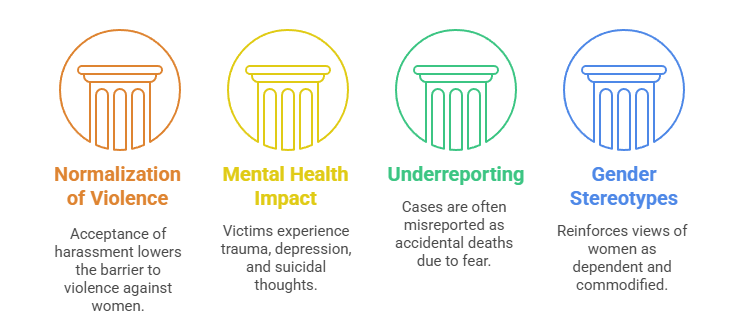
Impact on Society
Way Forward:
ConclusionDowry deaths are not merely personal tragedies but reflect a collective societal failure. Despite laws, dowry remains institutionalized within marriage customs, reflecting the deep-rooted patriarchal and caste-based hierarchies. Tackling this requires a multi-pronged approach — legal, educational, cultural, and economic. Every social evil is a product of structural forces — and therefore, must be addressed not just legally but sociologically. PYQs –Paper I
Paper II
|

To Read more topics, visit: www.triumphias.com/blogs
One comment