Introduction
In the era of globalization and digital transformation, the concept of digital labour has emerged as a critical site of analysis within sociology. From gig workers on Swiggy and Uber to content creators on YouTube and Instagram, digital labour refers to work performed on or mediated by digital platforms. This blog explores the sociological dimensions of digital labour and how it intersects with labour market dynamics, informalization of work, and technological change.
What is Digital Labour?
Digital labour encompasses all forms of labour facilitated or extracted through digital technologies. It includes:
- Gig and platform-based work (e.g., Uber drivers, Swiggy delivery agents)
- Unpaid digital activities (e.g., data generated by social media users)
- Remote and crowd-sourced tasks (e.g., Amazon Mechanical Turk workers)
- Freelance and algorithmically managed labour
This form of labour is often characterized by flexibility, precariat status, algorithmic control, and lack of traditional labour rights.
Sociological Analysis
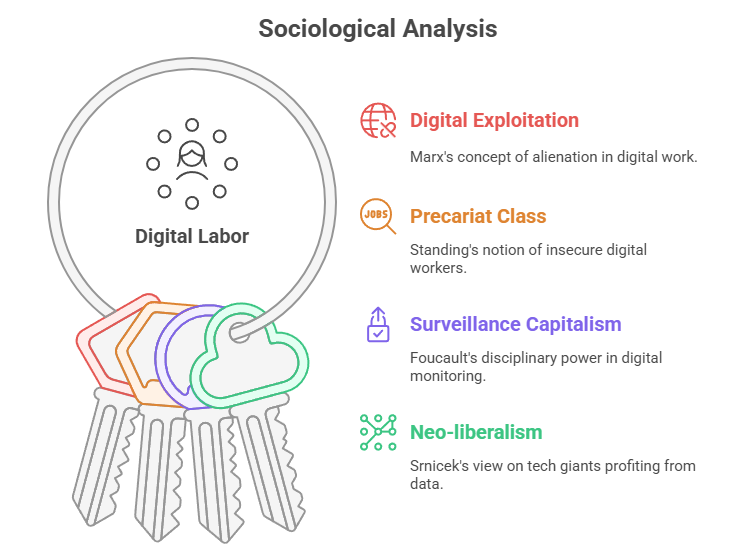
- Digital Exploitation: Marx’s concept of alienation explains how digital workers are disconnected from the product and process of their labour. Platform workers like food delivery agents don’t see the end result of their work and have no control over how it is performed, as everything is dictated by apps. They are isolated from fellow workers and operate under stressful surveillance. This mirrors Marx’s idea of capitalist exploitation, where platforms extract profit without offering job security or benefits.
- Precariat Class: Guy Standing’s notion of the precariat describes digital labourers who lack stable jobs, contracts, or social security. Gig workers live with income uncertainty and are constantly evaluated by customer feedback and ratings. Their work is insecure and identityless, reflecting a broader trend of class fragmentation and growing economic inequality under digital capitalism.
- Surveillance Capitalism: Foucault’s idea of disciplinary power applies to gig platforms where workers are tracked and monitored through GPS and ratings. They self-regulate due to algorithmic nudges and the fear of deactivation. This constant surveillance resembles a digital panopticon. Shoshana Zuboff’s theory adds that user behaviour itself is commodified, making data the new labour product in surveillance capitalism.
- Neo-liberalism: Nick Srnicek’s platform capitalism highlights how tech giants profit by commodifying data, attention, and labour. Under neoliberalism, state regulation is minimal, and workers are seen as independent entrepreneurs. This shifts risk and responsibility onto workers, weakening traditional labour rights and deepening insecurity in the digital age.
Digital Labour in India:
India has become a global hub for digital labour:
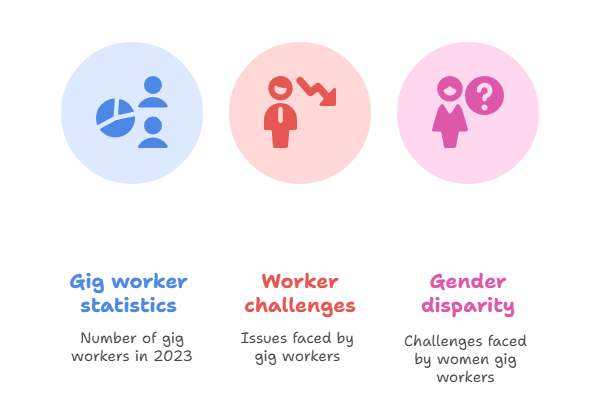
- Over 7.7 million gig workers in 2023 (NITI Aayog Report)
- Workers in Zomato, UrbanClap, and Ola face long hours, no job security, and algorithmic discrimination
- Gendered impact: Fewer women in gig work due to safety, unpaid care work, and digital illiteracy
While platform work offers income opportunities, it reinforces existing social hierarchies of caste, class, and gender.
Challenges and the Way Ahead
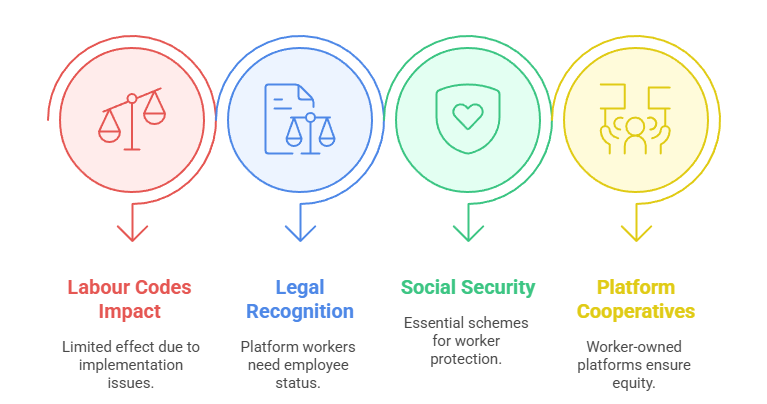
- Labour Codes in India (2020) have limited impact on gig workers due to lack of implementation.
- Need for legal recognition of platform workers as employees, not independent contractors.
- Social security schemes, health insurance, and grievance redressal mechanisms are essential.
- Encouraging platform cooperatives where workers own the platform can ensure equity and voice.
Conclusion
Digital labour is not just a technological shift but a sociological transformation. It redefines the boundaries of work, the employer-employee relationship, and class configurations. As India accelerates its digital economy, there is an urgent need to reimagine labour rights, regulate platforms, and ensure that technology uplifts rather than exploits. Understanding digital labour provides critical insights into contemporary sociological debates and policy challenges.
PYQs
Paper I –
- Discuss how Karl Marx’s theory of alienation is relevant in understanding the conditions of workers in the digital and platform economy. (2023)
- Explain the implications of the gig economy on labour and employment with reference to sociological perspectives. (2022)
- What are the challenges of applying classical sociological theories to understand modern work patterns in a globalised and digital economy? (2022)
- Explain how technology and digital platforms have transformed the nature of work and employment. (2021)
- Discuss the sociological significance of surveillance in modern society. How do digital technologies facilitate new forms of control? (2020)
- Critically examine the increasing informalisation of work in the context of globalization. (2019)
- What is meant by the term ‘precariat’? Examine its emergence in the context of contemporary labour market changes. (2018)
- Examine the effects of technological advancement on the division of labour. (2017)
- Discuss the nature of work and economic life in post-industrial society. (2015)
Paper II –
- Critically evaluate the implementation of labour codes in relation to the rights of informal and digital workers in India. (2023)
- How has the platform economy affected traditional caste and gender hierarchies in India’s urban labour market? (2022)
- Discuss the role of the gig economy in the transformation of India’s labour market. What sociological concerns does it raise? (2021)
- Discuss the changing nature of employment relations and worker identities in contemporary urban India. (2020)
- Examine how globalization has influenced patterns of employment and labour relations in India. (2019)
- Explain how the intersection of class, caste, and technology creates new inequalities in India’s digital economy. (2018)
- Assess the impact of neoliberal economic reforms on labour rights and social security in India. (2017)
- Examine the role of the state in regulating new forms of employment in the digital sector. (2016)
- How do technology-driven jobs impact rural-to-urban migration and labour participation in India? (2015)
- Discuss the challenges of measuring informal labour in a rapidly digitizing economy. (2014)
|



One comment