
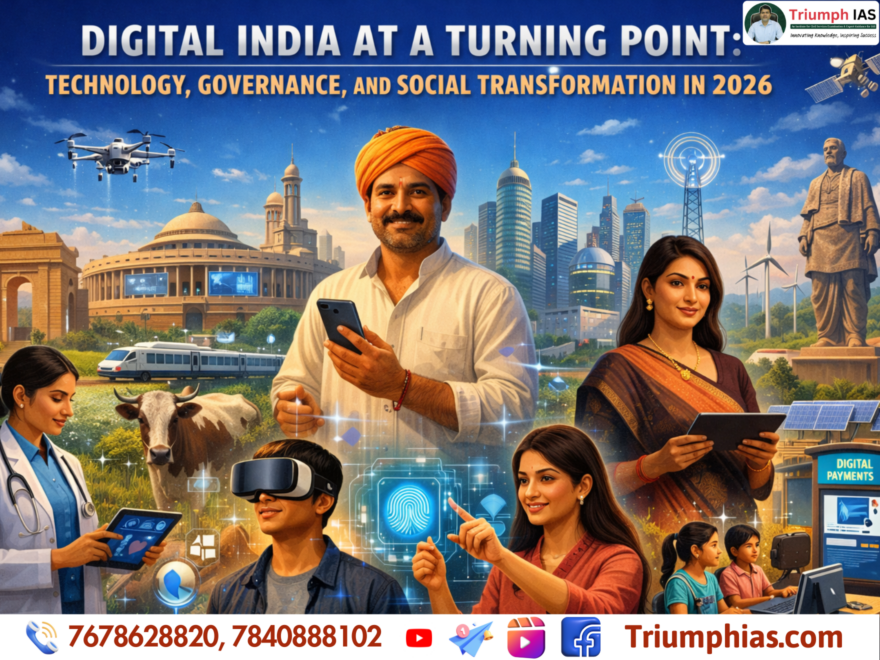
Digital India at a Turning Point: Technology, Governance, and Social Transformation in 2026
(Relevant for Sociology Paper II)
|
As India enters 2026, digital transformation has moved beyond being a policy aspiration to becoming a lived social reality. From digital payments and online welfare delivery to artificial intelligence in governance and education, technology is reshaping the relationship between the state, market, and citizens. Today’s current affairs reflect a crucial transition: India is no longer merely digitising services, but redefining governance, economy, and social interaction through technology. This blog analyses India’s digital trajectory in 2026, focusing on governance, economy, social inclusion, ethical concerns, and future challenges. Digital Public Infrastructure: India’s New Governance Model1. Rise of Digital Public Infrastructure (DPI)India’s model of Digital Public Infrastructure has emerged as a global example. Platforms for digital identity, payments, data exchange, and service delivery now form the backbone of governance. The state increasingly functions as a platform provider, enabling private innovation while retaining regulatory oversight. This shift has transformed how citizens access services such as subsidies, pensions, healthcare, and education. Technology has reduced leakages, improved efficiency, and enhanced transparency. However, it has also raised questions about surveillance, exclusion, and data ownership. 2. Changing State–Citizen RelationshipDigital governance has altered the traditional bureaucratic interface. Citizens interact with the state through apps, portals, and biometric systems rather than physical offices. While this improves convenience, it also reduces face-to-face accountability and places technological literacy at the centre of citizenship. In this context, digital access increasingly determines inclusion in welfare systems, making technology a new axis of social stratification. Artificial Intelligence and Public Policy1. Expanding Use of AI in GovernanceArtificial intelligence is now being deployed in areas such as traffic management, predictive policing, health diagnostics, agricultural forecasting, and grievance redressal. These applications promise efficiency and data-driven decision-making. However, AI systems often reflect existing social biases embedded in data. Without transparency and accountability, algorithmic governance risks reinforcing caste, class, gender, and regional inequalities. 2. Ethical and Regulatory ChallengesIndia is currently debating ethical frameworks for AI governance. Key concerns include:
Balancing innovation with rights protection has become one of the most significant governance challenges of the digital age. Digital Economy: Growth, Jobs, and Inequality1. Platform Economy and EmploymentDigital platforms have transformed sectors such as transportation, food delivery, education, and retail. While these platforms generate employment opportunities, they also blur the boundaries between formal and informal work. Gig workers often lack job security, social protection, and collective bargaining rights. The platform economy raises critical questions about labour rights, welfare, and the future of work. 2. Digital Divide and Economic ExclusionDespite rapid digitalisation, significant sections of Indian society remain digitally excluded. Rural areas, women, the elderly, and marginalized communities often face barriers such as lack of devices, internet access, or digital literacy. Thus, while the digital economy contributes to growth, it can also widen economic inequalities if inclusion is not prioritised. Education in the Digital Era1. Technology-Driven LearningDigital platforms have expanded access to education through online courses, virtual classrooms, and AI-based assessment tools. These innovations are particularly relevant in addressing teacher shortages and regional disparities. However, unequal access to devices and connectivity continues to undermine educational equity. Digital learning, without adequate support systems, risks reinforcing existing educational inequalities. 2. Knowledge, Surveillance, and AutonomyEducational technology increasingly collects student data to personalise learning. While beneficial, this raises concerns about surveillance, data misuse, and psychological profiling. The challenge lies in ensuring that technology enhances learning without compromising autonomy, creativity, and privacy. Digital Welfare and Social Policy1. Technology and Welfare DeliveryDigital systems have streamlined welfare delivery by linking beneficiaries to databases and direct transfers. This has reduced corruption and administrative delays. Yet, technological failures, biometric mismatches, and data errors can lead to exclusion from essential services. Welfare delivery increasingly depends on system reliability rather than human discretion. 2. Technology as a Tool of Inclusion or ExclusionFrom a sociological perspective, technology functions as both an enabler and a barrier. Those who lack digital access or skills may be excluded not because of poverty alone, but due to technological disadvantage. This raises the question: is digital access becoming a new social right? Digital Surveillance and Civil Liberties1. Expansion of Surveillance TechnologiesThe use of facial recognition, data analytics, and monitoring tools has increased in the name of security and efficiency. While these tools help in crime prevention and disaster management, they also raise serious concerns about civil liberties. Without strong safeguards, digital surveillance can undermine privacy, freedom of expression, and dissent. 2. Balancing Security and FreedomDemocratic governance requires balancing security needs with individual rights. The absence of comprehensive data protection and surveillance oversight frameworks risks concentrating power in opaque technological systems. This debate lies at the heart of contemporary democracy in the digital age. Global Context: India and Digital Geopolitics1. Technology and Global PowerTechnology has become a key arena of global competition. Control over data, semiconductors, artificial intelligence, and digital standards increasingly defines geopolitical influence. India’s position as a major digital market gives it strategic leverage, but also exposes it to external dependencies and cyber vulnerabilities. 2. Digital Cooperation and Global GovernanceIndia advocates digital public infrastructure as a global public good, especially for developing countries. This approach challenges technology monopolies and promotes inclusive digital growth. However, global digital governance remains fragmented, with competing regulatory regimes and power asymmetries. Society, Culture, and Digital Life1. Social Media and Public DiscourseDigital platforms have transformed political communication, activism, and public debate. While they amplify voices and democratise expression, they also enable misinformation, polarisation, and algorithmic manipulation. Public discourse increasingly occurs in digital spaces shaped by corporate algorithms rather than democratic norms. 2. Identity, Community, and Digital BelongingDigital spaces reshape identity formation and social relationships. Online communities transcend geography but also risk deepening echo chambers and social fragmentation. Understanding these changes is essential to analysing contemporary Indian society. Challenges AheadIndia’s digital future faces several key challenges:
Addressing these challenges requires not just technological solutions, but democratic participation, legal frameworks, and social awareness. ConclusionIn 2026, India stands at a critical digital crossroads. Technology has become central to governance, economy, and everyday life. While digital transformation offers immense opportunities for efficiency, inclusion, and innovation, it also introduces new forms of inequality, surveillance, and power concentration. The future of Digital India will depend on how effectively the state balances innovation with rights, growth with equity, and efficiency with accountability. Technology must remain a tool for human development, not a substitute for democratic values. Understanding today’s digital current affairs is therefore essential for imagining an inclusive, ethical, and sustainable future. |
To Read more topics, visit: www.triumphias.com/blogs
Read more Blogs:
Education in Transition: Reform, Inequality, and the Future of Learning in Contemporary India
A World at a Crossroads: India and Global Developments Shaping January 2026
One comment