From Digital Dependence to Technological Sovereignty: A Sociological Analysis of India’s Tech Trajectory

From Digital Dependence to Technological Sovereignty: A Sociological Analysis of India’s Tech Trajectory

From Digital Dependence to Technological Sovereignty: A Sociological Analysis of India’s Tech Trajectory

(Relevant for Sociology Paper 1: Social Change in Modern Society)

Introduction: Digital Dependence to Technological Sovereignty

Technological sovereignty—India’s ability to independently design, develop, and deploy critical technologies—has emerged as a key pillar of national security, economic resilience, and cultural preservation in the 21st century. As India accelerates its pursuit of Aatmanirbhar Bharat in the digital realm, this shift is not merely technical or economic but deeply sociological. It marks a transformation in how societies organize knowledge, power, and innovation in a rapidly digitizing world.

In this blog, we explore the sociological underpinnings of India’s quest for technological sovereignty, examine its intersection with themes like power, globalization, dependency, digital stratification, and national identity, and analyze the journey through various sociological perspectives and key thinkers like Karl Marx, Max Weber, Immanuel Wallerstein, Anthony Giddens, Manuel Castells, and others.

What Is Technological Sovereignty – A Sociological Framing

In sociological terms, technological sovereignty is not just about control over hardware or software but about the agency of a society to define its technological path in alignment with its cultural values, economic goals, and social justice frameworks.

It involves:

  • Autonomy over digital infrastructure and data flows,
  • Resistance to cultural imperialism through tech platforms,
  • Control over knowledge production and distribution.

Anthony Giddens’ concept of “reflexive modernization” becomes useful here, highlighting how late modern societies like India must constantly reassess their dependence on external systems and realign to build autonomous, internally cohesive systems that reflect national priorities.

India’s Current Technological Dependence: A Structural Analysis

  1. Dependency Theory and Technological Imperialism

Andre Gunder Frank’s Dependency Theory explains how the Global South (like India) remains economically and technologically dependent on the Global North, perpetuating global inequality.

  • Today, global tech corporations (Google, Meta, Microsoft, etc.) dominate India’s digital infrastructure, creating a neocolonial digital order.
  • The cloud computing example—where an Indian company was denied access due to foreign decisions—mirrors Frank’s warning of “satellite economies” being vulnerable to core economies’ shifts.
  1. World-Systems Theory (Immanuel Wallerstein)

According to Wallerstein, India sits in a semi-peripheral position in the global tech order—consuming innovation but lacking full control over production.

  • The India Stack, UPI, and initiatives like Sarvam AI are India’s attempts to move towards the core by producing and exporting innovation.
  • The development of Bharat 6G Vision and the India Semiconductor Mission represent moves to redefine India’s global position.

Technological Sovereignty and the State: A Weberian Perspective

Max Weber’s concept of bureaucracy and rational-legal authority offers insight into the Indian state’s role.

  • India’s state-led programs like ISM, DPDP Act, and BHASHINI signal a Weberian rationalization of digital infrastructure.
  • Bureaucracies such as CERT-In, MeitY, and ISRO reflect technocratic governance—where legitimacy stems from expertise, efficiency, and procedural order.

Yet, as Weber warns, over-bureaucratization can stifle innovation, and India’s fragmented regulatory systems (DST, DBT, MeitY) often create bottlenecks.

The Role of Technology in Shaping Social Structures

The Role of Technology in Shaping Social Structures

  1. Manuel Castells: Network Society

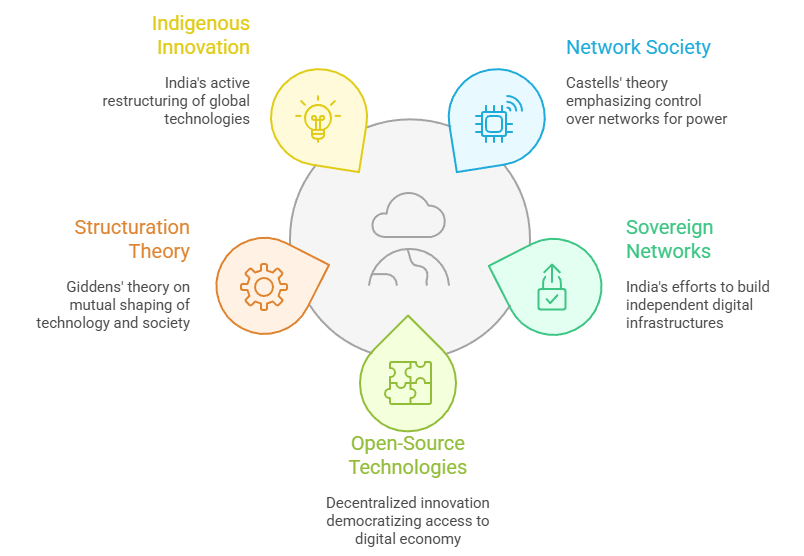
Castells’ “Network Society” thesis argues that power lies in the ability to control networks, not just resources.

  • India’s efforts to build sovereign networks (UPI, NavIC, India Stack) is a way to claim symbolic and structural power in global network society.
  • The proliferation of open-source technologies creates decentralized nodes of innovation, democratizing access to the digital economy.
  1. Anthony Giddens: Structuration Theory

Technological systems both structure social practices and are shaped by them.

  • While global technologies shape Indian governance and lifestyles (Zoom, AWS, etc.), India is now actively restructuring these systems through indigenous innovation, reclaiming agency.

Cultural Sovereignty and Digital Colonialism

Sociologists like Arjun Appadurai and Edward Said have discussed the dangers of cultural homogenization in globalization.

  • India’s dependence on foreign digital platforms has eroded local content, languages, and epistemologies.
  • BHASHINI and AI models like Sarvam AI aim to indigenize digital discourse, resisting what Ngũgĩ wa Thiong’o called the “colonisation of the mind”.

Digital colonialism is resisted not through isolation, but through contextual innovation rooted in India’s pluralistic sociocultural landscape.

Digital Inequality and Stratification

  1. Pierre Bourdieu: Digital Capital

Bourdieu’s concepts of cultural and social capital now extend to digital capital—access to and ability to use digital tools.

  • Technological sovereignty without digital inclusion can reinforce existing inequalities (urban-rural, gender, caste).
  • While UPI and DigiLocker improve access, issues of digital literacy and data exclusion (especially among Dalits, Adivasis, and rural women) persist.
  1. Ulrich Beck: Risk Society

In a “risk society,” Beck notes, the production of risk becomes central to governance.

  • Cybersecurity threats (e.g., WazirX hack by Lazarus Group) illustrate the risks of foreign dependency.
  • India must not only develop sovereign systems but also secure them, turning technological capacity into resilience.

Challenges Through a Sociological Lens

Challenge Sociological Insight
Semiconductor dependence Global division of technological labor (Wallerstein)
Brain drain Functionalist view: imbalance between education system and labor markets
Low R&D investment Capitalism’s short-termism (Marx), lack of trust in state’s innovation system
Weak IP enforcement Legal-institutional gaps → undermining trust (Weberian inefficiency)
Inefficient government procurement Structural-functionalism: Systemic dysfunction limiting innovation
Fragmented governance Absence of cohesive collective consciousness (Durkheimian anomie)

The Role of Diaspora: Bridging Structural Gaps

India’s global tech diaspora offers cultural, economic, and symbolic capital.

  • Sociologist Robin Cohen’s concept of “diaspora as a resource” is visible in India’s efforts to channel its talent abroad for nation-building.
  • Structured “brain circulation” policies can convert global exposure into sovereign innovation, transforming dependency into partnership.

Way Forward: A Sociological Roadmap to Sovereignty

Way Forward: A Sociological Roadmap to Sovereignty

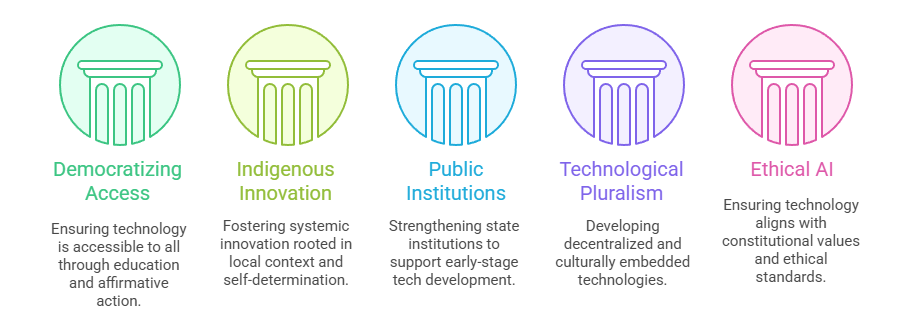
  1. Democratizing Access to Technology
    • Bridge the digital divide through education, affirmative action in tech, and vernacular digital content.
    • Empower women and marginalized castes in STEM, tech entrepreneurship, and AI development.
  2. Indigenous Innovation Culture
    • Move from jugaad (hack) to systemic innovation, incentivizing context-sensitive R&D.
    • Use Gandhi’s idea of Swaraj—self-rule—as a metaphor for technological self-determination.
  3. Public Institutions as Anchors
    • State institutions must become “innovation anchors”—supporting early-stage deep-tech development through procurement, validation, and long-term funding.
  4. Technological Pluralism
    • Avoid replicating the centralizing tendencies of Western tech. Instead, develop pluralistic, decentralized, and culturally embedded technologies.
  5. Ethical AI and Responsible Tech
    • Technology should reflect India’s constitutional values: justice, equality, and fraternity.
    • Regulatory sandboxes and ethical AI frameworks must ensure that sovereignty doesn’t come at the cost of rights.

Conclusion: From Margins to the Centre

India’s quest for technological sovereignty is a sociological transformation—from being a consumer of foreign-made tools to becoming a producer of inclusive, indigenous, and ethical technology.

The journey involves more than chips and code. It is about:

  • Reclaiming epistemic agency,
  • Ensuring democratic control over infrastructure,
  • Creating tech that resonates with Indian realities.

As Emile Durkheim might argue, technology must serve the collective conscience, not dominate it.

India stands at a crossroads—not just of technology, but of civilization. The path it chooses will shape not only its digital destiny but its sociological soul.

To Read more topicsvisit: www.triumphias.com/blogs

Read more Blogs:

Centenary of the Self-Respect Movement: Reclaiming Dignity, Resisting Caste

Waves of Feminism

One comment

Leave a Reply

Your email address will not be published. Required fields are marked *