Introduction
In the age of the internet, digital activism has emerged as a powerful tool for political mobilization, social justice, and participatory democracy. From hashtags on Twitter to viral videos on Instagram and campaigns on Change.org, digital platforms have transformed how people raise their voices against injustices. In India, where traditional forms of protest often face institutional barriers, the digital space provides a relatively freer and more democratic arena.
This blog delves into the sociological analysis of digital activism, linking it with contemporary movements. It discusses how digital activism intersects with civil society, class, gender, caste, and the state.
What is Digital Activism?
Digital activism refers to the use of digital tools and platforms—such as social media, blogs, emails, websites, and online petitions—to promote, organize, or participate in activism. It includes both online-only campaigns and online-to-offline (O2O) movements, where digital mobilization leads to real-world protests.
Examples:
- #JusticeForManisha (against caste-based rape in Hathras)
- #FarmersProtest (solidarity with farmers opposing the farm laws)
- #MeTooIndia (addressing sexual harassment and patriarchy)
- #SaveAarey (environmental campaign in Mumbai)
Sociological Analysis
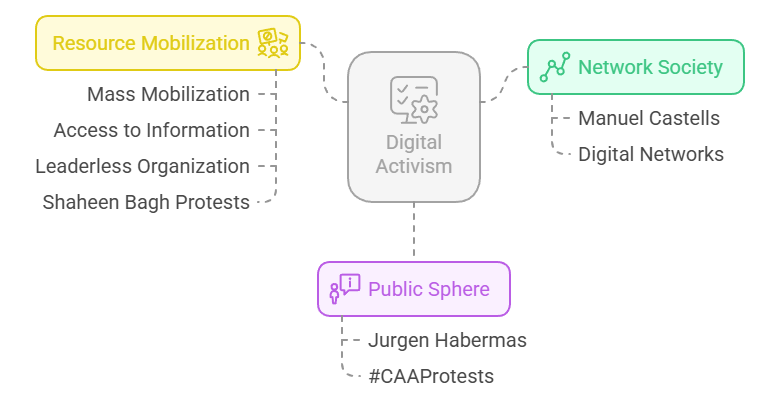
- Network Society: Sociologist Manuel Castells describes the current era as a “network society” where social structures are organized through digital networks. Digital activism, in this framework, emerges as decentralized, horizontal, and inclusive.
“Power now lies in communication networks”—Castells
In India, social media empowers marginalized groups (e.g., Dalits, women, Adivasis) to bypass mainstream media and share their narratives.
- Jurgen Habermas’ Public Sphere: Digital spaces can be seen as new-age public spheres where rational-critical debates can happen outside the control of the state. Movements like #CAAProtests saw massive public discourse emerge through online discussions.
- Resource Mobilization Theory: This theory posits that the success of movements depends on their ability to mobilize resources—material and non-material. Digital activism enables:
- Mass mobilization with low cost
- Access to information
- Leaderless organization
Example: The Shaheen Bagh protests were fueled by WhatsApp messages and viral videos.
Types of Digital Activism in India
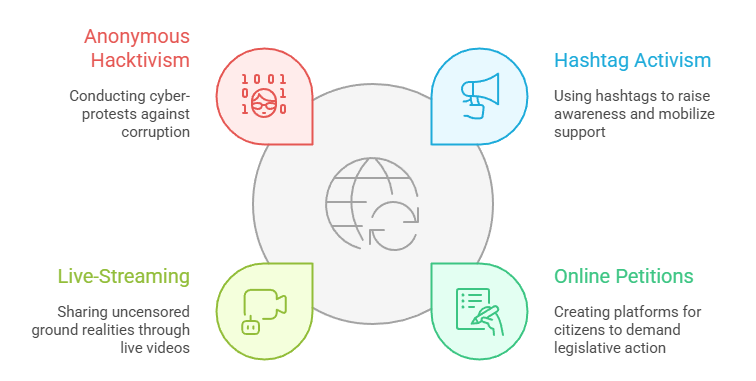
- Hashtag Activism
- #DalitLivesMatter
- #MeTooIndia
- #BlackDay (against caste discrimination)
- Online Petitions
Websites like Change.org, Jhatkaa.org have created platforms for citizens to demand legislative action.
- Live-Streaming and Citizen Journalism
Instagram Live, YouTube videos, and Twitter threads are now vital tools to share uncensored ground realities. Example: Alt News and The Wire use digital journalism to counter fake news and mainstream media narratives.
- Anonymous Hacktivism
Groups like Anonymous India conduct cyber-protests against corruption or authoritarianism, although their legality remains contested.
Key Features of Digital Activism
- Decentralized leadership (no single figurehead)
- Viral potential (through hashtags and visual content)
- Intersectionality (gender, caste, region, language)
- Speed and scale (rapid mobilization)
Digital Activism and Civil Society
Civil society organizations now heavily rely on digital media to:
- Educate the public
- Coordinate protests
- Build pressure on policymakers
- Document human rights violations
Example: India Against Corruption Movement (2011) utilized online platforms to build a nationwide network that pushed for the Jan Lokpal Bill.
Digital Activism and the State
While digital platforms offer freedom, the state’s response is often ambivalent or suppressive.
- Internet Shutdowns: India tops the world in internet shutdowns (e.g., Kashmir, Manipur).
- Digital Surveillance: Facial recognition during protests, Pegasus spyware.
- Misinformation Laws: Often used to target dissenting voices.
Sociologically, this reflects the state vs. civil society tension as described by Antonio Gramsci—where the state attempts to maintain hegemony over counter-hegemonic forces.
Digital Activism and Identity Politics
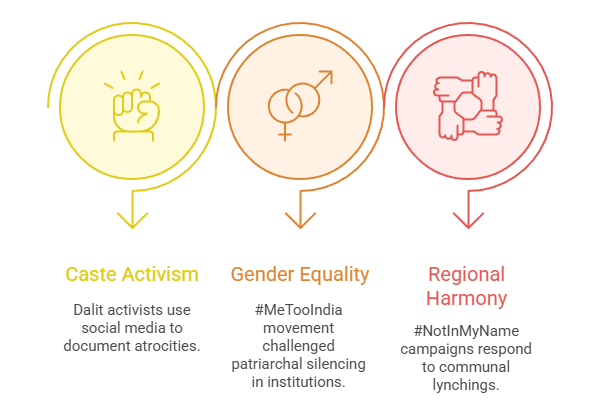
- Caste: Dalit activists like Dalit Camera and Equality Labs use social media to document caste atrocities and advocate for annihilation of caste.
- Gender: The #MeTooIndia movement challenged patriarchal silencing within institutions like media, Bollywood, and academia. Women shared personal stories via Twitter and Instagram, pushing institutions to respond.
- Region and Religion: Campaigns such as #NotInMyName emerged in response to communal lynchings, showcasing how digital activism challenges majoritarian narratives.
Challenges to Digital Activism
- Digital Divide: Rural and poor communities lack internet access.
- Surveillance and Repression: Activists are arrested for tweets or posts under sedition and UAPA laws.
- Clicktivism vs Real Activism: Critics argue that liking or sharing a post is a passive form of engagement.
- Misinformation and Echo Chambers: Algorithmic filters can reinforce biases and misinformation.
Contemporary Examples
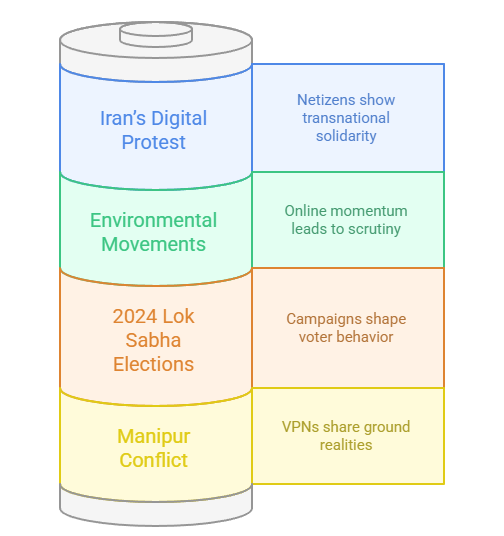
- Manipur Conflict (2023–24): Internet bans limited digital activism by civil society; people used VPNs and proxy servers to share ground realities.
- 2024 Lok Sabha Elections: Political digital campaigns by parties shaped voter behavior and debates.
- Environmental Movements: #SaveMollem, #StopAdani gained momentum online and led to judicial scrutiny.
- Iran’s Digital Protest Parallels: Indian netizens supported Iranian women during the anti-hijab protests, showing transnational digital solidarity.
Sociological Insights
- Cultural Lag (Ogburn): While digital tech progresses, society’s ethical and legal adaptation lags behind.
- Symbolic Interactionism: Digital activism is also about meaning-making through symbols, memes, hashtags.
- Conflict Theory: Digital platforms are new sites of class and ideological struggle.
Conclusion
Digital activism is transforming the landscape of social movements in India. It allows subaltern voices to speak truth to power, promotes citizen-led democracy, and challenges traditional hierarchies of caste, gender, and power. However, it is not without challenges, including state surveillance, digital divide, and shallow engagement.
PYQs
Paper I:
- Discuss how technology influences the social structure and institutions. (2021)
- Analyze how the Internet has transformed the nature of social movements in recent times. (2020)
- Discuss the role of media in shaping public opinion in contemporary society. (2016)
- Discuss the role of new communication technologies in redefining the space of public discourse. (2014)
- What is the significance of informal networks in contemporary social movements? (2013)
Paper II:
- Assess the impact of Internet shutdowns on democratic protests in India. (2023)
- Discuss the transformation of political participation with the rise of digital platforms in India. (2022)
- How has digital media impacted the nature of social movements in India? Illustrate with examples. (2020)
- Examine the role of social media in the construction of caste and religious identities. (2021)
- Do you agree that online spaces have become new arenas for identity politics in India? Justify your answer. (2019)
- Analyze how digital technology is reshaping the urban public sphere in India. (2018)
- Discuss the limitations of online activism in addressing deep-rooted social inequalities in India. (2016)
- Explain how youth participation through social media is redefining democratic engagement in India. (2015)
- Examine the challenges and prospects of using technology for grassroots democratic mobilization. (2014)
|