|
India lives in its villages—this Gandhian belief still resonates as over 65% of India’s population resides in rural areas (Census 2011, projected 2024 estimates). A strong rural economy is not just essential for equitable development but also for national stability, food security, and long-term economic sustainability. Despite rapid urbanisation and technological advancement, rural India continues to grapple with poverty, underemployment, low productivity, and migration. Developing the rural economy is not merely an economic goal—it is a social, cultural, and political imperative for India.
Importance of Rural Economy in India
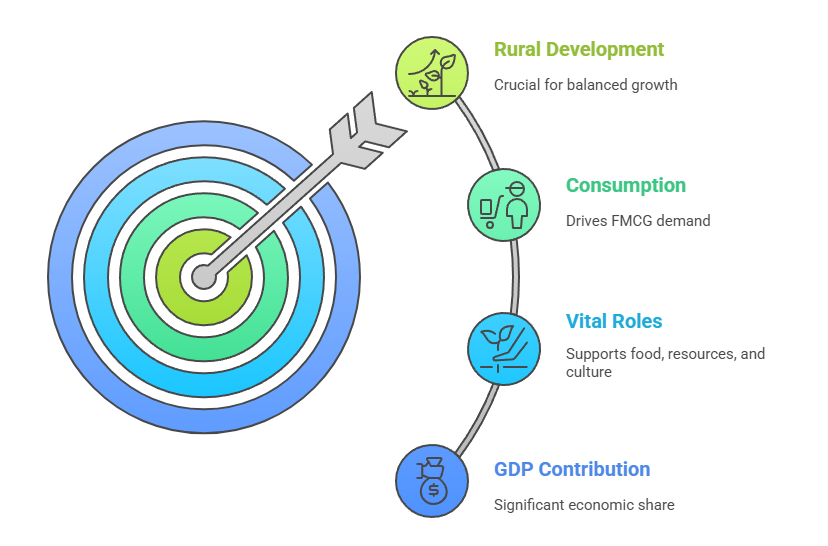
- Agriculture and Allied Sectors contribute nearly 18% to the GDP, with over 45% of the workforce engaged in it.
- Rural areas are vital for food production, natural resource management, biodiversity conservation, and cultural continuity.
- Consumption from rural areas accounts for over 40% of India’s total FMCG demand, indicating its rising potential.
- Rural development is crucial to reduce urban migration, pressure on city infrastructure, and regional inequalities.
Key Pillars for Rural Economic Development
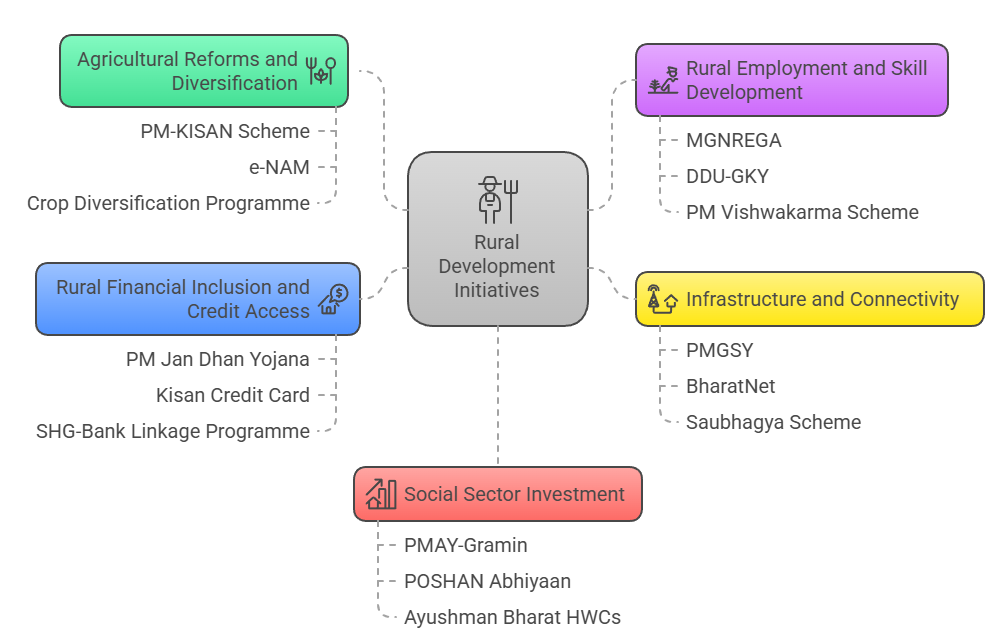
-
Agricultural Reforms and Diversification
While agriculture remains the mainstay of the rural economy, it is plagued by low productivity, fragmentation of landholdings, and climate vulnerability.
Recent Initiatives:
- PM-KISAN Scheme: Offers ₹6,000 per year as income support to small and marginal farmers.
- e-NAM (National Agriculture Market): Creates a unified national market for agricultural produce.
- Crop Diversification Programme (CDP): Encourages farmers to shift from paddy-wheat monoculture to high-value crops, pulses, and oilseeds.
- Digital Agriculture Mission (2021-26): Promotes AI, IoT, and blockchain for precision farming.
Way Forward:
- Promote climate-resilient agriculture.
- Expand organic and natural farming (e.g., Bhartiya Prakritik Krishi Paddhati).
- Ensure better MSP implementation and transparent procurement.
-
Rural Employment and Skill Development
Low non-farm employment in rural areas leads to disguised unemployment in agriculture.
Key Schemes:
- MGNREGA: Provides 100 days of guaranteed wage employment per year. In 2023-24, over ₹89,400 crore was allocated.
- Deen Dayal Upadhyaya Grameen Kaushalya Yojana (DDU-GKY): Trains rural youth for skill-based employment.
- PM Vishwakarma Scheme (2023): Supports traditional artisans with credit, tools, and market linkage.
Challenges:
- Skilling often does not align with industry demands.
- Many youths migrate to urban areas due to lack of local job opportunities.
Suggestions:
- Create rural industrial clusters and agro-based MSMEs.
- Link skill training with gig economy platforms and local industries.
-
Infrastructure and Connectivity
Rural areas lag behind in infrastructure such as roads, electricity, internet, and health facilities.
Flagship Schemes:
- PMGSY (Pradhan Mantri Gram Sadak Yojana): Has connected over 97% of eligible habitations.
- BharatNet: Aims to provide high-speed internet in all 2.5 lakh Gram Panchayats by 2025.
- Saubhagya Scheme: Ensures last-mile electricity delivery to rural households.
- Jal Jeevan Mission: Targets Har Ghar Jal by 2024; over 75% rural households now have tap water connections.
Next Steps:
- Focus on green infrastructure, solar-powered cold chains, and digital infrastructure.
- Promote smart village models using technologies like IoT and AI.
-
Rural Financial Inclusion and Credit Access
Access to formal credit remains a barrier to rural entrepreneurship and farming investment.
Recent Initiatives:
- PM Jan Dhan Yojana: Over 50 crore bank accounts opened, boosting savings and direct benefit transfers.
- Kisan Credit Card (KCC): Provides short-term credit to farmers—coverage extended to animal husbandry and fisheries sectors.
- SHG-Bank Linkage Programme: Empowered over 80 lakh women SHGs under DAY-NRLM.
Suggestions:
- Strengthen rural cooperative banks and digital financial literacy.
- Use fintech platforms for better credit delivery and insurance.
-
Social Sector Investment
Social infrastructure—education, health, sanitation, and housing—directly impacts rural productivity.
Government Efforts:
- PMAY-Gramin: Target to build 2.95 crore pucca houses by 2024 under housing for all.
- POSHAN Abhiyaan and Saksham Anganwadi: Address malnutrition and early child development.
- Ayushman Bharat Health & Wellness Centres (HWCs): Aims to establish 1.5 lakh HWCs, many in rural areas.
Need of the Hour:
- Invest in digital health and telemedicine.
- Expand mobile education and EdTech in rural schools.
Challenges in Developing Rural Economy
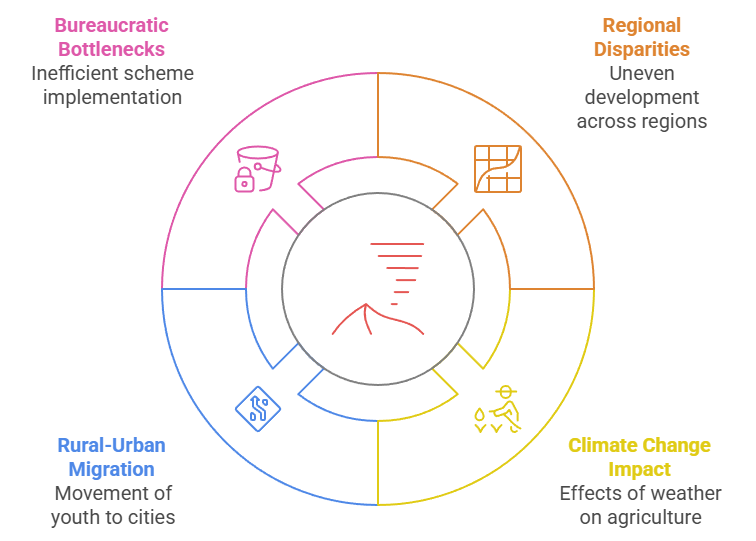
- Regional Disparities: Backward areas like Bundelkhand, Vidarbha, and tribal belts lag behind even in basic amenities.
- Climate Change: Unseasonal rains, droughts, and heatwaves are affecting farm productivity.
- Rural-Urban Migration: Youth prefer urban jobs, weakening rural economies.
- Bureaucratic bottlenecks and poor last-mile delivery hinder scheme outcomes.
Case Studies and Best Practices
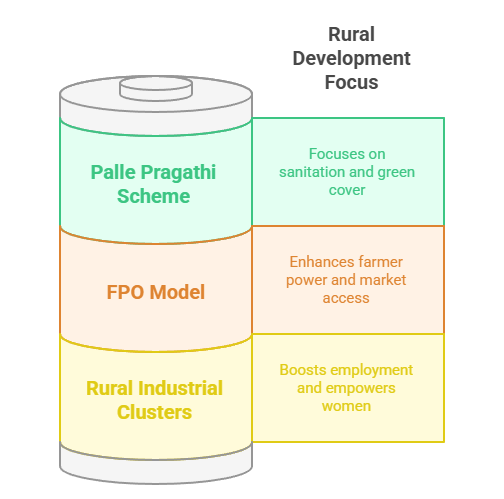
- Rural Industrial Clusters in Gujarat (e.g., handicrafts and dairy): Boosted employment and women empowerment.
- Palle Pragathi Scheme in Telangana: Focus on sanitation, waste management, and rural green cover.
- FPO (Farmer Producer Organisation) Model in Maharashtra and MP: Enhancing farmer bargaining power and market access.
Conclusion
Developing the rural economy is central to India’s inclusive and sustainable growth journey. While multiple government schemes are in place, there is a pressing need for better convergence, transparency, community participation, and technology integration. By turning villages into vibrant economic zones—with clean energy, good schools, thriving farms, and digital connectivity—India can truly achieve the vision of Gram Swaraj and a $5 trillion economy that leaves no one behind. |


One comment