Demography as Destiny
India stands at the cusp of a transformative demographic shift. With over 66% of its population below the age of 35 and a median age of around 28.4 years (2023), it is one of the youngest countries in the world. This demographic dividend offers a unique window of opportunity to accelerate economic growth, enhance productivity, and ensure inclusive development.
However, the true potential of this dividend can only be realized through strategic investment in human capital, employment generation, and social infrastructure. If left unaddressed, this demographic bulge could turn into a demographic disaster, marked by unemployment, social unrest, and wasted potential.
Understanding Demographic Dividend
A demographic dividend refers to the accelerated economic growth that can result from changes in a country’s age structure, particularly when the working-age population (15–64 years) is larger than the dependent population (children and elderly).
India’s working-age population is expected to peak around 2041, offering a 20–25 year window of opportunity. According to the United Nations Population Fund (UNFPA), such a demographic dividend can boost GDP growth by 1–2% annually, provided appropriate policies are in place.
India Demographic Snapshot
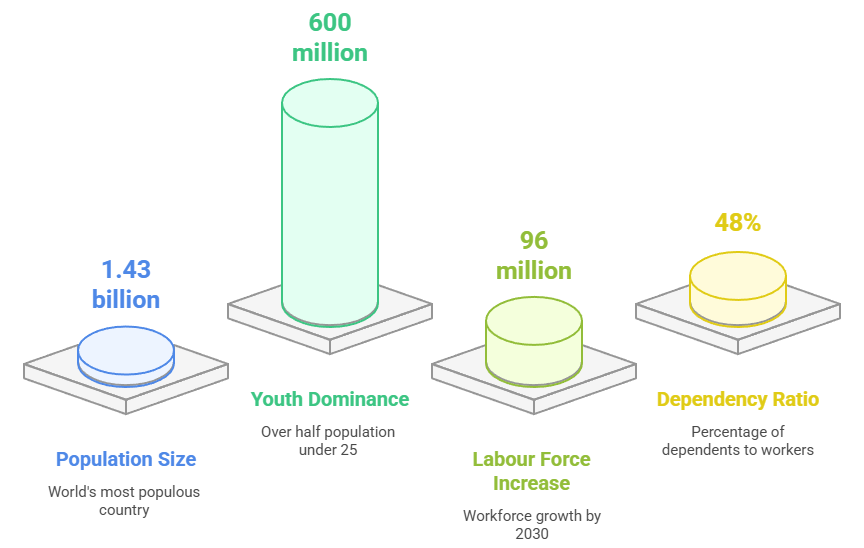
- Population Size: India surpassed China in 2023 to become the world’s most populous country with over 1.43 billion people.
- Youth Dominance: Over 600 million Indians are below the age of 25.
- Labour Force: The potential workforce is expected to increase by 96 million between 2023 and 2030 (World Bank).
- Dependency Ratio: Currently around 48%, expected to decline further before beginning to rise after 2041.
These numbers underscore the importance of turning this potential into productive output through education, skills, and employment.
Opportunities Offered by India Demographic Structure
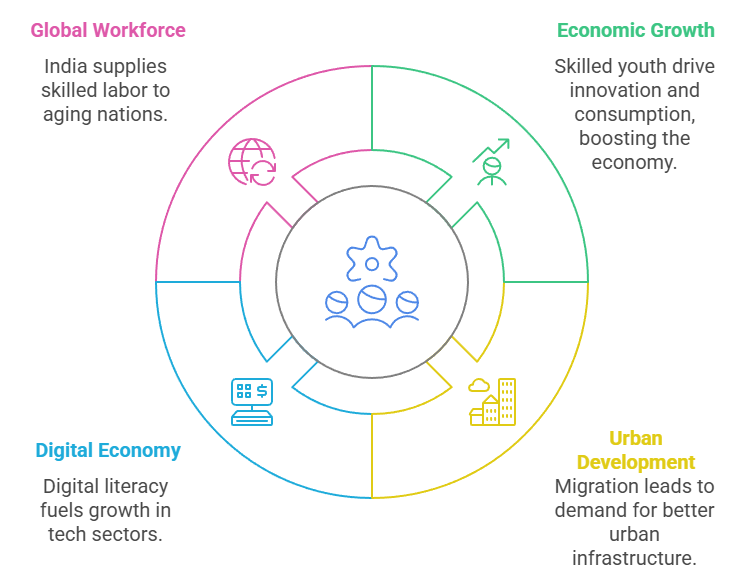
Economic Growth Engine
- A youthful workforce, if skilled and gainfully employed, can drive innovation, entrepreneurship, and consumption—fuelling economic growth.
- India’s services and manufacturing sectors can benefit immensely from an abundant labor supply.
Urbanisation and Infrastructure Development
- Youth-led migration is accelerating urbanisation, creating demand for better housing, transport, healthcare, and digital infrastructure.
- Smart urban planning can leverage this shift to foster sustainable cities and employment hubs.
Innovation and Digital Economy
- With digital literacy improving, India’s young population is driving the growth of startups, fintech, AI, and e-commerce.
- India’s digital economy is expected to reach $1 trillion by 2030, contributing 18–23% of GDP.
Global Workforce Supplier
- As developed countries face aging populations (e.g., Japan, Germany), India can become a global supplier of skilled labor and professionals, through brain export and diaspora engagement.
Challenges Hindering Demographic Potential
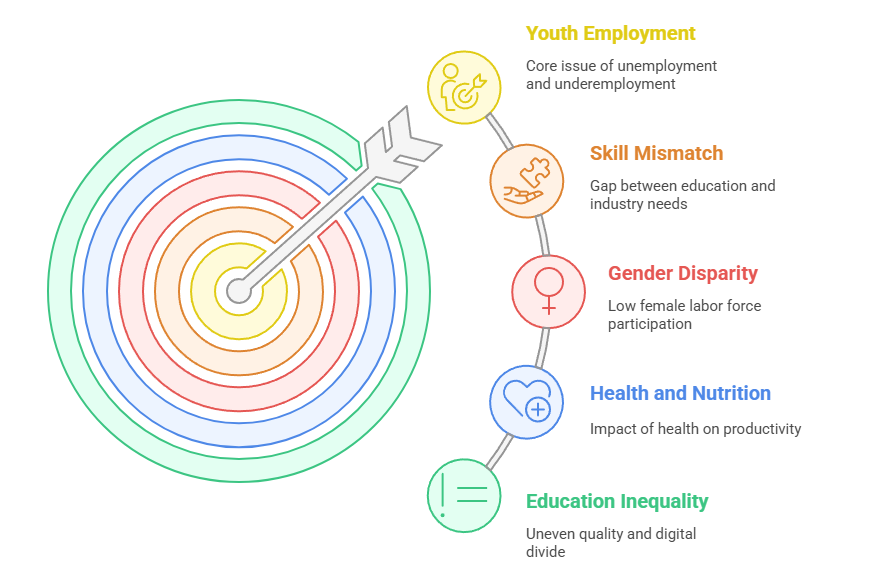
Unemployment and Underemployment
- According to CMIE (2024), the unemployment rate among youth (15–24 years) stands at over 18%, with educated youth facing the brunt.
- Many employed youth are in low-skill or informal jobs, indicating underemployment.
Skill Mismatch
- Only 20% of India’s workforce is formally skilled, as per NSDC (2023).
- There is a gap between academic education and industry demands, especially in emerging sectors like green energy and AI.
Gender Disparity
- Female Labour Force Participation Rate (FLFPR) is just 24% (PLFS 2023), one of the lowest globally.
- Cultural barriers, lack of safety, and inadequate childcare support restrict women’s employment.
Health and Nutrition
- Poor childhood nutrition, as shown in NFHS-5, affects cognitive development and future productivity.
- Mental health and lifestyle diseases are rising among youth, impacting long-term workforce efficiency.
Education Inequality
- Quality of school education remains uneven, with ASER reports highlighting gaps in foundational literacy and numeracy.
- Digital divide exacerbated by income and regional disparities, especially in rural and tribal areas.
Government Initiatives and Policy Framework
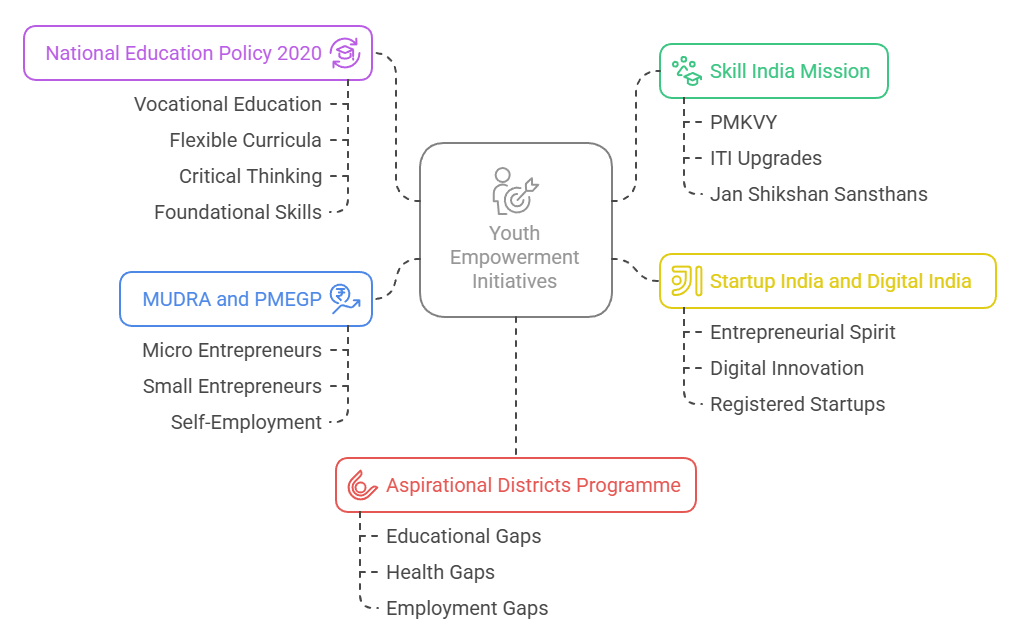
Skill India Mission
- Launched in 2015, it aims to train over 40 crore youth by 2025 through schemes like PMKVY, ITI upgrades, and Jan Shikshan Sansthans.
National Education Policy (NEP) 2020
- Emphasizes vocational education, flexible curricula, critical thinking, and foundational skills to prepare students for a changing job market.
Startup India and Digital India
- Promoting entrepreneurial spirit and digital innovation among youth, with over 1 lakh registered startups as of 2024.
MUDRA and PMEGP
- Financial support to micro and small entrepreneurs, particularly youth and women, enabling self-employment.
Aspirational Districts Programme
- Focuses on developmental backward regions, addressing educational, health, and employment gaps at the grassroots.
State-Specific Demographic Trends
India’s demographic dividend is not uniform across states:
- Southern states (e.g., Kerala, Tamil Nadu) are already aging, requiring elder care systems and migration inflows.
- Northern and eastern states (e.g., Bihar, UP, Jharkhand) have younger populations, but also face challenges in literacy, skills, and infrastructure.
Hence, state-specific strategies are essential to align demography with development.
Way Forward: Policy Recommendations
- Invest in Quality Education: Focus on foundational learning, teacher training, and school-to-work transition pathways.
- Bridge Skill Gaps: Align vocational training with industry needs, and promote apprenticeships, especially in new-age sectors.
- Boost Job Creation: Encourage labour-intensive industries like textiles, food processing, and tourism, along with ease of doing business for MSMEs.
- Empower Women: Expand access to childcare, safe transportation, and flexible work options to improve FLFPR.
- Strengthen Health and Nutrition: Enhance public health infrastructure, ensure implementation of POSHAN Abhiyaan, and promote mental well-being.
- Leverage Technology: Use AI, data analytics, and online learning platforms to personalize education and skilling.
Conclusion
India’s demographic dividend is a powerful tool that, if leveraged wisely, can transform the country into a global economic powerhouse. But this transition is not automatic—it requires visionary planning, inclusive policies, and coordinated implementation.
By turning its youth into productive, empowered, and healthy citizens, India can convert its demographic potential into a sustainable developmental force that drives prosperity, equity, and global influence in the 21st century. |

One comment