
Debt and Desire: The Social Story of India’s Households
(Relevant for Sociology Paper 1: Stratification and Mobility)
Introduction: Debt and DesireIn contemporary India, household debt has surged at a pace that has outstripped asset creation. While economists often present this as a macroeconomic challenge, from a sociological standpoint, debt is far more than a financial statistic. It is a mirror reflecting the values, anxieties, and aspirations of Indian society. Borrowing patterns reveal the pressures of modern life, social inequalities, and the cultural norms that shape individual behavior. From urban apartments to rural villages, debt serves multiple purposes. It enables access to education, healthcare, housing, and consumer goods, often bridging the gap between aspiration and reality. Yet, debt also reshapes social relationships, identity formation, and cultural expectations, signaling shifts in both economic practice and social imagination. Household Behavior: Borrowing as a Social Practice
Traditionally, Indian households relied on family networks, community support, gold, and bank deposits to manage finances. Borrowing was largely limited to emergencies or agricultural needs, and saving was both a moral and social value, reinforced intergenerationally. Today, the landscape has shifted dramatically:
Sociologist Pierre Bourdieu’s concept of habitus is particularly useful here. Habitus refers to the deeply ingrained habits, skills, and dispositions shaped by social context. In this framework, younger Indian households are internalizing a culture where borrowing is simultaneously a tool for survival and a marker of status, reflecting changing norms and aspirations. Debt, Identity, and StatusDebt is now intertwined with identity and social positioning. For middle-class families, loans for education, cars, or homes are ways to signal upward mobility and cultural capital. For low-income households, debt often represents necessity rather than choice, highlighting structural inequalities. Thorstein Veblen’s theory of conspicuous consumption becomes relevant here: borrowing enables individuals to participate in social rituals and display symbols of prosperity, even when it exceeds their immediate means. Weddings, festivals, and housing often involve loans, reflecting a cultural expectation to maintain social parity. This creates a duality: while borrowing can promote social mobility, it can also entrench vulnerability, especially among poorer households reliant on unsecured consumption loans. From a sociological lens, debt becomes a moral and relational act, shaping family dynamics, community reputation, and intergenerational expectations. Urban-Rural Disparities and Cultural PressuresDebt patterns reveal stark urban-rural divides and social inequalities:
Cultural pressures amplify these trends. Festivals, weddings, and social events often dictate expenditures beyond capacity. Anthropologist Arjun Appadurai’s work on “capacity to aspire” highlights how social aspirations shape economic behavior. In India, households often borrow not merely out of necessity but to participate fully in society, signaling belonging and status. Consequences Beyond EconomicsWhile rising debt can temporarily stimulate consumption, the sociological implications are profound:
The concept of financial marginality, discussed by sociologist William Julius Wilson, is relevant here. Just as marginalized communities are excluded from social and economic opportunities, households with high consumption debt face both economic and social exclusion, reducing their capacity to build wealth and participate fully in societal life. Cultural Dimensions of BorrowingDebt is embedded in cultural practices and moral frameworks:
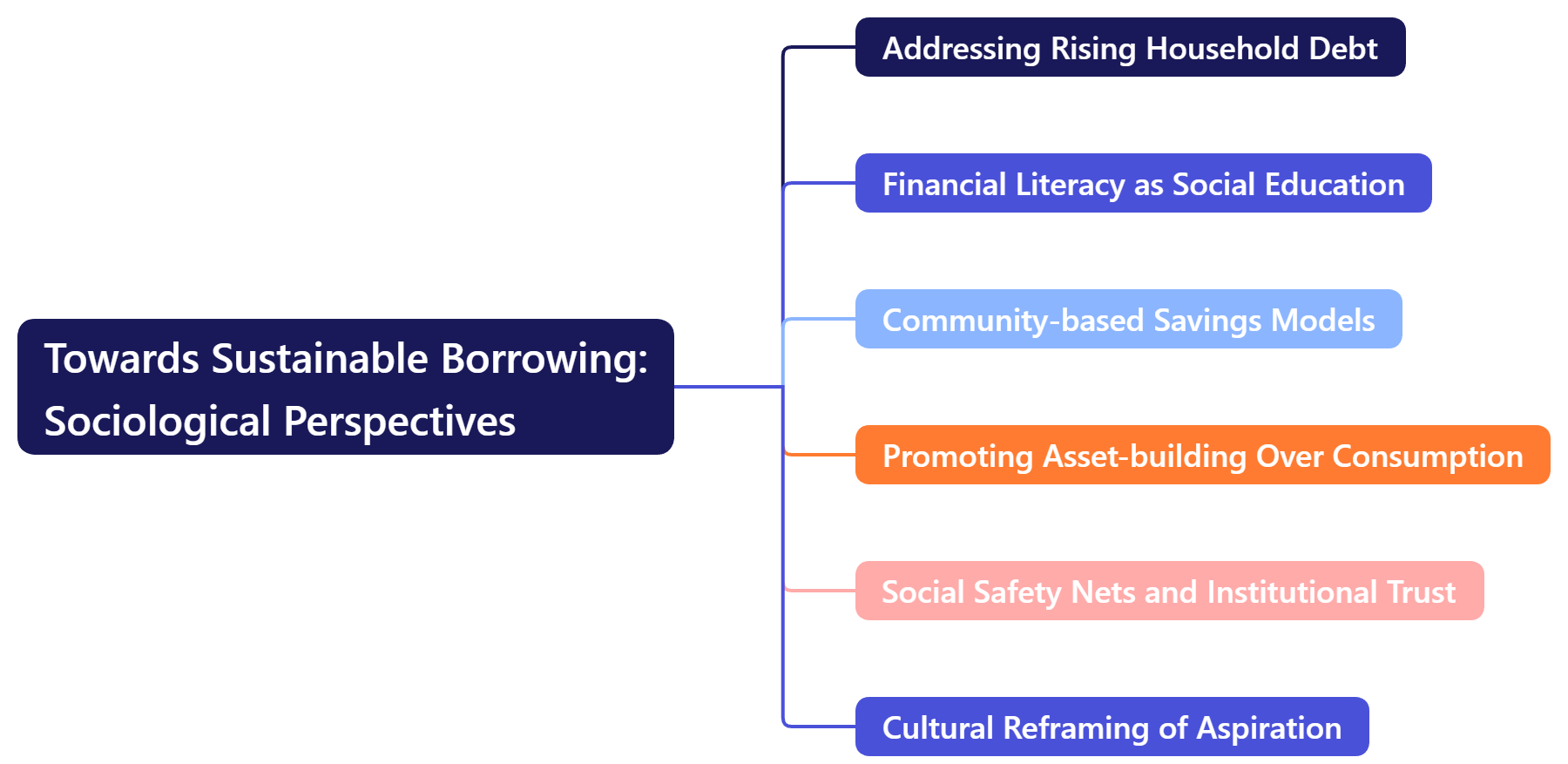
This resonates with Max Weber’s ideas on the “spirit of capitalism”, where economic activity is deeply linked to ethical, cultural, and social norms. Indian households increasingly approach borrowing as both a practical tool and a moral statement, navigating between survival, aspiration, and societal expectation. Towards Sustainable Borrowing: Sociological Perspectives
Addressing rising household debt requires cultural and behavioral solutions, not just economic reforms:
Conclusion: The Social Life of DebtRising household debt in India is not just an economic phenomenon; it is a social story of aspiration, inequality, and identity. Debt reveals how society negotiates modernity, risk, and belonging. It maps the contours of ambition, stress, and social expectation, showing who participates in opportunity and who is left vulnerable. Sociological thinkers like Bourdieu, Weber, and Appadurai help us understand debt as embedded in habitus, moral norms, and capacity to aspire. Financial stability, therefore, depends not only on macroeconomic policy but also on social education, cultural practices, and equitable access to financial instruments. In the end, understanding debt sociologically transforms the conversation: it is not merely about interest rates or GDP ratios, but about the ways households live, aspire, and negotiate social pressures in a rapidly changing India. To ensure both economic and social stability, policy must address culture, behavior, and inequality alongside finance. Debt, in this view, is more than numbers: it is a mirror of society itself. |

To Read more topics, visit: www.triumphias.com/blogs
Read more Blogs:
Tech-Driven Multilingual Inclusion: Bridging Language, Culture, and Digital India
Power, Parties, and the People: The Sociological Crisis of Internal Democracy in Indian Politics