
Dark Money and Democratic Deficit: A Sociological Analysis of Political Funding in India
(Relevant for Sociology Paper 1: Politics and Society)
Dark Money and Democratic Deficit:The Supreme Court’s decision to re-examine the rule allowing political parties to receive anonymous cash donations up to ₹2,000 has reignited India’s long-simmering debate on political finance transparency. What appears on the surface as a technical legal matter is, in sociological terms, a profound question about power, democracy, and the structure of the Indian state. At stake is not just a rule—it is the very nature of political representation, the relationship between citizens and the state, and the invisible networks of influence that shape policy, governance, and democratic legitimacy. Political Funding as a Sociological InstitutionPolitical funding is not merely about money; it is an institution that allocates power, influence, and symbolic capital, to use Pierre Bourdieu’s term. Donations translate into access, access into influence, and influence into policy outcomes. This power circuit becomes especially dangerous when invisible. Anonymous cash donations below ₹2,000—enabled under Section 13A(d) of the Income Tax Act—thus constitute a shadow arena of influence, shielded from public scrutiny. The petition before the Supreme Court argues that such opacity violates voters’ fundamental right to information under Article 19(1)(a), an argument consistent with the Court’s reasoning in ADR v. Union of India (2024) when it struck down the Electoral Bonds Scheme. Transparency, therefore, is not simply a procedural reform—it is a democratic necessity. Why Anonymous Funding is a Sociological Concern
Jürgen Habermas famously described democracy as requiring a rational, open, equal public sphere.
When citizens cannot know who funds parties, deliberation becomes unequal—and thus irrational in the Habermasian sense.
From a Marxist perspective, anonymous donations create an invisible chain between capital and the political class.
Thus, the state becomes what Marx called the “executive committee of the bourgeoisie.”
Public choice theorists like Buchanan argue that in the absence of regulation, politicians behave like rational economic actors—seeking funds to win elections, and donors seek returns through policy concessions. Anonymous donations make quid pro quo:
Opaque funding thus institutionalises corruption. Rules Governing Political Donations: A Sociological Reading
India’s regulatory framework—RPA, Income Tax Act, Companies Act, FCRA, Electoral Trusts Scheme—appears comprehensive. Yet beneath the surface lie deep structural problems.
Companies can donate up to 7.5% of average net profits.
While more transparent than cash, they create an intermediary structure that shields donors from direct scrutiny—thus reproducing what Foucault might call a “technology of opacity.”
By redefining “foreign source” to allow majority-foreign-owned Indian companies to donate, the state effectively blurred the boundary between domestic sovereignty and foreign influence. These frameworks reflect Weber’s concept of a bureaucratic state that maintains the appearance of legality while enabling discretionary power. Why Transparency Matters: Sociological Insights
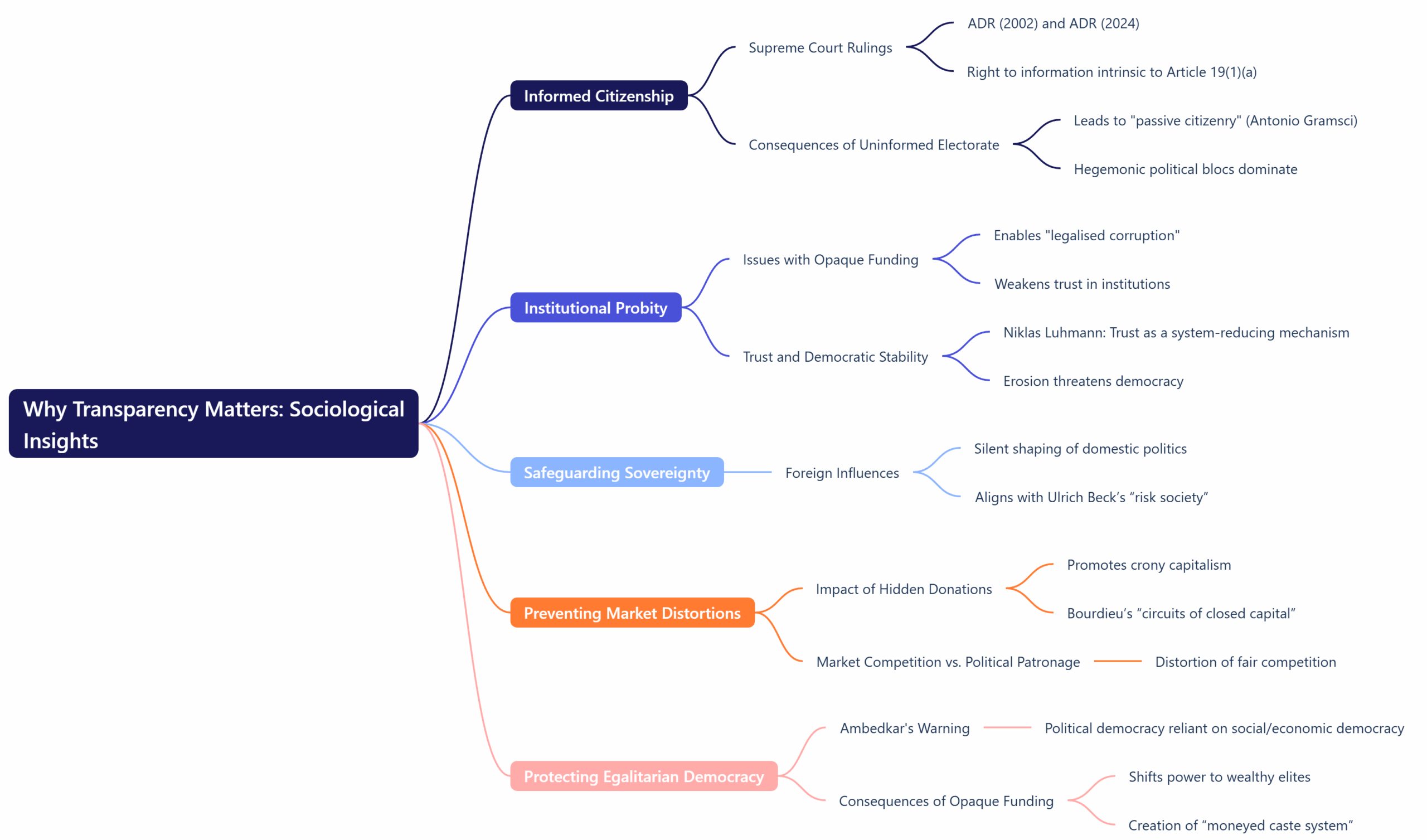
In ADR (2002) and ADR (2024), the Supreme Court held that voters’ right to information is intrinsic to Article 19(1)(a).
Opaque funding enables “legalised corruption,” weakening trust. According to Niklas Luhmann, trust is a system-reducing mechanism—and its erosion threatens democratic stability.
Foreign or hostile influences can silently shape domestic politics—aligning with Ulrich Beck’s ”risk society,” where modern threats are invisible, transnational, and systemic.
Hidden corporate donations promote crony capitalism, creating what Bourdieu calls “circuits of closed capital.”
Ambedkar warned repeatedly that political democracy must rest on social and economic democracy. The Sociological Logic of Needed Reforms
Erasing the ₹2,000 loophole would eliminate:
Mandating digital donations would create Bourdieu’s audit trails of accountability.
A Weberian perspective shows that bureaucracies require:
The petition’s demand to scrutinise Form 24A and withdraw symbols from non-compliant parties aligns with the need to strengthen regulatory rationality.
ECI-appointed auditors would reduce the risk of parties marking their own answer sheets—introducing institutional independence in line with Lijphart’s “consensus democracy” model.
A centralised, automated, ECI-IT integrated portal is a Foucauldian counter-surveillance mechanism: the state becomes visible to citizens rather than the other way around.
Public funding—recommended by Indrajit Gupta Committee—would redistribute power from corporations to citizens.
A common ceiling across states and parties strengthens political equality—remedying what Dahl called the “polyarchic imbalance” created by unequal resources. Political Transparency as Democratic SurvivalIndia stands at a crossroads. The Supreme Court’s intervention is not simply a rule review—it is a chance to reshape India’s democratic architecture. Anonymous donations create:
A democracy cannot survive if its financial foundation is invisible. Political funding transparency is not a technical reform—it is a sociological necessity for democratic renewal, ensuring that power flows from the people, not from the shadows around them. |


To Read more topics, visit: www.triumphias.com/blogs
Read more Blogs:
Brewing Uncertainty: A Sociological Lens on Climate Change and India’s Tea Crisis
50 Years of ICDS: A Sociological Reflection on India’s Experiment in Early Childhood Justice
2 comments