
Custodial Violence in India: A Sociological Examination of State Power, Structural Inequality, and Punitive Governance
(Relevant for Sociology Paper 1: Stratification and Mobility)
|
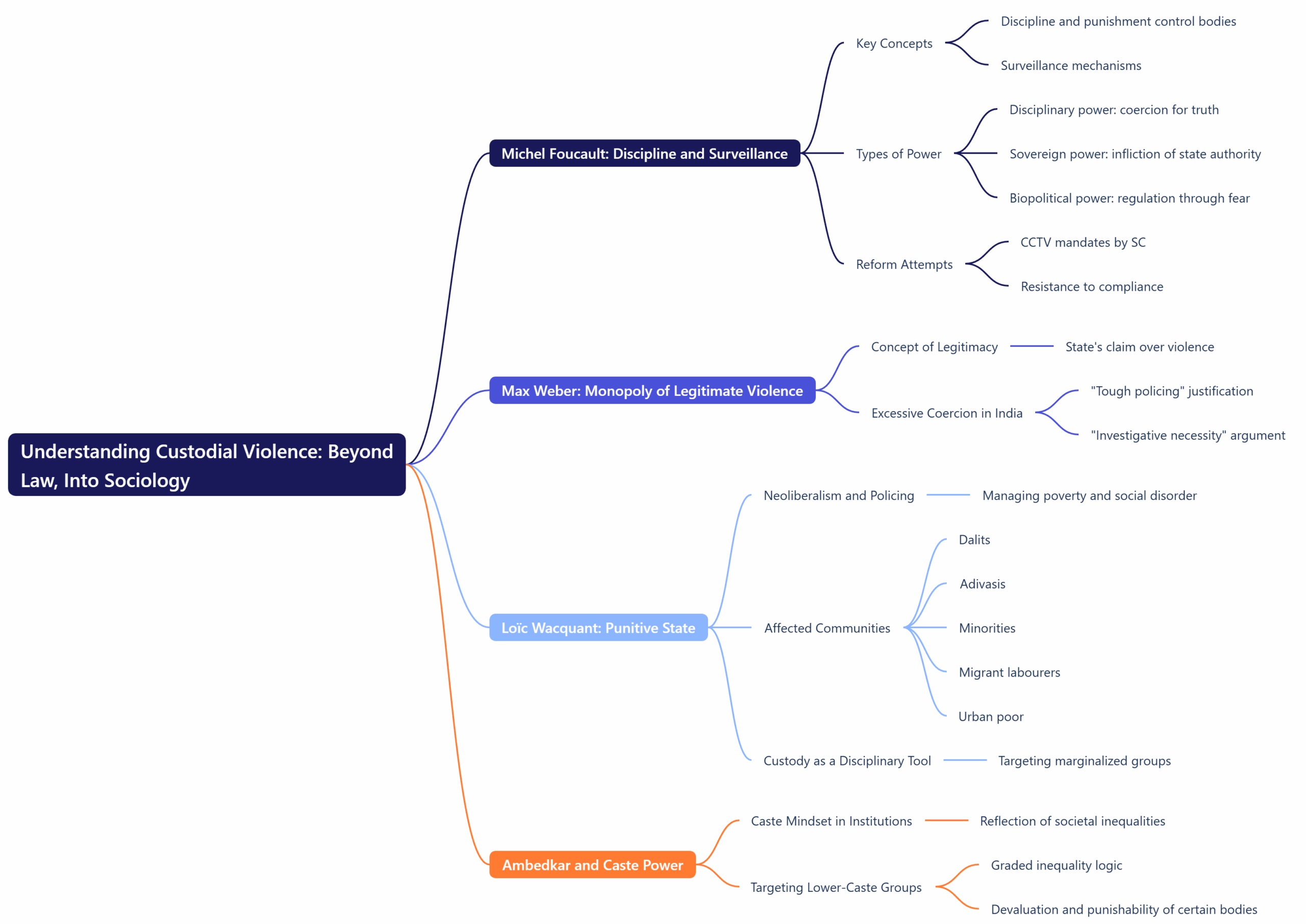
When the Supreme Court recently revisited the issue of custodial torture—following poor compliance with its 2020 Paramvir Singh Saini order mandating CCTV cameras—the discussion resurfaced around a deeper sociological problem: Why does custodial violence persist in a democratic, constitutional state? Custodial violence is not merely a legal violation; it is a sociological phenomenon involving power, inequality, institutional culture, and the logic of punitive governance. Understanding Custodial Violence: Beyond Law, Into Sociology
Though not legally defined, custodial violence involves torture, assault, humiliation, sexual abuse, and deaths during police or judicial custody.
Foucault’s work (Discipline and Punish) is central to understanding policing in India. He argued that modern states use surveillance, discipline, and punishment to control bodies.
CCTV cameras—mandated by the SC—attempt to check this power, but weak compliance shows that the disciplinary apparatus resists its own reform.
Max Weber argued that the state claims a monopoly over “legitimate violence.”
Wacquant’s idea of punitive neoliberalism suggests that modern states use policing to manage poverty and social disorder rather than address structural inequalities.
Custody becomes a tool for disciplining the marginalised.
Ambedkar warned that institutions reflect society’s caste mindset. Historical Sociology of Custodial Violence in India
From Arthashastra’s mutilation punishments to Shariat-based corporal disciplines, early Indian governance normalised physical coercion.
Created after the 1857 revolt, the 1861 Act built a police force not for service, but for control.
Independent India retained colonial policing structures with minimal reform. 2023–24 NHRC data—2,346 judicial custody deaths and 160 police custody deaths—show how entrenched the problem remains. Regulatory Framework: Constitutional & Legal SafeguardsSociologically, the Indian Constitution acts as a counter-power to the violence of the state. Constitutional Protections
These provisions represent what T.H. Marshall called “social and civil rights of citizenship.” New Criminal Codes (2023): BNS, BNSS, BSAThey criminalise torture-induced confessions and mandate procedural transparency. International Human Rights FrameworkIndia is committed to UDHR and ICCPR, yet has not ratified UNCAT, signalling ambivalence toward global anti-torture norms. Why Custodial Violence Persists: A Sociological Diagnosis
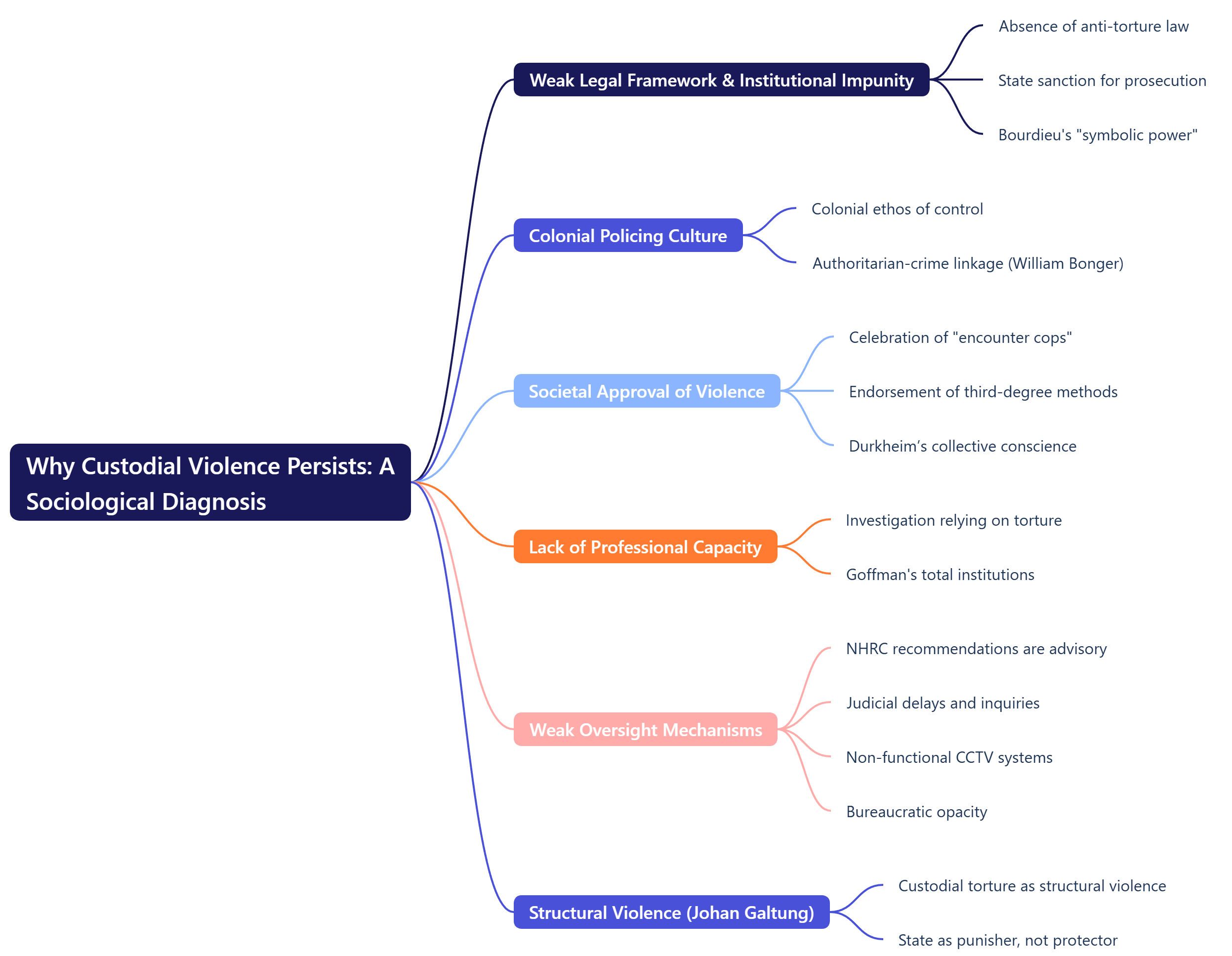
The absence of a clear anti-torture law and the requirement of state sanction for prosecution form what Bourdieu calls “symbolic power”—the ability of the state to define acceptable violence.
The police still operate under a colonial ethos of controlling subjects rather than serving citizens.
Society often celebrates “encounter cops” and third-degree methods.
Relying on torture as an investigative shortcut stems from:
This aligns with Goffman’s idea of total institutions, where extreme pressures distort behaviour.
NHRC recommendations remain advisory.
Custodial torture is not only direct physical violence; it is also structural, arising from:
Thus, the poor and oppressed experience the state not as protector, but as punisher. Reforming Policing: Sociological Pathways to Prevent Custodial Torture
A clear legal definition dismantles loopholes.
Technology introduces Foucauldian counter-surveillance—the state watching the watchers.
Training must include:
This transforms policing from a force to a service, shifting institutional habitus.
Giving them binding powers ensures that institutions cannot ignore violations.
Citizens must know:
Collective awareness empowers resistance to everyday state violence. Conclusion: Ending Custodial Violence Requires Transforming the State-Society RelationshipCustodial violence in India is not an aberration—it is a product of historical legacies, institutional design, power structures, and social attitudes.
Ultimately, as Ambedkar warned, a democratic constitution is only as effective as the social structure supporting it. |

To Read more topics, visit: www.triumphias.com/blogs
Read more Blogs:
Four Labour Codes and the Transformation of India’s World of Work: A Sociological Analysis
One comment