
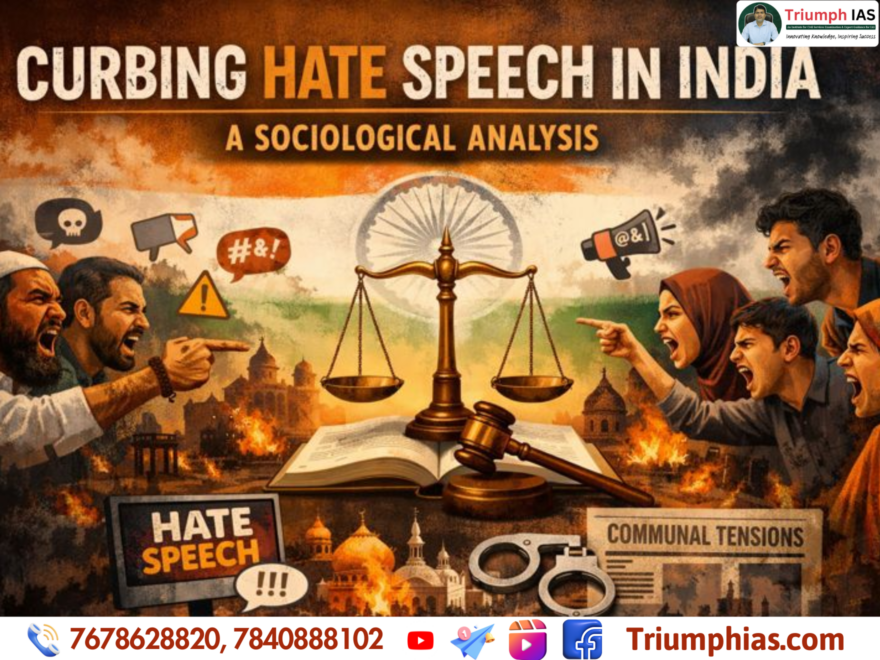
Curbing Hate Speech in India: A Sociological Analysis
(Relevant for Sociology Paper 2: Vision of Social Change in India and Industrialization and Urbanisation in India)
|
Hate speech is more than just an isolated social ill—it is a deeply ingrained phenomenon that undermines the fabric of society, especially in diverse nations like India. Recently, the state of Karnataka took a bold step by introducing the Karnataka Hate Speech and Hate Crimes (Prevention) Bill, 2025, marking the first time an Indian state has attempted to specifically define and legislate against hate speech. However, beyond the legal framework, the sociological implications of such legislation are profound, especially when viewed through the lens of India’s pluralistic society. What is Hate Speech? A Sociological InterpretationHate speech, as defined by the 267th Law Commission Report (2017), involves words or actions intended to incite hatred or violence against individuals or groups based on factors such as religion, race, caste, gender, or sexual orientation. However, from a sociological perspective, hate speech cannot merely be reduced to a collection of offensive words; it represents a social mechanism through which societal divisions are not only reproduced but also magnified. The philosopher John Stuart Mill, in his influential work On Liberty, famously argued that the freedom of speech must be protected, but he also acknowledged that speech should be curtailed when it incites harm to others. In sociological terms, this means that hate speech has the potential to damage social cohesion, promoting distrust and even violence within communities. While Mill’s liberal ideas focus on protecting individual freedoms, Emile Durkheim, one of the founding fathers of sociology, provides us with a different lens through which to view hate speech. Durkheim’s concept of social solidarity suggests that societies are bound together by shared beliefs and values. Hate speech, in this context, threatens social solidarity by creating in-groups and out-groups, thereby exacerbating social division. Durkheim would argue that allowing hate speech to flourish undermines the moral fabric of society, making it harder for individuals to live together harmoniously. Impact of Hate SpeechMax Weber: Power and DominationMax Weber’s theories on power and social domination provide a crucial sociological framework for understanding the function of hate speech in society. Weber argued that power relations in society often result in the domination of certain groups over others. Hate speech is one of the tools used by dominant groups to assert their power, often marginalizing already vulnerable communities. This is particularly evident in India, where hate speech has been used as a political tool to divide communities and assert dominance, particularly along lines of religion and caste. Weber’s concept of legitimacy also plays a role here. When hate speech is not effectively regulated or condemned, it becomes socially legitimized, allowing it to perpetuate domination and violence. In this sense, the need for a legal framework to curb hate speech becomes even more important—not just for justice but to prevent the further entrenchment of social hierarchies. Karl Marx: Ideology and Social ControlKarl Marx’s ideas on ideology and false consciousness help explain how hate speech can function as a tool of social control. Marx argued that the dominant ideology of any society serves the interests of the ruling class, often at the expense of marginalized groups. Hate speech, in this framework, serves to perpetuate class-based divisions, racial hierarchies, and other forms of inequality by spreading harmful stereotypes about vulnerable communities. For instance, hate speech targeting Dalits or Muslims in India is not just a personal attack; it is deeply ideological, reinforcing the power of dominant castes and religious groups over marginalized populations. Hate speech, therefore, becomes a form of cultural hegemony, where the ruling class uses language to maintain its control over the social order. Antonio Gramsci’s notion of cultural hegemony—the dominance of certain cultural norms over others—is useful here. According to Gramsci, dominant groups in society often use culture, including media and political discourse, to maintain power. Hate speech thus becomes part of this hegemonic structure. Michel Foucault: Discourse and PowerMichel Foucault’s work on discourse and power offers a valuable lens for analyzing how hate speech is not just about harmful words but also about the formation of social truths. Foucault argued that knowledge is deeply intertwined with power, and that those in power have the ability to shape social truths through discursive practices. Hate speech is an example of such a discourse—it is not simply a series of isolated utterances but part of a broader social construction of what is considered acceptable, normal, or other. In this sense, hate speech can be seen as a biopolitical tool, shaping societal norms and identities in ways that marginalize certain groups. The growing prevalence of hate speech on digital platforms is a prime example of how online discourses can shape public perceptions and fuel social polarization. Foucault’s ideas on surveillance and self-regulation are also relevant when considering the role of institutions in curbing hate speech. He argued that power works not only through laws and institutions but also through subtle mechanisms of social control. In the digital age, where hate speech is often spread anonymously, it becomes harder to regulate, and individuals may self-censor to avoid becoming targets of online hate. The Legal Landscape and Sociological CritiqueThe introduction of the Karnataka Hate Speech and Hate Crimes (Prevention) Bill, 2025 is a significant step in the legal regulation of hate speech in India. However, from a sociological perspective, we must ask: Does the law address the root causes of hate speech? Émile Durkheim’s work on anomie, a condition where social norms are weak or unclear, can help us understand why hate speech persists in society. Durkheim would argue that laws alone are not sufficient to combat hate speech unless they are part of a broader social transformation that reinforces the collective conscience. In this sense, while the Karnataka bill might provide legal mechanisms for regulating hate speech, it is equally important to promote social norms that value diversity and tolerance. Legal measures must be accompanied by public education campaigns and community-based interventions that address the underlying social prejudices. Moreover, Erving Goffman’s work on stigma is also pertinent. Goffman argued that certain groups are marginalized and subjected to dehumanizing stereotypes, often through language. Hate speech serves to stigmatize vulnerable groups, further alienating them from mainstream society. Thus, anti-hate speech laws must be seen as part of a larger effort to dismantle the stigmatization of marginalized communities in India, whether based on caste, religion, gender, or sexual orientation. ConclusionIn conclusion, while legal frameworks like the Karnataka Hate Speech Bill are essential, they must be part of a broader sociological strategy to tackle hate speech. This includes:
By combining legal, social, and cultural interventions, India can work toward creating a society where speech does not harm the social fabric but instead fosters understanding and solidarity. |
To Read more topics, visit: www.triumphias.com/blogs
Really helpful insights. I found this article very informative and easy to understand
Thanks for sharing this. I learned something new today from your blog.