Introduction
In an era of global interconnectedness and rising identity politics, the idea of cultural nationalism has taken center stage in public discourse. Cultural nationalism refers to a form of nationalism wherein the nation is defined by a shared culture, language, religion, history, or ancestry, rather than political boundaries or civic agreements. It seeks to foster a collective national identity based on cultural heritage and traditional values. For UPSC aspirants, cultural nationalism is a highly relevant topic under themes like identity formation, nationalism and modernity, ethnicity and communalism, secularism, and cultural integration vs isolation.
What is Cultural Nationalism?
Cultural nationalism is a form of nationalism where the nation is primarily defined by a shared culture. It differs from civic nationalism (based on shared values and institutions) and ethnic nationalism (based on common ancestry). It emphasizes:
- Myths and symbols: National epics, religious texts, festivals.
- Language and literature: Sanskrit, Hindi, Tamil, etc.
- Religion and rituals: Hindu dharma, cow worship, temple architecture.
- Traditions and practices: Clothing, cuisine, family systems.
This form of nationalism aims to preserve and revive the cultural soul of a nation perceived to be under threat from external or internal cultural dilution—be it colonialism, westernization, or multiculturalism.
Evolution of Cultural Nationalism in India
Pre-independence Phase
During colonial rule, Indian thinkers and leaders like Bankim Chandra Chatterjee, Swami Vivekananda, Dayanand Saraswati, and Aurobindo Ghosh invoked Bharat Mata, Vedas, and spiritual superiority of Indian civilization to counter Western hegemony. This was a cultural resistance to colonization—a narrative of pride and spiritual unity.
- Swadeshi Movement: Promoted indigenous goods and culture.
- Arya Samaj and Ramakrishna Mission: Reasserted Vedic culture.
- Cow protection movements: Early expressions of religious-cultural identity.
Post-independence Phase
After 1947, the Indian Constitution adopted a secular and pluralistic model of nationalism. However, cultural nationalism persisted as an undercurrent, particularly among organizations like the RSS, VHP, and BJP, which promoted the idea of Hindutva as the cultural ethos of India.
Key Features of Cultural Nationalism in Contemporary India
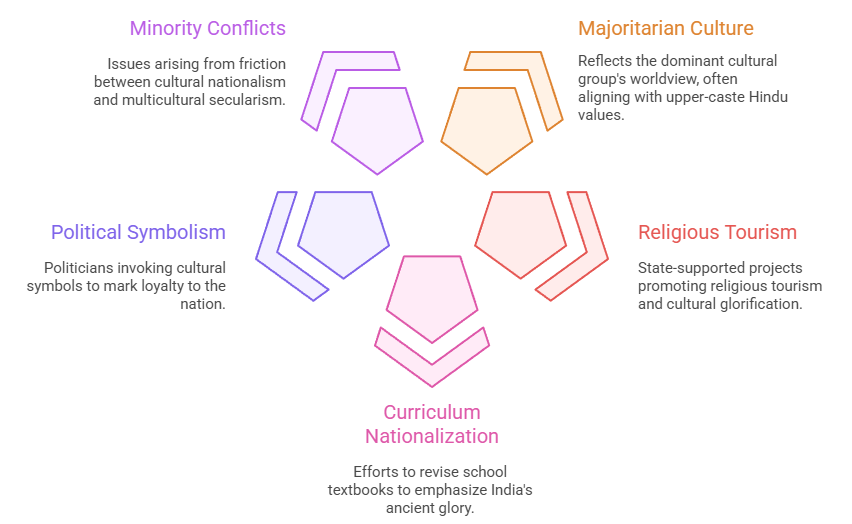
- Assertion of Majoritarian Culture: Cultural nationalism often reflects the dominant cultural group’s worldview—in India, this often aligns with upper-caste Hindu values. This includes celebration of Hindu festivals at national level, glorification of mythological figures, and Sanskritization of rituals.
- Temple Construction & Pilgrimage Promotion: State-supported religious tourism and projects like Ram Mandir, Kashi Corridor, and Statue of Unity reflect an ideological push towards cultural glorification.
- Textbook Rewriting & Curriculum Nationalization: There have been repeated efforts to revise school textbooks to emphasize India’s ancient glory and Hindu contributions to science, medicine, and mathematics.
- Cultural Symbols in Political Discourse: Politicians often invoke symbols like Ganga, Bharat Mata, Tilak, and Chanting of Vande Mataram as markers of loyalty to the nation.
- Conflict with Minority Cultures: Issues such as beef bans, love jihad narratives, hijab restrictions, and communal riots often stem from the friction between cultural nationalism and multicultural secularism.
Sociological Analysis
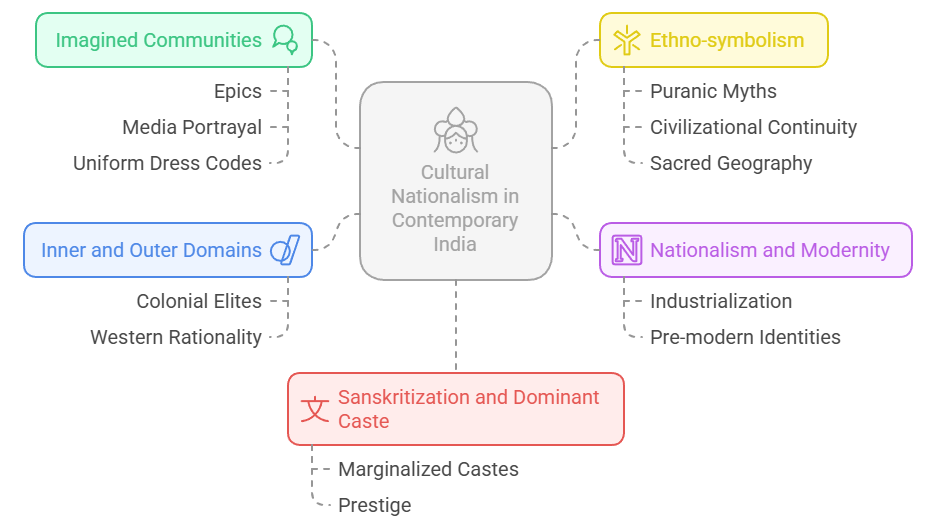
- Imagined Communities: Benedict Anderson argues that nations are “imagined communities” created through shared symbols, media, language, and narratives. Cultural nationalism utilizes these tools—epics, media portrayal of ‘Bharat’, uniform dress codes—to imagine a cohesive national identity.
- Nationalism and Modernity: Ernest Gellner sees nationalism as a product of modernity, especially industrialization. Cultural nationalism emerges as a response to modernization anxieties and seeks to reassert pre-modern identities.
- Ethno-symbolism: Anthony D. Smith emphasizes ethno-symbols—myths, memories, and cultural traditions—as key drivers of nationalism. Cultural nationalism in India thrives on reviving Puranic myths, civilizational continuity, and sacred geography.
- The Inner and Outer Domains: Partha Chatterjee argues that colonial elites created a bifurcation—modernity (outer domain) and tradition (inner domain). Cultural nationalism resides in the inner domain where religion and tradition are preserved from Western rationality.
- Sanskritization and Dominant Caste: According to M.N. Srinivas , The process of Sanskritization reflects cultural nationalism’s mechanism: marginalized castes emulate upper-caste practices to gain prestige. Cultural nationalism elevates this to a national scale.
Contemporary Relevance
Positive Aspects
- Cultural Unity: It strengthens national pride and binds people through shared traditions.
- Heritage Preservation: Helps safeguard endangered languages, folk arts, and oral histories.
- Resisting Cultural Imperialism: Counters Western cultural dominance and maintains local authenticity.
Criticisms
- Exclusion of Minorities: It marginalizes linguistic, religious, and tribal minorities.
- Rise of Communalism: Cultural nationalism often merges into religious fundamentalism.
- Cultural Homogenization: Destroys diversity under a singular dominant culture.
- Violation of Secularism: It blurs the line between state and religion, threatening constitutional ideals.
Cultural Nationalism vs. Constitutional Nationalism
| Cultural Nationalism |
Constitutional Nationalism |
| Based on religion, language, ethnicity |
Based on values—justice, liberty, equality |
| Often majoritarian in character |
Inclusive and pluralistic |
| Emotional and symbolic |
Rational and institutional |
| May fuel sectarianism |
Ensures democratic integrity |
Dr. Ambedkar, Jawaharlal Nehru, and Gandhi envisioned constitutional nationalism rooted in unity in diversity, not in cultural majoritarianism.
Case Studies
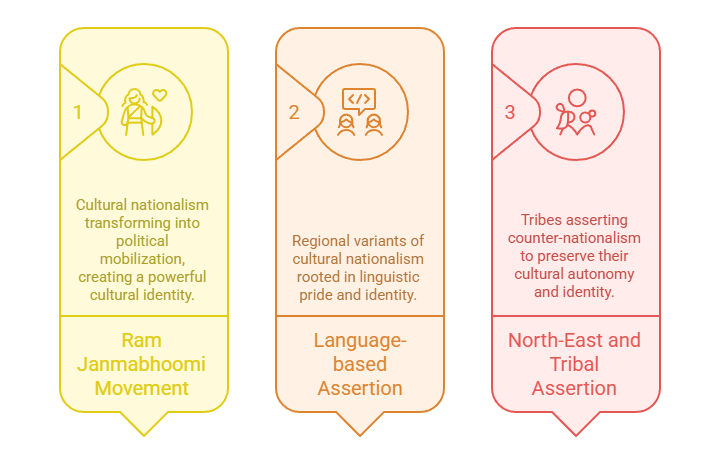
- Ram Janmabhoomi Movement: A prime example of cultural nationalism transforming into political mobilization. It created a powerful cultural identity around Lord Ram and Ayodhya, redefining national pride through religious lens.
- Language-based Cultural Assertion: Movements like Shiv Sena’s promotion of Marathi or Tamil nationalism in Tamil Nadu represent regional variants of cultural nationalism rooted in linguistic pride.
- North-East and Tribal Assertion: Cultural nationalism is not monolithic. Tribes and ethnic groups in the North-East assert counter-nationalism to preserve their cultural autonomy.
Conclusion:
Cultural nationalism is a powerful emotional force that can unify people through shared traditions, history, and language. But when it evolves into exclusivist ideology, it threatens the fabric of plural democracy and constitutional morality. A balance must be struck between cultural pride and inclusive citizenship. In the words of Amartya Sen, “Identity is not destiny.” The richness of Indian society lies in its multiplicity of identities—religious, linguistic, regional—and cultural nationalism must not undermine this mosaic.
Previous Year Questions
Paper 1
- Explain how the concept of nation differs from the concept of state in sociological theory. (2018)
Paper 2
- “Ethnicity and religion are major sources of identity in Indian society.” Discuss. (2020)
- What is the sociological significance of communalism in India? (2016)
|



One comment