Introduction: Cross-Border Marriages
In recent years, intercultural marriages involving Chinese nationals and South Asians (Indians, Pakistanis, and Bangladeshis) have seen a noticeable rise. These unions—once considered rare—are now emerging in various Border States, business circles, and student communities. From arranged cross-national weddings in rural Punjab to love marriages formed through international educational exchanges, the phenomenon is shaping new social dynamics. This trend is not just a cultural curiosity—it is a rich sociological case study involving themes of globalization, migration, kinship, gender roles, and cultural integration.
Factors Driving Intercultural Marriages
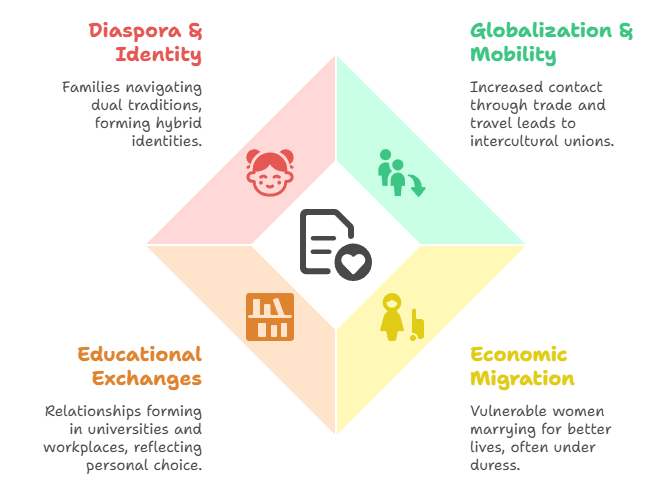
- Globalization and Cross-Cultural Mobility: Globalization has intensified people-to-people contact through trade, education, tourism, and work. This has led to increased intercultural marriages, especially in regions like Gilgit-Baltistan, Ladakh, Arunachal Pradesh, and Sindh, where Chinese traders and workers engage with local populations. These unions challenge conventional geographical and cultural boundaries of marriage.
- Economic Migration and Human Trafficking: In economically vulnerable regions of Pakistan and Bangladesh, women are sometimes married off to Chinese men under the promise of a better life. These cases, often bordering on trafficking, highlight structural gender inequalities and the commodification of marriage under global migration pressures.
- Educational and Professional Exchanges: With rising cross-border education and work exchanges, particularly among middle-class youth, romantic relationships often form in universities and global workplaces. These marriages reflect values of cosmopolitanism and personal choice, marking a shift from arranged marriages to companionate ones.
- Diaspora and Identity Redefinition: South Asians working or living in China, Hong Kong, or Singapore frequently marry locals. These intercultural families navigate dual traditions, contributing to the formation of hybrid identities and new diasporic communities that straddle both Chinese and South Asian cultures.
Sociological Analysis
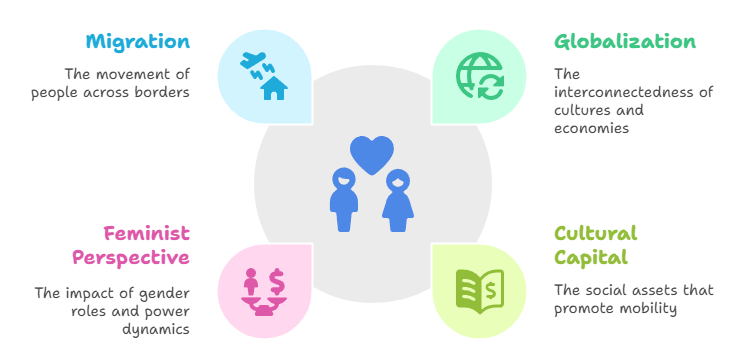
- Globalization and Deterritorialization of Kinship: The idea of deterritorialization explains how globalization reshapes kinship beyond geographic constraints. Marriages between Chinese and South Asians disrupt caste endogamy and traditional marriage markets, signaling a new globalized family structure.
- Bourdieu’s Cultural Capital and Marriage Choices: According to Pierre Bourdieu, intercultural marriages can serve as a route for upward social mobility. For South Asians, marrying a Chinese national may symbolize status enhancement and access to global networks, making marriage a strategic social investment.
- Feminist Perspective on Gender and Power: Ann Oakley’s feminist insights show that these marriages may be liberating for some women but exploitative for others. Poor women married into foreign families may face unfamiliar gender roles and isolation, reflecting deeper global gender hierarchies.
- Migration and Hybrid Identity Formation: Stuart Hall’s concept of identity as fluid helps explain how children of such marriages form hybrid identities. These individuals combine elements of both Chinese and South Asian cultures, shaping multicultural and transnational subcultures in the process.
Challenges and Sociopolitical Implications
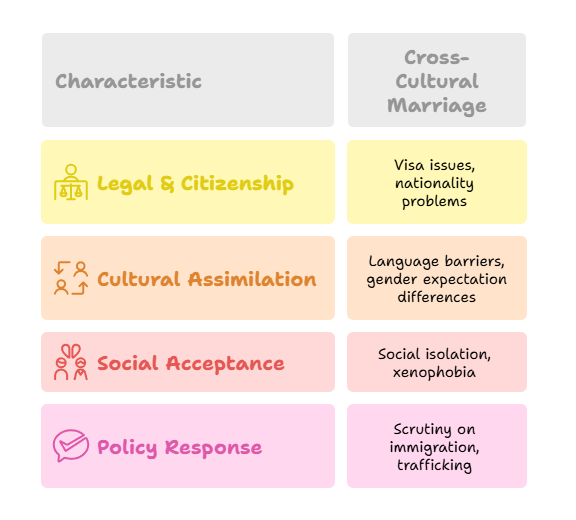
- Legal and Citizenship Issues: Visa challenges, dual nationality problems, and unclear legal status for children born in such unions.
- Cultural Assimilation and Conflict: Language barriers, differing gender expectations, and family opposition often create stress in such marriages.
- Xenophobia and Social Exclusion: These families may face social isolation or suspicion in both home and host countries, especially in tense geopolitical climates (g., India-China border tensions).
- Policy Response: Governments are increasingly scrutinizing such marriages under the lens of immigration control, human trafficking prevention, and citizenship regulation.
Conclusion
Intercultural marriages between Chinese and South Asians present a complex intersection of globalization, gender, identity, and migration. While they signify growing transnational ties, they also raise critical sociological questions around power, inequality, assimilation, and cultural negotiation. These emerging kinship patterns reflect the dynamic nature of modern social institutions and require nuanced understanding rooted in classical and contemporary theories.
PYQs
Paper I
- Examine how globalization has transformed patterns of social relationships in contemporary society. (2022)
- How is the institution of marriage undergoing transformation in contemporary society? (2021)
- Explain how descent and alliance theories help in understanding the rules of marriage in different societies. (2018)
- Discuss the social consequences of exogamy in kinship and marriage systems. (2015)
Paper II
- How do gender inequalities manifest in transnational marriages and what are their sociological implications? (2023)
- What changes do you observe in marriage and family in the context of recent social transformations in India? (2021)
- How do transnational families negotiate identity and belonging across borders? (2020)
- Discuss the impact of globalization on gender roles and marital relationships in India. (2019)
- Discuss the recent trends in inter-caste and inter-religious marriages in India. What do they indicate about changing social values? (2018)
- Examine the role of caste and class in regulating marriage choices in Indian society. (2016)
|


One comment