Introduction
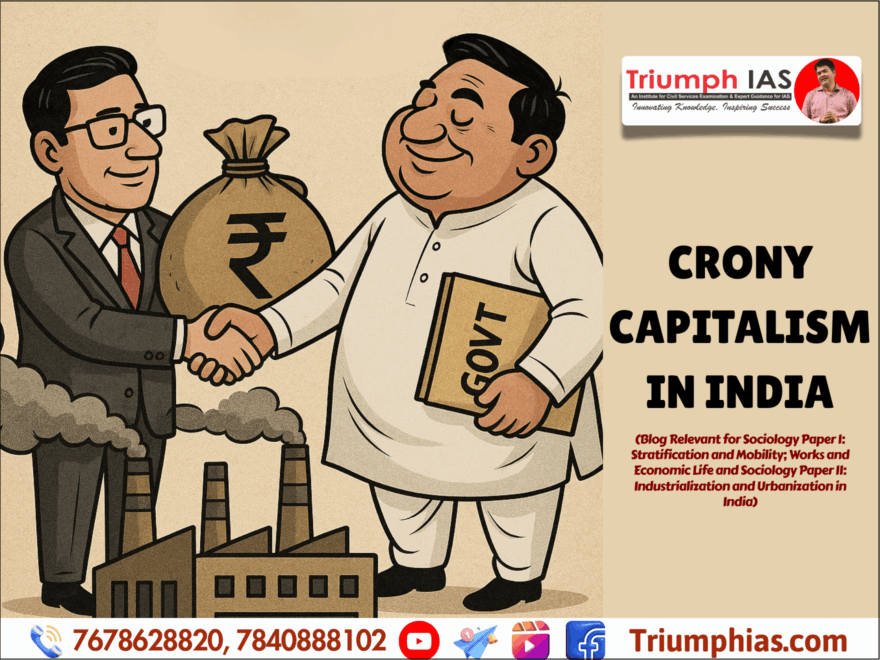
Crony Capitalism refers to an economic system in which business success is influenced by close relationships between businessmen and government officials. Instead of merit-based competition, favoritism in distribution of legal permits, government grants, tax breaks, and regulatory support becomes the norm. In the Indian context, crony capitalism is often cited in reference to the liberalization period post-1991, where economic reforms paved the way for both entrepreneurial expansion and corporate-political collusion. The term has gained traction due to high-profile scams, regulatory captures, and accusations of corporate lobbying influencing public policy.
Historical Context
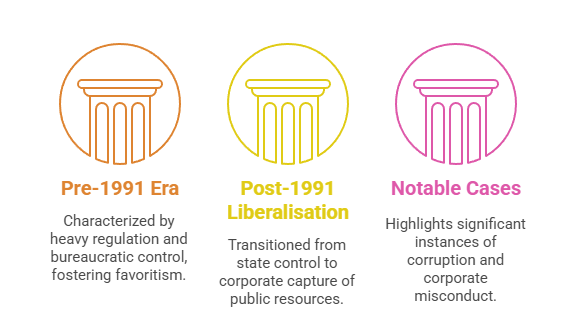
- Pre-1991 Era: Indian economy was heavily regulated. Industrial licenses, quotas, and permits were central to running a business. This created a space for license-permit raj, which was fertile ground for favoritism.
- Post-1991 Liberalisation: Economic liberalization was expected to eliminate the inefficiencies of a controlled economy. However, it often replaced state control with corporate capture of public resources like land, spectrum, coal, and water.
- Notable Cases:
- 2G Spectrum Scam
- Coal Allocation Scam
- Adani Controversies
- Bank NPAs linked to large industrialists
These events show how political patronage and capital accumulation have converged, making the market less free and more skewed toward a powerful few.
Sociological Analysis
- Conflict Theory and Capital Accumulation
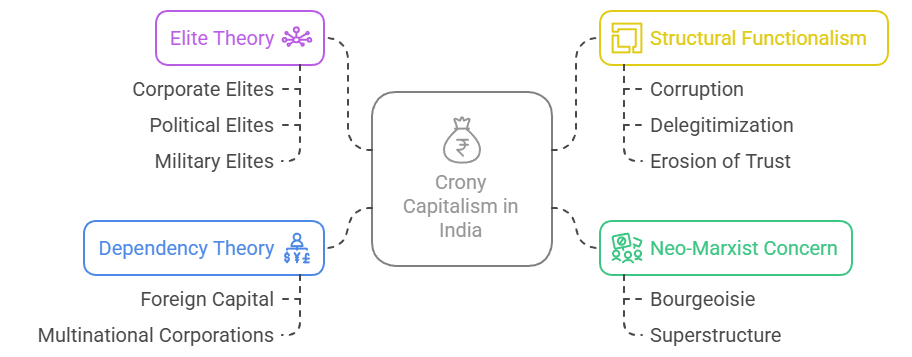
According to Karl Marx, capitalism is inherently exploitative. In India, crony capitalism represents a neo-Marxist concern where bourgeoisie (corporate class) consolidates economic power by influencing the superstructure (political and legal institutions).
- Example: Corporate lobbying influences tax laws and land acquisition rules to favor the rich.
- Sociological implication: Widening class inequalities and alienation of the working class.
- Elite Theory and Power Circulation
Wright Mills’ Power Elite Theory applies aptly. Mills spoke of a triad of power – corporate, political, and military elites—who make decisions without public accountability.
In India, this is seen in the revolving door between bureaucracy, politics, and corporations. Top executives become political advisors or ministers, while retired officials join corporate boards.
- Structural Functionalism and Dysfunction
While Parsons viewed institutions as serving a function in society, Merton’s dysfunctions theory is more applicable here. Crony capitalism results in:
- Institutional corruption
- Delegitimization of democratic governance
- Erosion of trust in public institutions
- Dependency Theory
India’s economic dependence on foreign capital and multinational corporations is often mediated through domestic business elites. These elites act as intermediaries for global capital, facilitating neo-colonial economic relations.
Contemporary Manifestations of Crony Capitalism in India
- Political Funding and Electoral Bonds
Opaque mechanisms like electoral bonds allow corporates to fund political parties without transparency. This creates a quid-pro-quo environment for policy favors.
- Privatisation Drive
Privatisation of public sector undertakings (PSUs) often leads to undervalued asset sales to a few industrialists, reinforcing crony ties.
- Corporate Influence on Media
Large corporations own a significant share of Indian media. The nexus between capital and media curbs freedom of expression and restricts public debate on economic inequalities.
Impact of Crony Capitalism on Indian Society
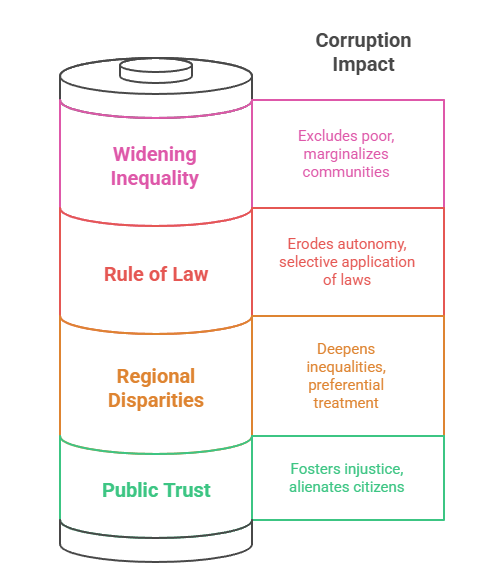
- Widening Inequality
- The Oxfam Reports on India have highlighted growing income inequality, with the top 1% owning more than 40% of national wealth.
- The Sociological implication: Exclusion of the poor and marginalized, especially Dalits, Adivasis, and informal workers, from economic growth.
- Erosion of Public Trust
- Crony capitalism fosters a sense of injustice and alienation among citizens.
- Trust deficit between government and people hampers citizen engagement and undermines democracy.
- Regional Disparities
- States with strong business-politics ties get preferential treatment in infrastructure and resource allocation, further deepening regional inequalities.
- Undermining Rule of Law
- Selective application of laws, corporate bailouts, and slow prosecution of financial frauds reflect the erosion of institutional autonomy.
Government Reforms to Curb Crony Capitalism
- Digital India and e-Governance: Promotes transparency in service delivery and reduces interface with middlemen.
- Insolvency and Bankruptcy Code (IBC): Aims to resolve the issue of non-performing assets (NPAs) and hold crony capitalists accountable.
- New Procurement Policies: Government e-Marketplace (GeM) ensures open bidding to reduce favoritism in contracts.
- Regulatory Strengthening: Strengthening of institutions like CAG, CVC, and CCI to counter regulatory capture.
However, the effectiveness of these reforms remains questionable unless backed by political will and independent media.
Way Forward
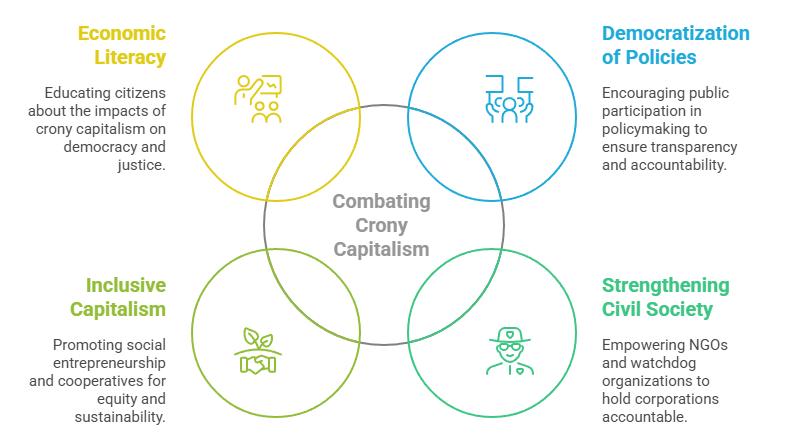
- Democratization of Economic Policies: Encourage public participation in policymaking through deliberative forums and social audits.
- Strengthen Civil Society: Empower NGOs, think tanks, and watchdog organizations to hold corporations accountable.
- Inclusive Capitalism: Promote social entrepreneurship and cooperatives that work towards equity and sustainability.
- Education on Economic Literacy: Citizens must be educated about how crony capitalism affects democracy, economy, and justice.
Conclusion
Crony capitalism in India represents a deviation from the ideals of free-market competition and democratic governance. It results in institutional decay, public disillusionment, and structural inequality.
PYQs
Paper I
- How does the Marxist theory explain the process of class formation in capitalist society?(2015)
- Explain the role of capitalism in bringing social change.(2016)
- Discuss the contribution of C. Wright Mills to the understanding of power elite(2018)
- How is inequality structured in capitalist societies? Use sociological theories to explain.(2020)
- How is power distributed in capitalist societies according to various sociological theories?(2023)
- How do conflict theorists explain inequality in capitalist societies? Evaluate with examples.(2024)
Paper II
- Examine the impact of economic reforms (1991) on class structure in India.(2015)
- Discuss the emerging pattern of class formation in India after liberalisation.(2016)
- How has the policy of liberalisation affected labour class in India?(2017)
- Critically examine the role of corporate sector in development with reference to recent controversies.(2018)
- How far has the privatization of public services in India resulted in social exclusion?(2020)
- Analyse the relationship between economic liberalisation and the growth of inequality in India.(2021)
- Discuss the nature of business-politics nexus in contemporary India. Use sociological concepts.(2022)
- Explain the role of economic reforms in shaping the emerging elite class in India.(2023)
- How does crony capitalism impact democratic governance and social justice in India?(2024)
|


3 comments