Introduction: Corruption in private sector
While public sector corruption has long captured the spotlight in India, corruption in the private sector is an equally alarming and under-discussed phenomenon. From corporate fraud and tax evasion to collusion with political elites, private corruption undermines economic integrity, erodes public trust, and contributes to structural inequality.
Why Private Sector Corruption Matters
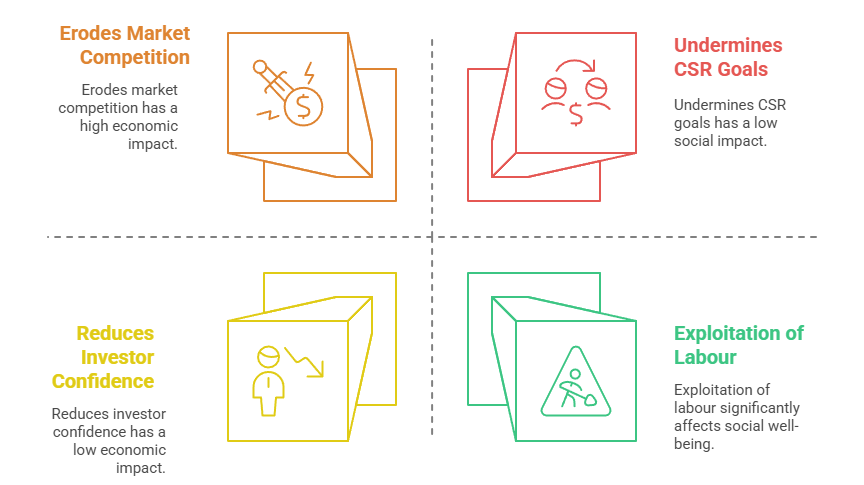
- Erodes Market Competition: Unethical practices like cartelization, bid-rigging, and insider trading distort free markets.
- Reduces Investor Confidence: Scams like the Satyam scam (2009) or IL&FS crisis (2018) create systemic shocks.
- Exploitation of Labour: Violation of labor rights, wage theft, and unsafe working conditions are common.
- Undermines CSR Goals: Several firms divert Corporate Social Responsibility (CSR) funds for personal gains.
Sociological Analysis
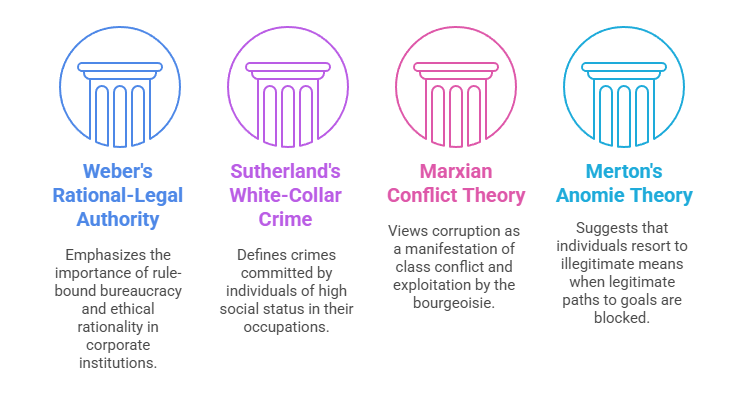
- Max Weber’s Theory of Rational-Legal Authority: Weber emphasized the importance of a rule-bound bureaucracy. In India, the absence of ethical rationality in corporate institutions leads to discretionary decision-making, favouritism, and lack of transparency in procurement and contracts.
- White-Collar Crime: Sutherland defined white-collar crime as “a crime committed by a person of respectability and high social status in the course of his occupation.” Corporate frauds, insider trading, and tax evasion are classic examples of elite deviance, often overlooked due to the social capital of the perpetrators.
- Conflict Theory : From a Marxian lens, corruption in the private sector is the manifestation of class conflict, where the bourgeoisie exploits the system to protect its capitalist interests while suppressing accountability mechanisms like audits and regulatory oversight.
- Anomie Theory: Merton’s strain theory suggests that when culturally approved goals (e.g., profit) cannot be achieved through legitimate means, individuals may resort to innovation—illegitimate paths like bribery and manipulation, common in corporate settings.
Case Studies
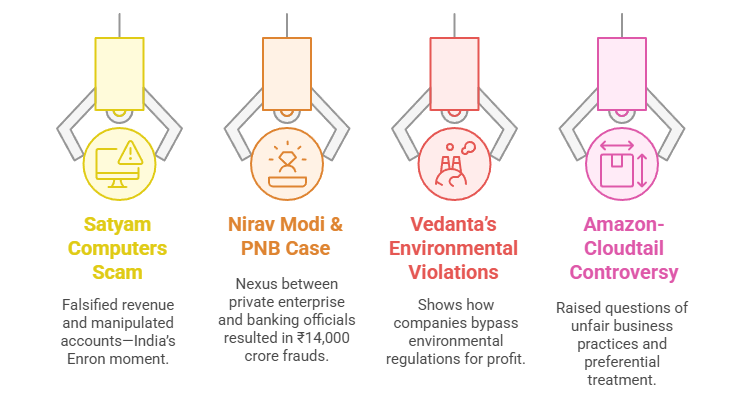
- Satyam Computers Scam: Falsified revenue and manipulated accounts—India’s Enron moment.
- Nirav Modi & PNB Case: Nexus between private enterprise and banking officials resulted in ₹14,000 crore frauds.
- Vedanta’s Environmental Violations: Shows how companies bypass environmental regulations for profit.
- Amazon-Cloudtail Controversy: Raised questions of unfair business practices and preferential treatment.
Way Forward
- Stronger Regulatory Bodies: Empower SEBI, CCI, and SFIO with more autonomy.
- Corporate Ethics Training: Mandatory courses for board members and executives.
- Whistleblower Protection: Incentivize reporting and ensure anonymity.
- Transparent CSR Audits: CSR must be tied to independent monitoring.
- Cross-sectoral Accountability: Ensure that private corruption is treated with the same seriousness as public corruption.
Conclusion
Corruption in the private sector is not merely a business ethics issue—it is a deep-rooted sociological problem that reflects power imbalance, elite immunity, and systemic gaps. To achieve sustainable and inclusive growth, India must address private corruption with urgency, accountability, and reform.
PYQs
Paper I
- “Distinguish between crime and white-collar crime. Explain how white-collar crime is more dangerous than ordinary crime.”
- “Write short notes on ‘Organized and White Collar Crimes’.”
Paper II
- “Discuss the nature and extent of corruption in India. How can it be controlled?”
- “Critically examine the impact of economic liberalization on working conditions in India.”
- “Analyze the growing salience of crony capitalism in India’s development trajectory.”
|



2 comments