Introduction
The contractualisation of labour refers to the increasing reliance on contract workers rather than permanent employees, especially in both public and private sectors. With the rise of liberalisation, privatisation, and globalisation (LPG reforms) since the 1990s, India has witnessed a significant shift in employment patterns. Today, a large portion of India’s workforce operates under precarious conditions without job security, social protection, or bargaining power.
What is Contractual Labour?
Contractual labour is a form of employment where workers are hired for a fixed-term contract by a third-party contractor, rather than being directly employed by the principal employer. This system is widely used in industries such as construction, manufacturing, sanitation, mining, and even IT services.
Causes of Contractualisation of Labour
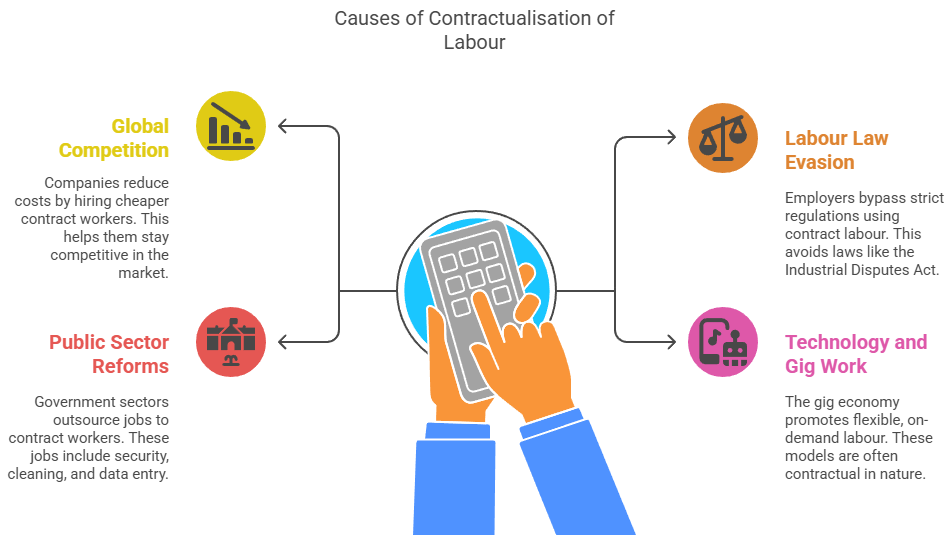
- Liberalisation and Global Competition: To reduce costs and stay competitive, companies prefer contract workers who are cheaper and easier to replace.
- Labour Law Evasion: Employers often use contract labour to bypass stringent regulations under laws like the Industrial Disputes Act.
- Public Sector Reforms: Even government sectors are increasingly outsourcing jobs like security, cleaning, and data entry to contract workers.
- Technology and Gig Work: The rise of the gig economy (e.g., Zomato, Swiggy, Ola) promotes flexible and on-demand labour models, often contractual in nature.
Current Trends and Data (2024-25)
- As per Periodic Labour Force Survey (PLFS) 2023-24, over 70% of India’s non-agricultural workforce is engaged in informal or contractual jobs.
- The Code on Social Security 2020 tries to universalize benefits, but implementation remains a challenge for contract workers.
- Delhi’s sanitation workers protest in 2024 against contractualization drew national attention to job insecurity and poor wages.
Sociological Analysis
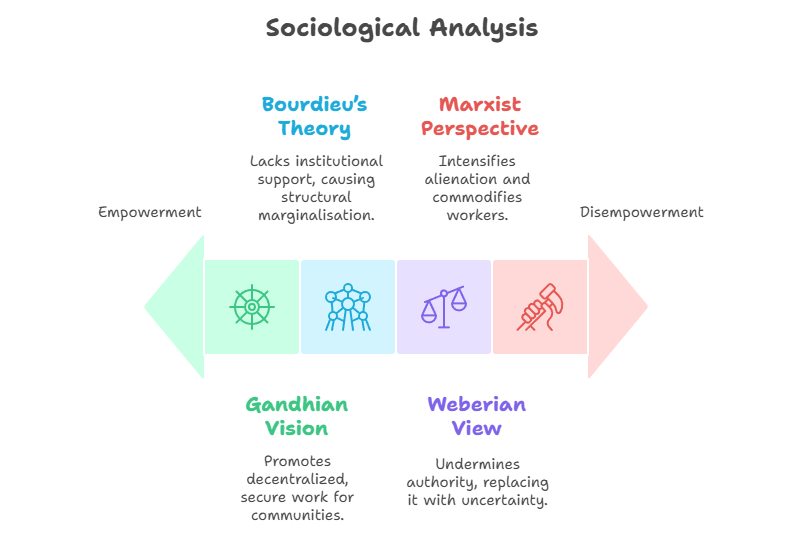
- Marxist Perspective: Karl Marx viewed capitalism as a system that exploits labour. Contractual labour intensifies alienation, reduces collective bargaining, and increases class conflict. Workers are commodified, valued only for their labour power.
- Weberian View: Max Weber’s idea of bureaucratisation contrasts with today’s informal labour structures. Contractualisation undermines rational-legal authority and institutional loyalty, replacing them with uncertainty and disempowerment.
- Bourdieu’s Theory of Social Capital: Pierre Bourdieu’s concept of social and economic capital suggests that contract workers lack the institutional support and networks that permanent employees have, leading to structural marginalisation.
- Gandhian Vision of Labour: Gandhi emphasized dignity of labour and decentralized economic structures. Contractualisation contradicts this by creating fragmented and insecure work lives, especially for marginalized communities.
Impact on Society
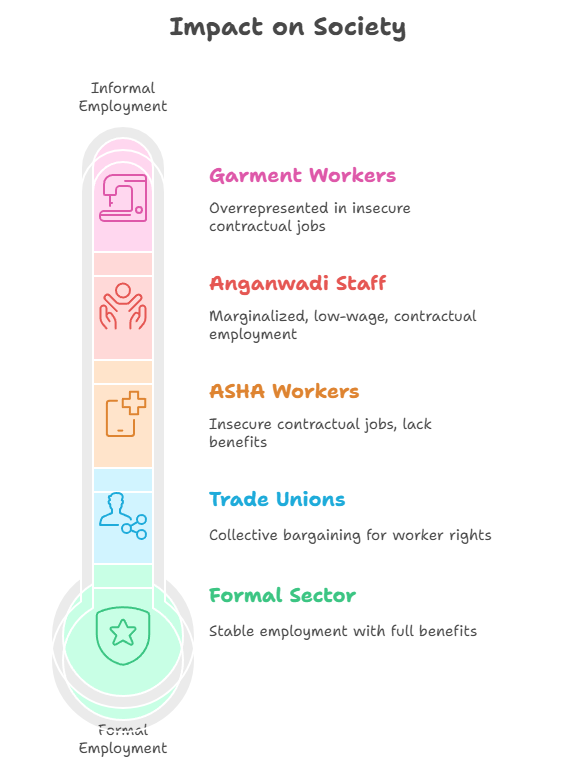
- Rise in informal sector employment: Contractual jobs increase economic insecurity.
- No social security benefits: Workers lack pensions, health insurance, and maternity leave.
- Weakened trade unions: Fragmented employment leads to a decline in unionisation.
- Gender impact: Women are disproportionately represented in insecure contractual jobs like ASHA workers, anganwadi staff, and garment factory workers.
- Caste-based marginalisation: Dalits and Adivasis are overrepresented in low-wage contractual jobs.
Government Initiatives
- Labour Codes 2020 – Promises to cover contract and gig workers under social security.
- E-Shram Portal – Database to register unorganised workers for welfare schemes.
Challenges
- Implementation is weak and often excludes actual beneficiaries.
- Middlemen and contractors often siphon off benefits.
- Lack of grievance redressal mechanisms.
Way Forward
- Regulate third-party contracts through strict monitoring and compliance.
- Ensure universal social protection for all categories of workers.
- Promote formalisation through incentives to employers.
- Strengthen worker unions to include gig and contractual labour.
- Implement legal protections for vulnerable groups including women, Dalits, and minorities.
Conclusion
Contractualisation of labour is a reflection of the changing dynamics of work in a globalised economy, but it raises serious questions about social justice, dignity, and equity. From a sociological lens, it reveals the structural inequalities that persist in India’s labour market, making it a core issue for policymakers, sociologists, and civil society.
PYQs
Paper 1:
- Discuss the relationship between bureaucracy and the labour process as analysed by Weber. (2014)
- How does globalisation affect the nature of work and workers in modern society? (2015)
- Discuss the role of industrialisation in shaping the structure and nature of work. (2016)
- How is the process of social mobility influenced by economic liberalisation and contractual employment? (2018)
- Examine how informal labour and precarious employment reflect changes in the mode of production. (2019)
- Discuss the changing nature of class structure in capitalist societies. (2020)
- Explain the Marxian concept of alienation. How is it relevant in the context of gig and platform-based economies today? (2021)
Paper 2:
- How does globalisation impact labour and working conditions in developing countries like India? (2015)
- Examine the impact of new economic policy (1991) on the informal sector workforce in India. (2016)
- Discuss the informalisation of labour in the context of post-liberalisation Indian economy. (2017)
- Discuss the impact of privatisation and outsourcing on employment security in public institutions in India. (2019)
- Explain the consequences of feminisation of labour in urban informal sectors. (2020)
- Critically examine the role of state policies in the promotion of labour rights in the informal sector. (2021)
- Highlight the structural and social issues faced by migrant labourers in India. (2022)
- What are the emerging trends in labour market in India in the era of platform-based gig economy? (2023)
- What are the implications of labour codes 2020 on workers’ rights in the informal sector? (2024)
|




One comment