|
A democratic nation thrives on a carefully calibrated balance of power among its various organs. The Indian Constitution, being one of the most detailed in the world, delineates the functions and powers of the Legislature, Executive, and Judiciary to ensure that no single branch overrides the others. However, contemporary governance has witnessed multiple instances where this delicate equilibrium has come under stress. This blog explores the current dynamics, challenges, and the way forward for maintaining constitutional balance in India.
Constitutional Architecture of Power Distribution
India follows the principle of separation of powers, though not in its rigid form. The Constitution assigns law-making powers to the Legislature (Parliament and State Legislatures), execution of laws to the Executive (President, Governors, Prime Minister, Chief Ministers, and their councils), and interpretation of laws to the Judiciary (Supreme Court, High Courts, and subordinate courts). While Article 50 of the Constitution urges separation of the judiciary from the executive, the overlap is often visible due to parliamentary form of government.
Recent Trends and Issues

-
Judicial Overreach and Activism:
- The Supreme Court and High Courts have, in several cases, issued directives that blur the line between interpretation and legislation. For instance, in the Vishaka v. State of Rajasthan (1997), the Court laid down guidelines on sexual harassment at the workplace in absence of a law.
- More recently, the judgment striking down the Electoral Bonds Scheme (2024) is seen as a critical intervention in ensuring transparency in political funding, but also reignited the debate over the judiciary’s encroachment into policy matters.
-
Executive Dominance:
- Concerns have been raised about excessive centralisation of power in the hands of the executive. The use of ordinances and repeated extensions of tenures of heads of enforcement agencies, like the ED and CBI, have been criticised by the opposition and civil society.
- The Pegasus spyware controversy and alleged misuse of investigative agencies indicate weakening of institutional checks and balances.
-
Legislative Lethargy and Lack of Debate:
- A steady decline in legislative productivity is a major concern. The Parliament passed several significant bills in recent years without adequate discussion, including the farm laws (later repealed) and the Jammu & Kashmir Reorganisation Act, 2019.
- The frequent disruptions and lack of debate dilute the legislative function and shift decision-making to the executive or judiciary.
Federal Tensions and Role of Governors
- In the federal structure, power-sharing between the Centre and States is vital. However, tensions have emerged, especially in opposition-ruled states, over issues like fund allocation, GST compensation, and misuse of the office of Governors.
- The recent friction in Tamil Nadu and Punjab, where Governors delayed bills or questioned policies of the elected state governments, highlight an imbalance and raise concerns over partisan conduct.
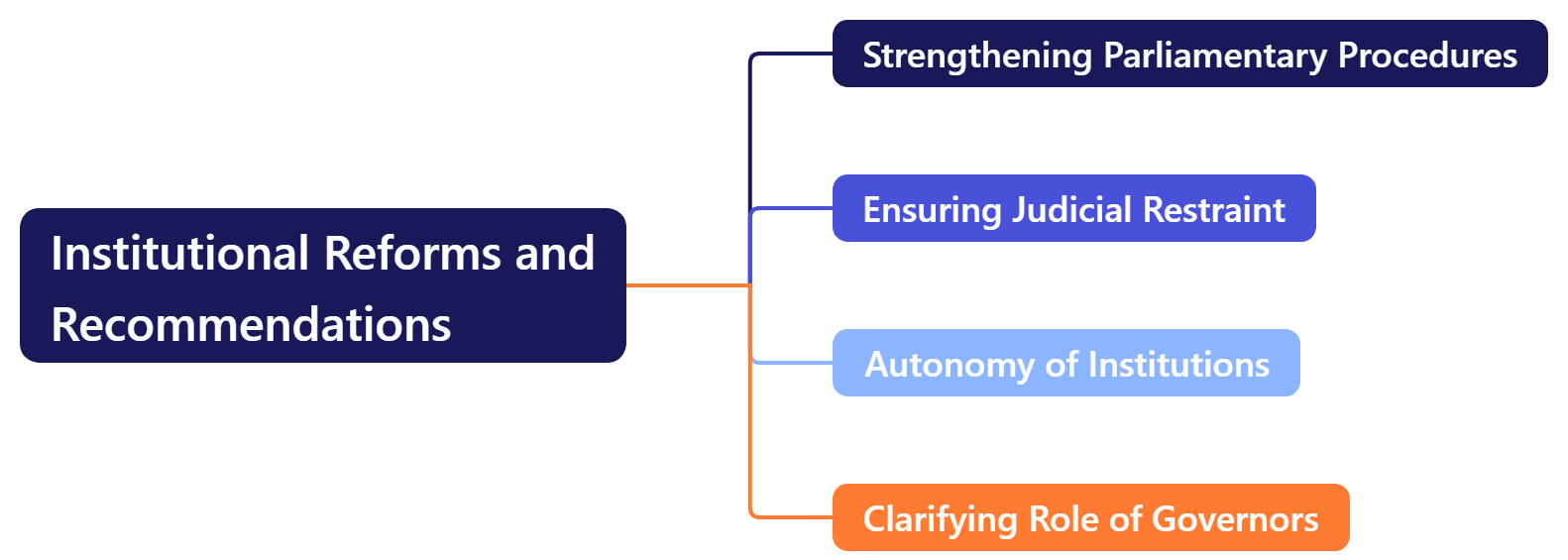
Institutional Reforms and Recommendations
-
Strengthening Parliamentary Procedures:
- Reinstating Parliamentary Committees as mandatory forums for scrutinising all bills before they are tabled can enhance legislative oversight.
- Ensuring minimum number of sitting days and regulating the use of ordinances can help restore the primacy of the legislature.
-
Ensuring Judicial Restraint:
- Courts must practise self-restraint and limit interventions to ensure they do not venture into policymaking.
- The doctrine of separation of powers must guide judicial decisions while ensuring rights are upheld.
-
Autonomy of Institutions:
- Institutions like the Election Commission, CBI, and Enforcement Directorate must be insulated from executive influence. The Supreme Court’s ruling in 2023 to constitute a committee for appointing the Chief Election Commissioner is a step in the right direction.
- Transparent and participatory appointment processes can reinforce institutional credibility.
-
Clarifying Role of Governors:
- Clear guidelines, possibly through a constitutional amendment or parliamentary legislation, are needed to define the discretionary powers of Governors and reduce Centre-State friction.
- The Punchhi Commission recommendations on Centre-State relations should be revisited and implemented in letter and spirit.
Comparative Perspectives
- In the US, the separation of powers is more rigid, with clear demarcation between the President, Congress, and Judiciary. In contrast, the UK’s parliamentary sovereignty ensures executive accountability to the legislature.
- India, with its hybrid model, must ensure that the fusion of powers does not lead to erosion of accountability.
Conclusion
Democracy is sustained not merely by elections but by the robust functioning of institutions, adherence to constitutional morality, and mutual respect among the three branches of government. India’s journey as the world’s largest democracy hinges on maintaining the fine balance of power envisaged by the framers of the Constitution. With political will, institutional reforms, and civic awareness, the equilibrium can be restored and preserved for generations to come. |



2 comments