
|
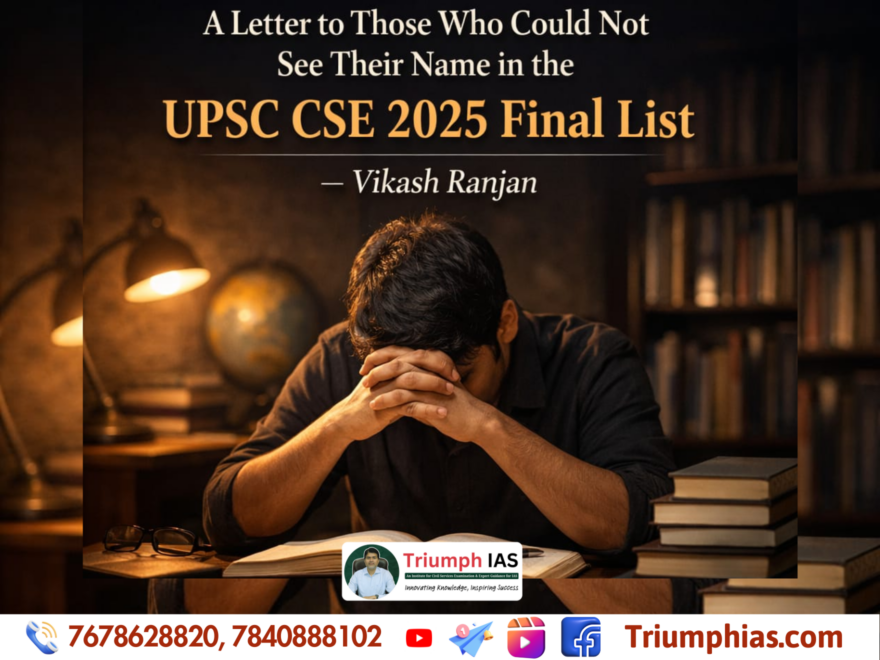
Dear Aspirants, Today the final results of the Civil Services Examination 2025 have been declared. Some names have found their place in the list, and with them many dreams have taken their first formal step toward public service. I extend my sincere congratulations to each one of them. But today I am writing particularly to those who searched the list again and again and could not find their name. I understand that moment. The silence after the result can feel heavier than the years of preparation behind it. It is not merely an examination outcome that confronts you today—it is the weight of expectations, sacrifices, unanswered questions, and the quiet anxiety about the future. Allow me to say something clearly. A UPSC result is an outcome; it is not a measure of your worth, intelligence, or potential. Every year thousands of capable and sincere aspirants prepare with dedication, yet only a few hundred make the final list. The difference between those who succeed and those who miss it is often not capability, but the strategic mastery of a few decisive components of the examination. From years of observing and guiding aspirants, one truth repeatedly emerges: four areas often determine the final outcome— Optional, Essay, Ethics, and the Interview. These are not merely papers in the syllabus; they are the true differentiators in the Civil Services Examination. General Studies papers often test your awareness and coverage. But these four components test something deeper—your intellectual clarity, analytical maturity, moral reasoning, and personality. Your Optional subject is not just another paper; it is the intellectual backbone of your rank. Many aspirants underestimate how decisive Optional marks can be. Mastery in Optional is not achieved through scattered information but through conceptual clarity, disciplined answer writing, and the ability to interpret society and institutions analytically. When Optional becomes your strength, it gives you both confidence and a decisive advantage. The Essay paper is also widely misunderstood. Essay is not about ornamental language or literary decoration. It is a reflection of how you think. It tests whether you can connect ideas, understand complexity, and present balanced arguments on society, governance, and human values. A powerful essay reflects clarity, philosophical balance, and intellectual honesty. Then comes Ethics, a paper that quietly carries tremendous weight. Ethics is not about memorizing quotations or thinkers alone. It is about demonstrating moral reasoning—showing that you can think like a future civil servant who must balance empathy with responsibility and idealism with practicality. And finally, the Interview. The interview is not merely a test of knowledge. It is an interaction where your personality, authenticity, intellectual humility, and composure become visible. It is where preparation meets character. Many aspirants lose valuable marks not because they lack knowledge, but because these four areas remain underdeveloped. Let me also share another important observation that aspirants often overlook. For General Studies Papers I, II, and III, a serious aspirant can substantially rely on the foundation built during UPSC Preliminary preparation—the disciplined study of NCERTs, standard sources, newspapers, and conceptual understanding. Over the years, however, a troubling trend has emerged. An increasing over-reliance on short-term “innovative” General Studies courses offered by coaching institutions is harming serious preparation. These compressed courses often promise quick coverage but leave aspirants with fragmented understanding. They replace intellectual engagement with mechanical note collection. Similarly, another emerging concern is the excessive dependence on AI tools for content creation and answer preparation. While technology can assist learning, over-dependence on automated content gradually weakens the very abilities this examination seeks to test—original thinking, analytical depth, and independent judgment. The Civil Services Examination does not reward those who merely reproduce information. It rewards those who think clearly, reason independently, and write authentically. Remember this carefully: UPSC does not select the most knowledgeable candidate; it selects the most balanced mind. To those who will attempt again, let this moment become one of strategic reflection rather than emotional defeat. Ask yourself honestly: Where did my preparation truly lack depth? These questions are not meant to discourage you. They are meant to help you transform effort into effectiveness. And to those who faced their final attempt today, remember this with dignity: The knowledge, discipline, intellectual maturity, and social understanding developed during UPSC preparation never disappear. They accompany you throughout life—in academia, governance, policy, entrepreneurship, or public discourse. Many individuals who once missed this list have later built institutions, influenced policy debates, written books, guided thousands of students, and contributed to society in ways far beyond the boundaries of a designation. Life is far larger than a single examination. Yet if your resolve remains alive, the path forward also remains open. The Civil Services Examination does not merely test patience—it builds it. So pause today. Reflect. Regain balance. And then rise again—calmer, wiser, and more focused than before. To those who succeeded, I extend my heartfelt congratulations. May your journey in public service be guided by humility, integrity, and compassion. And to those who did not see their name today, remember: A result may close a chapter, but it never closes the story of a determined mind. With faith in your journey, Vikash Ranjan |
To Read more topics, visit: www.triumphias.com/blogs
Read more Blogs:
Poverty, Deprivation, and the Debate on the Multidimensional Poverty Index (MPI)